



Florida Party Rental Agreement Overview
A party rental agreement in Florida is a short-term commercial contract for renting equipment and supplies for events — weddings, corporate functions, quinceañeras, birthday parties, destination events, and community gatherings. Florida's year-round warm climate, extensive coastline, theme park industry, and status as a top destination wedding location make it one of the largest party rental markets in the country. The agreement covers tents, tables, chairs, linens, dance floors, lighting, sound systems, bounce houses, and specialty tropical event items.
Florida's legal landscape for party rentals changed significantly in 2023 with the passage of HB 837, which shifted the state from pure comparative negligence to a modified comparative negligence system with a 51% bar. The Bureau of Fair Rides Inspection within the Department of Agriculture and Consumer Services administers one of the most detailed inflatable regulatory programs in the nation. Florida's hurricane risk adds a layer of weather-related complexity that few other states share. Combined with the Division of Alcoholic Beverages and Tobacco's licensing requirements and the Deceptive and Unfair Trade Practices Act, Florida party rental agreements require thorough, state-specific drafting.
51% Bar
Comparative negligence
$1M/$2M
Inflatable insurance
ABT
Alcohol control
6%
State sales tax
Florida Liability & Insurance Requirements
Florida's 2023 tort reform (HB 837) significantly changed the liability landscape for party rental companies. The state now follows a modified comparative negligence system with a 51% bar — if the injured party is more than 50% at fault, they cannot recover any damages. Previously, under pure comparative negligence, even a plaintiff who was 99% at fault could recover 1% of their damages. This reform provides substantially more protection for rental companies that maintain proper safety protocols and documentation.
Florida Bureau of Fair Rides Inspection
The Bureau of Fair Rides Inspection (Fla. Stat. 616.242) requires all inflatable devices to be registered with the state, inspected annually by a state-certified inspector, and operated with $1 million per occurrence / $2 million aggregate liability insurance. Operators must maintain trained attendants, properly anchor devices, post capacity limits, and deflate units at wind speeds over 25 mph. Florida imposes fines up to $5,000 per violation and can criminally charge operators for gross negligence resulting in injury.
Key Liability Provisions for Florida
- Modified comparative negligence (2023): Plaintiff recovers nothing if more than 50% at fault; damages reduced by fault percentage if 50% or less (HB 837)
- No social host liability for adults: Fla. Stat. 768.125 shields social hosts from liability for serving alcohol to adults; liability exists for knowingly serving minors
- Product liability: Florida follows strict liability for defective products — rental companies are liable for equipment defects as part of the distribution chain
- Workers' compensation: Required for non-construction employers with four or more employees (Fla. Stat. 440.02)
- Premises liability: Florida applies a reasonable care standard for all lawful visitors under Fla. Stat. 768.0755 (2023 amendment)
Florida Alcohol Regulations for Events
Florida regulates alcohol through the Division of Alcoholic Beverages and Tobacco (ABT) within the Department of Business and Professional Regulation. Florida is a license state with no dry counties — all 67 counties permit alcohol sales. However, municipalities can restrict the hours and locations of alcohol service. Florida's hospitality-driven economy and year-round event season mean that alcohol service is common at nearly all event types.
Florida provides significant protection for social hosts. Under Fla. Stat. 768.125, a person who furnishes alcohol to another person of legal drinking age is generally not liable for damages caused by the intoxicated person. However, this protection does not extend to furnishing alcohol to anyone under 21 or to a person known to be habitually addicted to alcohol. This makes Florida more hospitable to event hosts than states with broad social host liability, but the agreement should still include alcohol acknowledgment clauses.
Florida ABT Event Permits
- Special event license: Required for events where alcohol is sold to the public — apply through ABT at least 10 business days in advance
- Caterer permits: Licensed caterers can serve alcohol at off-premises events under their existing license with proper documentation
- Private events: No ABT permit required for private events where alcohol is provided free to invited guests
- Service hours: Florida restricts alcohol sales between 12 AM-2 AM and 7 AM depending on county (Fla. Stat. 562.14); some counties allow 24-hour service
Florida Permits & Safety Requirements
Florida's event permitting is handled primarily at the county and municipal level, with the Bureau of Fair Rides Inspection providing statewide oversight of amusement devices. Miami-Dade, Broward, Palm Beach, Orange, and Hillsborough counties each have their own permitting processes. Florida's hurricane risk and building code requirements add unique safety considerations for temporary event structures.
Tent Permits & Wind Load Requirements
Florida's Fire Prevention Code requires permits for tents over 400 square feet. The Florida Building Code sets wind-load requirements for temporary structures that vary by region — the High-Velocity Hurricane Zone (HVHZ) in Miami-Dade and Broward counties requires structures to withstand 180+ mph winds. Tent fabric must meet NFPA 701 standards. In South Florida, tent anchoring must use engineered systems rather than simple stakes. Applications should be submitted at least 14 days before the event.
Inflatable Device Registration
The Bureau of Fair Rides Inspection requires all inflatables to be registered ($50-$150 per device), inspected annually by state-certified inspectors, and operated with $1M/$2M insurance coverage. Florida requires trained attendants, proper anchoring (6+ stakes or equivalent), posted capacity limits, and deflation at 25 mph winds. The Bureau conducts unannounced inspections at events statewide. Florida's afternoon thunderstorms require constant weather monitoring during inflatable operations.
Hurricane & Severe Weather Preparedness
Florida party rental agreements must include robust weather provisions. During hurricane season (June-November), tropical systems can develop rapidly. All tents and temporary structures must be removed or secured when a tropical storm or hurricane warning is issued. The rental company should retain the right to remove equipment for safety without penalty. Insurance policies should cover windstorm damage. The agreement should specify a clear protocol for weather-related cancellations and rescheduling.
Noise Regulations
Florida has no statewide noise ordinance, but municipalities enforce their own rules. Miami's noise ordinance limits amplified sound to 60 dB at residential property lines after 11 PM. Orlando limits outdoor entertainment noise in residential areas after 10 PM. Tampa enforces decibel limits at property boundaries. Jacksonville limits amplified sound after midnight. Beach communities like Fort Lauderdale, Naples, and the Keys have stricter outdoor entertainment restrictions. Verify local ordinances before booking entertainment equipment.
Key Agreement Terms for Florida
A Florida party rental agreement must address the state's updated comparative negligence system, comprehensive inflatable regulations, ABT alcohol requirements, hurricane preparedness, and the FDUTPA consumer protection framework.
| Contract Term | Florida Standard |
|---|---|
| Security Deposit | 25-50% of rental total; no state cap; must comply with FDUTPA disclosure requirements |
| Cancellation Policy | Clearly disclosed; separate hurricane/weather cancellation clause strongly recommended |
| Damage Liability | Renter liable for replacement cost; address salt/sand/humidity damage for coastal events |
| Hurricane Clause | Essential — specify cancellation/rescheduling terms for tropical storms and hurricanes; rental company retains safety authority |
| Indemnification | Mutual indemnification enforceable; include specific alcohol and inflatable safety indemnification |
| Dispute Resolution | Arbitration clauses enforceable under Florida Arbitration Code; small claims for disputes under $8,000 |
Sample Florida Party Rental Agreement
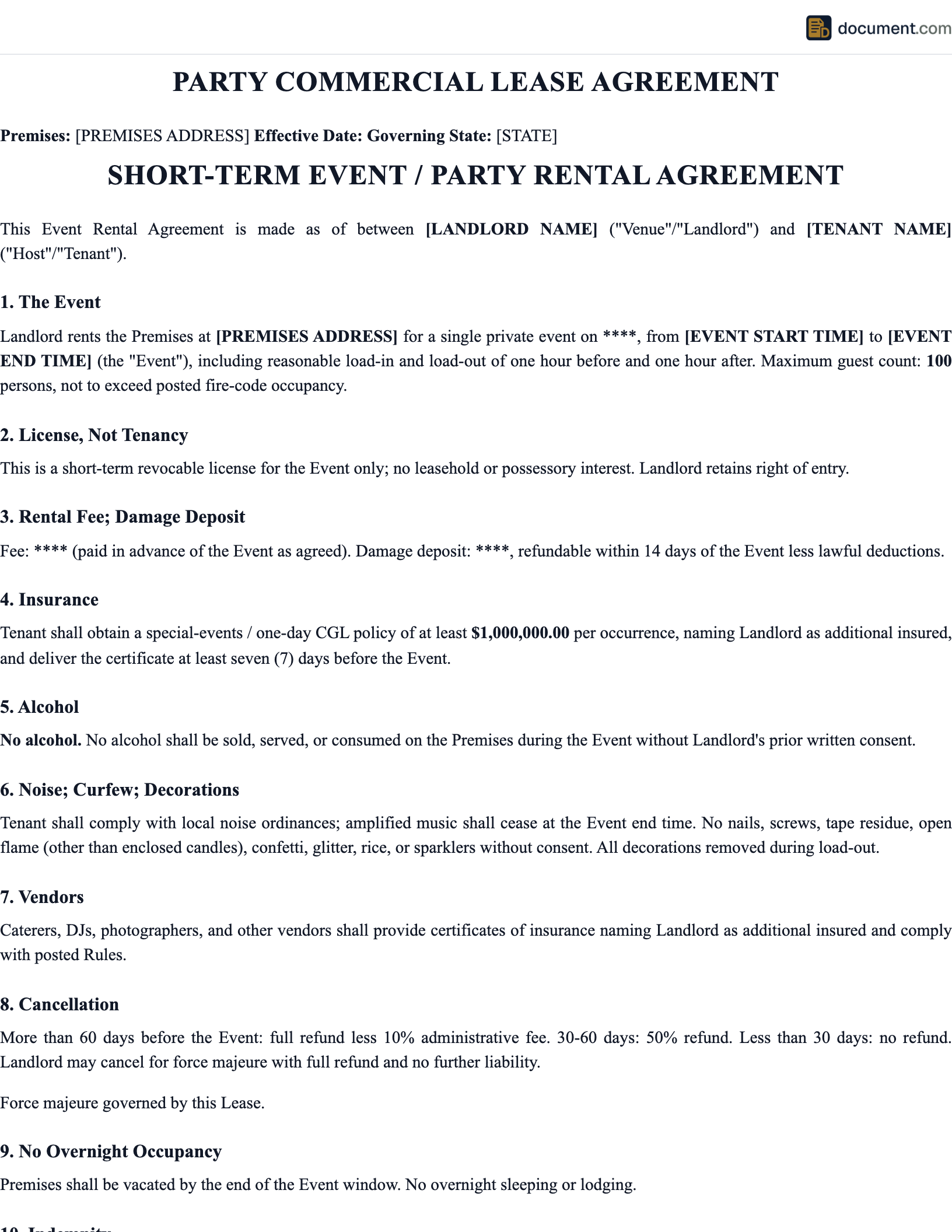
Below is a preview of key sections from a Florida-compliant party rental agreement. The full document includes Florida's updated comparative negligence provisions, Bureau of Fair Rides compliance language, ABT alcohol acknowledgments, and hurricane cancellation terms.
PARTY & EVENT EQUIPMENT RENTAL AGREEMENT
STATE OF FLORIDA
Short-Term Commercial Rental Contract
RENTAL COMPANY
Company: [Business Name]
Address: [Business Address, Florida]
FL Business License #: [Number]
Bureau of Fair Rides Registration #: [Number if applicable]
Insurance Policy #: [Number]
CUSTOMER / EVENT HOST
Name: [Full Legal Name]
Address: [Mailing Address]
Phone: [Contact Number]
Email: [Email Address]
EVENT DETAILS
Event Date: [Date]
Setup Time: [Time] | Event: [Start] to [End] | Breakdown: [Time]
Venue: [Address, City, County, Florida]
Outdoor/Indoor: [Specify] | Beach Location: [Yes/No]
Expected Attendance: [Number]
Event Type: [Wedding / Corporate / Birthday / Quinceañera]
Alcohol Served: [Yes/No] — If yes, ABT license #: [Number or N/A]
FLORIDA LIABILITY & WEATHER ACKNOWLEDGMENT
Customer acknowledges Florida's modified comparative negligence system (51% bar). Customer assumes responsibility for safe use of all rented equipment. Customer acknowledges that Florida's hurricane and severe weather conditions may require early removal of equipment for safety. Customer agrees to cooperate with Rental Company's weather-related safety decisions and indemnifies Rental Company from claims arising from Customer's negligence.
FINANCIAL SUMMARY
Equipment Rental Total: $[Amount]
Delivery & Setup: $[Amount]
Security Deposit: $[Amount]
Event Insurance (if applicable): $[Amount]
Florida Sales Tax (6% state + county surtax): $[Amount]
Total Due: $[Amount]
Florida Party Rental Agreement FAQ
Common questions about party and event equipment rental agreements in Florida, covering the 2023 tort reform, inflatable regulations, alcohol licensing, hurricane provisions, and consumer protection requirements.
Official Florida Resources
Use these official Florida resources for alcohol licensing, inflatable device registration, fire safety compliance, and consumer protection information relevant to party rental operations.
Related Florida Documents
Depending on your event, you may also need these related documents alongside your Florida party rental agreement.
Create your Florida Commercial Party Lease Agreement in under 5 minutes.
Answer a few questions and download a Florida-compliant document, ready for the state agency.