



Connecticut Party Rental Agreement Overview
A party rental agreement in Connecticut is a short-term commercial contract for renting event equipment — tents, tables, chairs, linens, dance floors, lighting, sound systems, inflatables, and specialty items for weddings, corporate events, birthday parties, graduation celebrations, and community functions. Connecticut's affluent Fairfield County corridor, historic New England venues, and coastal settings drive a strong demand for upscale event rentals, particularly during the June-October outdoor event season.
Connecticut's legal environment for party rentals is notably strict. The state's Dram Shop Act (Conn. Gen. Stat. 30-102) extends social host liability to anyone who "sells or gives" alcohol to an intoxicated person, making it broader than most states. The Department of Consumer Protection actively regulates inflatable amusement devices with registration, inspection, and insurance requirements. The Unfair Trade Practices Act (CUTPA) gives consumers strong protections against unfair contract terms. These combined factors demand that Connecticut party rental agreements be drafted with particular care.
51% Bar
Comparative negligence
DCP
Inflatable oversight
DCP/LCC
Liquor control
6.35%
State sales tax
Connecticut Liability & Insurance Requirements
Connecticut follows a modified comparative negligence system with a 51% bar (Conn. Gen. Stat. 52-572h). An injured party can recover damages only if their negligence is less than the combined negligence of all defendants — if they are 51% or more at fault, recovery is completely barred. Combined with the state's broad Dram Shop liability and active consumer protection enforcement, Connecticut party rental companies face a complex liability landscape that requires thorough contract drafting and adequate insurance coverage.
Connecticut Dram Shop Act — Social Host Liability
Connecticut's Dram Shop Act (Conn. Gen. Stat. 30-102) imposes liability on any person who "sells or gives" alcohol to an intoxicated person whose subsequent conduct causes injury. Unlike most states, this extends to private social hosts, not just licensed vendors. This means an event host who provides alcohol to a visibly intoxicated guest at a party can face civil liability for damages. Party rental agreements should include prominent alcohol liability acknowledgments and require the renter to maintain appropriate insurance when serving alcohol.
Key Liability Provisions for Connecticut
- Modified comparative negligence: 51% bar — plaintiff recovers nothing if their fault equals or exceeds the combined fault of defendants (Conn. Gen. Stat. 52-572h)
- Broad social host liability: The Dram Shop Act extends to social hosts who "give" alcohol to intoxicated persons — significantly broader than most states
- Product liability: Connecticut follows strict product liability under the Connecticut Product Liability Act (Conn. Gen. Stat. 52-572m through 52-572q) for defective rental equipment
- Workers' compensation: Required for all employers with one or more employees (Conn. Gen. Stat. 31-275), with strict enforcement and penalties for non-compliance
- Premises liability: Property owners owe reasonable care to invitees — event venues and hosts must maintain safe conditions for guests attending rented events
Connecticut Alcohol Regulations for Events
Connecticut regulates alcohol through the Department of Consumer Protection, Liquor Control Commission (LCC). The state is a license state where private businesses hold permits to sell and serve alcohol. Connecticut's alcohol regulations are particularly relevant to party rentals because of the state's broad Dram Shop Act — any person who provides alcohol to an intoxicated individual faces potential civil liability, regardless of whether they are a licensed vendor or a social host.
Connecticut does not have dry counties, and alcohol is available statewide. However, individual municipalities can restrict the number and types of liquor permits issued locally. For events where alcohol will be sold (as opposed to provided free at a private gathering), a permit from the DCP is required. The permit process varies based on whether the event is public or private and whether a licensed caterer is involved.
Connecticut Event Alcohol Permits
- Temporary permit: Required for events where alcohol is sold to the public — apply through the DCP at least 15 business days in advance
- Caterer permits: Licensed Connecticut caterers may serve alcohol at off-premises events under their existing permit
- BYOB/private events: No permit needed for private events where alcohol is not sold, but the host assumes full Dram Shop liability for serving intoxicated guests
- Service hours: Connecticut prohibits alcohol sales between 2 AM and 9 AM (Conn. Gen. Stat. 30-91), and municipalities can further restrict hours
Connecticut Permits & Safety Requirements
Connecticut's 169 municipalities each have their own building officials and fire marshals who regulate temporary structures, events, and safety compliance. The Connecticut Department of Consumer Protection oversees amusement device registration statewide. The State Fire Marshal sets fire prevention codes, while local fire marshals enforce them. This decentralized system means permit requirements vary significantly from town to town.
Tent Permits
Connecticut's Fire Prevention Code requires permits for tents exceeding 400 square feet. The local fire marshal issues the permit and may inspect before and during the event. Tent fabric must be flame-retardant certified under NFPA 701, with certification tags attached and visible. Exits must provide minimum 3-foot clear width, fire extinguishers must be within 75 feet, and no smoking signs must be posted. Applications are typically required 10-14 days before the event.
Inflatable Device Registration
The Connecticut DCP requires all inflatable amusement devices to be registered and inspected annually. Operators must obtain a per-event permit, carry liability insurance, maintain trained supervision during operation, properly anchor devices, and post height/weight limits. Connecticut charges registration fees of $50-$100 per device. Non-compliance can result in fines up to $1,000 per violation and equipment seizure.
Fire Safety & Capacity
Connecticut follows the Connecticut State Fire Safety Code for occupancy calculations. Standard capacity is 15 square feet per person for standing events and 10 for seated. Events exceeding 300 attendees in enclosed or tented spaces typically require fire watch personnel. Electrical connections must comply with the National Electrical Code, and generators must maintain required clearances from tent walls and exits.
Noise Regulations
Connecticut does not have a statewide noise statute, but municipalities enforce local ordinances. Hartford limits amplified sound after 10 PM in residential areas. Stamford enforces strict decibel limits (55 dB at residential property lines after 10 PM). Greenwich and other affluent Fairfield County towns have particularly restrictive noise regulations. New Haven requires entertainment permits for outdoor events with amplified music. Verify local requirements before finalizing rental terms.
Key Agreement Terms for Connecticut
Connecticut party rental agreements must account for the state's broad Dram Shop liability, DCP inflatable regulations, CUTPA consumer protections, and the variation in municipal event ordinances across 169 towns. Careful drafting is essential to ensure enforceability.
| Contract Term | Connecticut Standard |
|---|---|
| Security Deposit | 25-50% of rental total; must be reasonable and clearly disclosed to avoid CUTPA challenge |
| Cancellation Policy | Must be prominently disclosed; unconscionable forfeiture provisions vulnerable under CUTPA |
| Damage Liability | Renter liable for actual replacement cost; specify damage assessment methodology in the agreement |
| Weather Clause | Force majeure for nor'easters, hurricanes, and severe weather; inflatable deflation at 25+ mph winds |
| Alcohol Acknowledgment | Critical in Connecticut — renter must acknowledge Dram Shop liability and agree not to serve visibly intoxicated guests |
| Dispute Resolution | Arbitration clauses enforceable; small claims court for disputes under $5,000 |
Sample Connecticut Party Rental Agreement
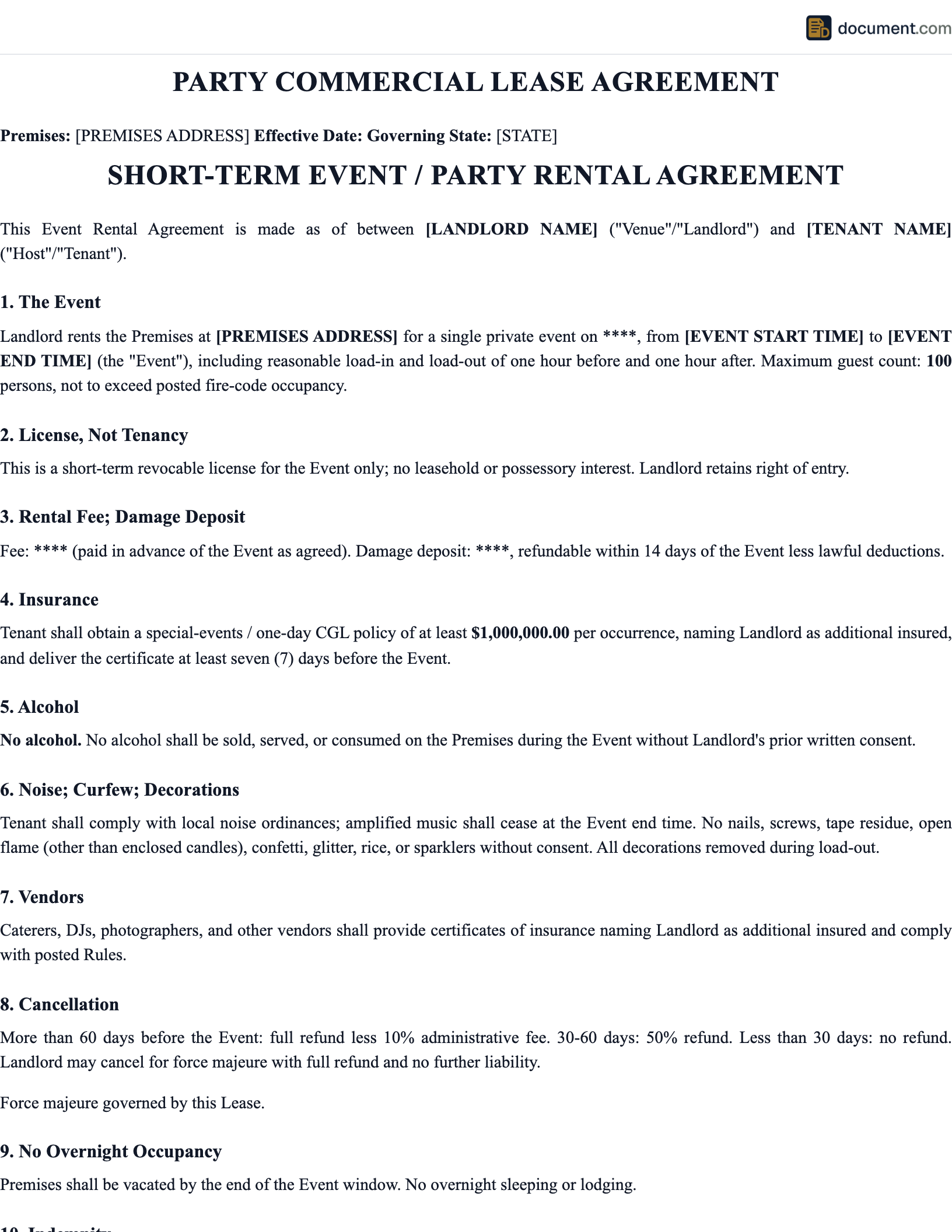
Below is a preview of key sections from a Connecticut-compliant party rental agreement. The full document includes Connecticut-specific Dram Shop acknowledgments, DCP inflatable compliance language, CUTPA-compliant cancellation terms, and municipal permit responsibility clauses.
PARTY & EVENT EQUIPMENT RENTAL AGREEMENT
STATE OF CONNECTICUT
Short-Term Commercial Rental Contract
RENTAL COMPANY
Company: [Business Name]
Address: [Business Address, Connecticut]
CT Business Registration #: [Number]
DCP Amusement Device Permit (if applicable): [Number]
Insurance Policy #: [Number]
CUSTOMER / EVENT HOST
Name: [Full Legal Name]
Address: [Mailing Address]
Phone: [Contact Number]
Email: [Email Address]
EVENT DETAILS
Event Date: [Date]
Setup Time: [Time] | Event: [Start] to [End] | Breakdown: [Time]
Venue: [Address, Town/City, Connecticut]
Expected Attendance: [Number]
Event Type: [Wedding / Corporate / Birthday / Community]
Alcohol Served: [Yes/No] — If yes, DCP permit #: [Number or N/A]
CONNECTICUT DRAM SHOP LIABILITY ACKNOWLEDGMENT
Customer acknowledges Connecticut's Dram Shop Act (Conn. Gen. Stat. 30-102) extends liability to any person who provides alcohol to an intoxicated individual. Customer agrees to monitor alcohol consumption at the event, not to serve alcohol to visibly intoxicated persons or minors, and to indemnify the Rental Company from any claims arising from alcohol service at the event.
FINANCIAL SUMMARY
Equipment Rental Total: $[Amount]
Delivery & Setup: $[Amount]
Security Deposit: $[Amount]
Event Insurance (if applicable): $[Amount]
Connecticut Sales Tax (6.35%): $[Amount]
Total Due: $[Amount]
Connecticut Party Rental Agreement FAQ
Common questions about party and event equipment rental agreements in Connecticut, covering the Dram Shop Act, inflatable regulations, CUTPA compliance, and municipal permit requirements.
Official Connecticut Resources
Use these official Connecticut resources for alcohol licensing, inflatable device registration, fire safety compliance, and consumer protection information relevant to party rental operations.
Related Connecticut Documents
Depending on your event, you may also need these related documents alongside your Connecticut party rental agreement.
Create your Connecticut Commercial Party Lease Agreement in under 5 minutes.
Answer a few questions and download a Connecticut-compliant document, ready for the state agency.