



Colorado Party Rental Agreement Overview
A party rental agreement in Colorado is a short-term commercial contract for renting event equipment and supplies — tents, tables, chairs, linens, dance floors, lighting, sound systems, bounce houses, and related items. Colorado's diverse event landscape ranges from downtown Denver rooftop celebrations to mountain resort weddings in Vail and Aspen, outdoor festivals in Boulder, and ranch events on the Eastern Plains. Each setting presents different logistical and legal considerations for party rental companies.
Colorado's legal environment for event rentals is shaped by its modified comparative fault system (50% bar), the Amusement Rides and Devices Act administered by the Department of Labor, and the state's Liquor Enforcement Division within the Department of Revenue. The state's high-altitude climate — with unpredictable afternoon thunderstorms, high winds, and intense sun — creates unique weather-related risks that must be addressed in party rental contracts. Colorado's strong home-rule tradition also means that cities like Denver, Boulder, and Colorado Springs have their own event regulations.
50% Bar
Comparative fault
DOLE
Ride safety oversight
LED
Liquor enforcement
2.9%
State sales tax
Colorado Liability & Insurance Requirements
Colorado's modified comparative fault system (C.R.S. 13-21-111) provides a balanced framework for party rental liability. An injured person can recover damages only if their fault does not exceed 50%. If allocated 51% or more fault, they are completely barred from recovery. This gives Colorado rental companies stronger protection than pure comparative negligence states like California, but less than the four contributory negligence jurisdictions. The system incentivizes rental companies to document safety warnings and customer acknowledgments.
Colorado Amusement Rides & Devices Act
The Amusement Rides and Devices Act (C.R.S. 24-32-2801 et seq.) requires all inflatable amusement devices used at public events to be registered with the Colorado Department of Labor and Employment, inspected annually by qualified third-party inspectors, and operated according to manufacturer specifications. The Division of Oil and Public Safety enforces this Act and can suspend operators for non-compliance.
Key Liability Provisions for Colorado
- Modified comparative fault: 50% bar rule — injured party recovers nothing if more than 50% at fault (C.R.S. 13-21-111)
- Assumption of risk: Colorado recognizes express and implied assumption of risk as defenses — signed waivers for recreational activities are generally enforceable
- Social host liability: Social hosts face liability for furnishing alcohol to minors (C.R.S. 18-13-122); the Dram Shop Act applies to licensed vendors (C.R.S. 12-47-801)
- Product liability: Colorado follows the Colorado Product Liability Act (C.R.S. 13-21-401 et seq.) with a 2-year statute of limitations and 10-year repose for defective products
- Workers' compensation: Required for all employers with one or more employees (C.R.S. 8-40-101), one of the lowest thresholds in the nation
Colorado Alcohol Regulations for Events
Colorado regulates alcohol through the Liquor Enforcement Division (LED) within the Colorado Department of Revenue. Colorado is a license state where private businesses hold licenses to manufacture, distribute, and sell alcohol. The state's craft beer and spirits industry has driven significant changes to alcohol regulations in recent years, including expanded tasting room permissions and special event licensing options.
Colorado's social host liability is limited — adult hosts are generally not liable for serving alcohol to other adults. However, the state criminalizes providing alcohol to minors under C.R.S. 18-13-122 and imposes civil liability on social hosts who knowingly serve minors. For events with mixed-age attendance, the party rental agreement should include clear language about the renter's responsibility for alcohol management and ID verification.
Colorado Event Alcohol Permits
- Special event permit: Required for events where alcohol is sold — issued by the local licensing authority with LED approval, typically requiring 30 days advance notice
- Arts license: Colorado offers an Arts License for qualifying cultural events, allowing alcohol service at galleries, theaters, and cultural venues
- Private events: Events where alcohol is provided free to invited guests do not require a state permit, but local regulations may apply
- Open container laws: Colorado prohibits open containers in vehicles (C.R.S. 42-4-1305) but allows municipalities to create open container districts — Denver has several entertainment districts with relaxed rules
Colorado Permits & Safety Requirements
Colorado's strong home-rule tradition means event permitting varies significantly across the state. Denver, Boulder, Colorado Springs, Fort Collins, and mountain resort communities each maintain their own processes. State-level regulations apply to amusement devices, fire safety, and food service. Colorado's high-altitude weather — including afternoon thunderstorms, high winds, hail, and rapid temperature changes — creates safety considerations unique to this state.
Tent Permits
Most Colorado municipalities require permits for tents over 400 square feet. Denver Fire Department issues temporary structure permits with fire marshal inspection. All tent fabric must be flame-retardant (NFPA 701 or CPAI-84). At high-altitude venues, the dry climate increases fire risk significantly — additional fire extinguishers and no-smoking perimeters may be required. Tent staking must account for Colorado's rocky terrain, and alternative anchoring methods (concrete ballasts) are often necessary.
Inflatable Device Registration
Under the Amusement Rides and Devices Act, inflatables must be registered with the Colorado DOLE, inspected annually, and operated by trained attendants. Colorado's high winds and afternoon thunderstorms require operators to monitor weather constantly — inflatables must be deflated when wind exceeds 25 mph. At altitudes above 5,000 feet, UV exposure degrades inflatable materials faster, requiring more frequent equipment inspections.
Fire Safety & Capacity
Colorado follows the International Fire Code for occupancy limits in event spaces. Standard calculations allow 15 square feet per standing person and 10 for seated. Events in wildfire-prone areas (common in mountain communities) may face additional restrictions during fire season — county fire bans can prohibit outdoor cooking, generators, and even some lighting equipment. The party rental agreement should address fire ban compliance.
Noise Regulations
Denver's noise ordinance (D.M.C. 36-6) restricts excessive noise between 10 PM and 7 AM and limits amplified music to specific decibel levels at property boundaries. Boulder has particularly strict noise regulations, including daytime limits. Mountain resort towns like Vail and Breckenridge enforce quiet hours starting as early as 9 PM. Fort Collins limits outdoor entertainment noise to 55 dB at residential property lines after 10 PM.
Key Agreement Terms for Colorado
A well-drafted Colorado party rental agreement should address the state's comparative fault system, altitude and weather-related risks, amusement ride regulations, and the wide variation in local event ordinances across the state.
| Contract Term | Colorado Standard |
|---|---|
| Security Deposit | 25-50% of rental total; no state cap on commercial deposits |
| Cancellation Policy | Must be clearly disclosed; liquidated damages enforceable if reasonable under Colorado law |
| Damage Liability | Renter liable for replacement cost; specify fair market value vs. new replacement cost in the agreement |
| Weather Clause | Force majeure for hailstorms, lightning, high winds, and wildfire evacuations; essential for mountain venues |
| Indemnification | Mutual indemnification enforceable; exculpatory clauses valid in Colorado for recreational activities |
| Dispute Resolution | Arbitration clauses enforceable under Colorado Revised Uniform Arbitration Act; small claims for disputes under $7,500 |
Sample Colorado Party Rental Agreement
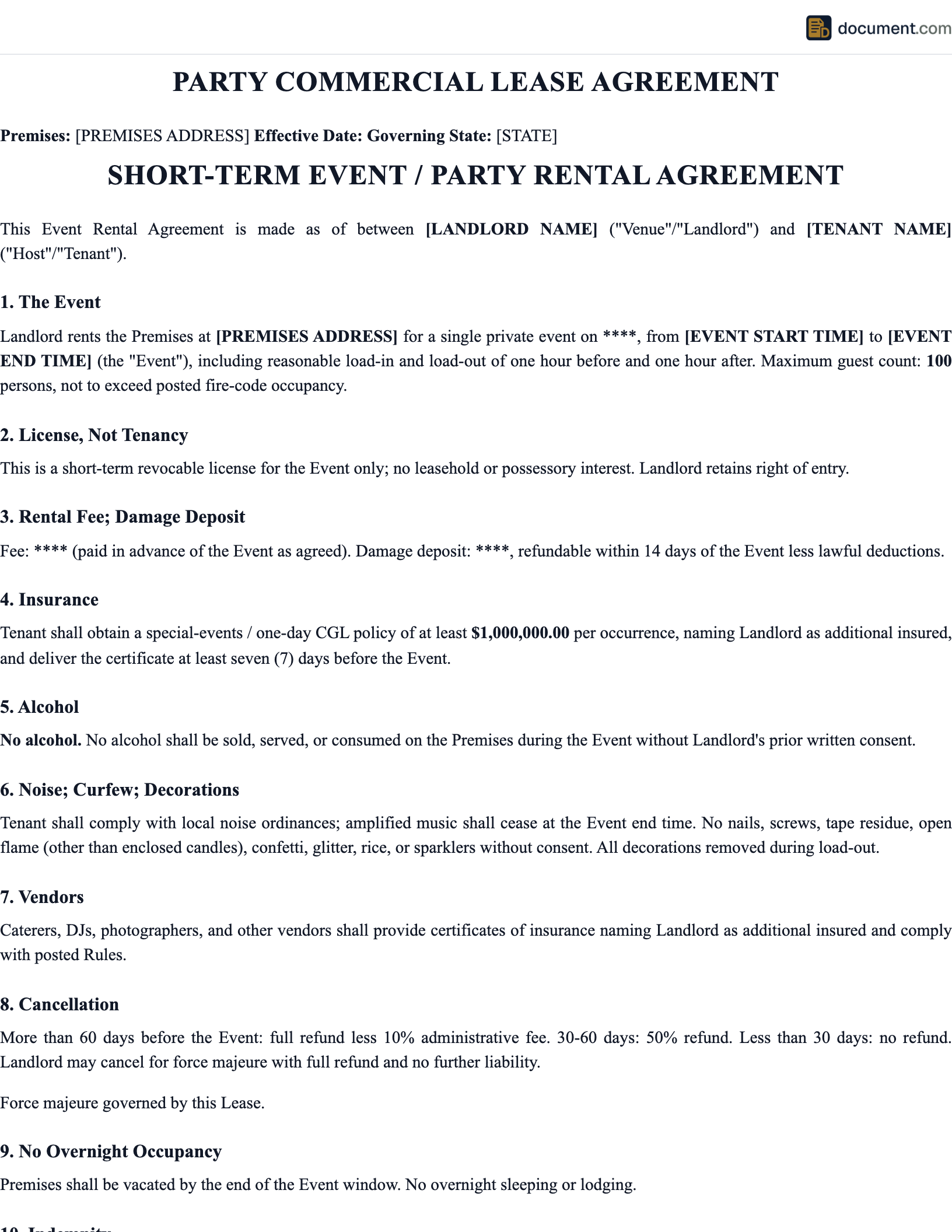
Below is a preview of key sections from a Colorado-compliant party rental agreement. The full document includes Colorado-specific comparative fault provisions, altitude and weather clauses, amusement ride compliance language, and local permit responsibility clauses.
PARTY & EVENT EQUIPMENT RENTAL AGREEMENT
STATE OF COLORADO
Short-Term Commercial Rental Contract
RENTAL COMPANY
Company: [Business Name]
Address: [Business Address, Colorado]
CO Business License #: [Number]
Insurance Policy #: [Number]
CUSTOMER / EVENT HOST
Name: [Full Legal Name]
Address: [Mailing Address]
Phone: [Contact Number]
Email: [Email Address]
EVENT DETAILS
Event Date: [Date]
Setup Time: [Time] | Event: [Start] to [End] | Breakdown: [Time]
Venue: [Address, City, County, Colorado]
Venue Elevation: [Feet above sea level]
Expected Attendance: [Number]
Event Type: [Wedding / Corporate / Birthday / Festival]
Alcohol Served: [Yes/No] — If yes, LED permit #: [Number or N/A]
COLORADO LIABILITY & WEATHER ACKNOWLEDGMENT
Customer acknowledges that Colorado follows a modified comparative fault system (50% bar rule). Customer assumes responsibility for safe use of all rented equipment, agrees to follow all posted safety instructions, and acknowledges that Colorado's high-altitude weather conditions may require event modifications or cancellation for safety reasons. Customer agrees to cooperate with Rental Company's safety decisions regarding wind, lightning, and severe weather.
FINANCIAL SUMMARY
Equipment Rental Total: $[Amount]
Delivery & Setup: $[Amount]
Security Deposit: $[Amount]
Event Insurance (if applicable): $[Amount]
Colorado Sales Tax (2.9% state + local): $[Amount]
Total Due: $[Amount]
Colorado Party Rental Agreement FAQ
Common questions about party and event equipment rental agreements in Colorado, covering liability, insurance, alcohol regulations, altitude considerations, and local permit requirements.
Official Colorado Resources
Use these official Colorado resources for alcohol licensing, amusement device registration, fire safety compliance, and consumer protection information relevant to party rental operations.
Related Colorado Documents
Depending on your event, you may also need these related documents alongside your Colorado party rental agreement.
Create your Colorado Commercial Party Lease Agreement in under 5 minutes.
Answer a few questions and download a Colorado-compliant document, ready for the state agency.