
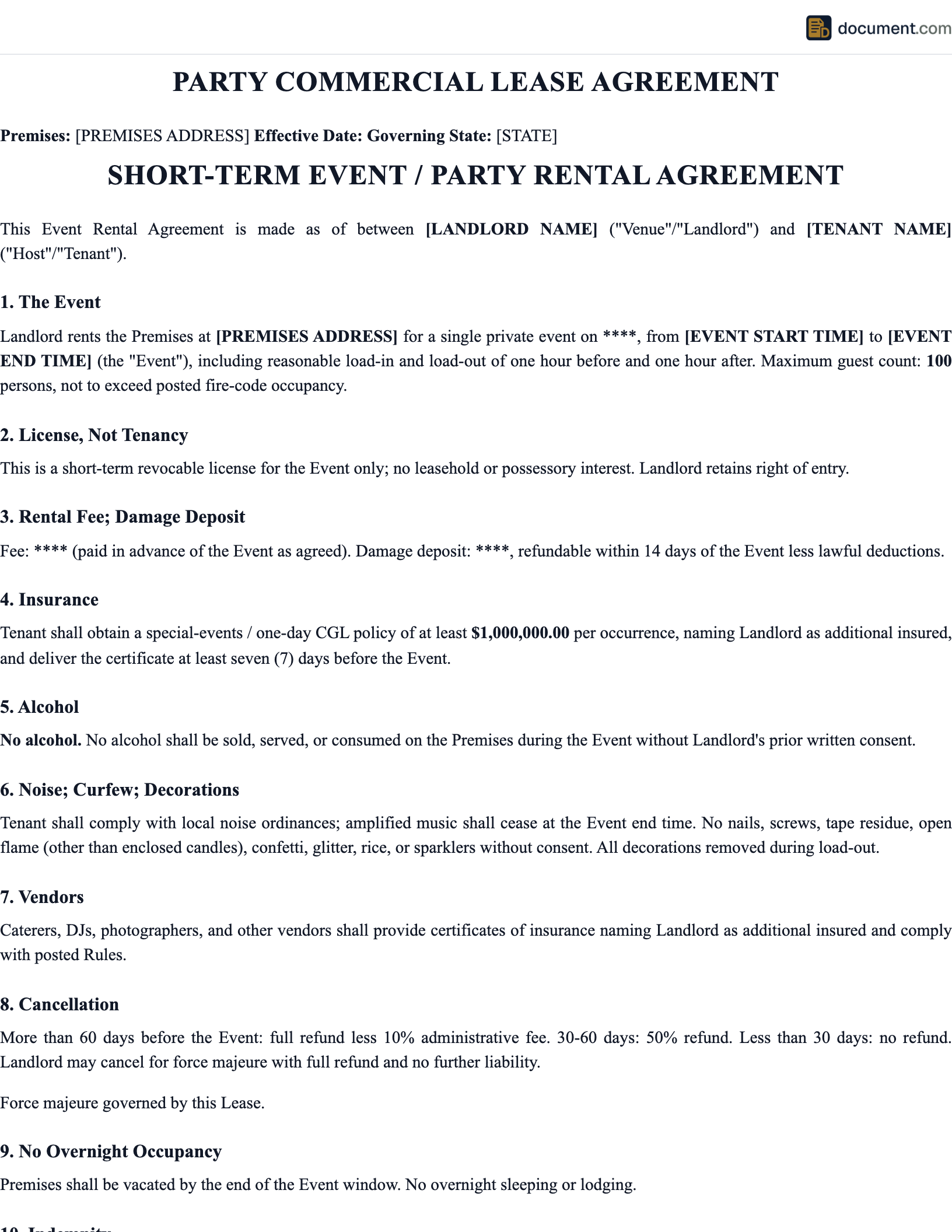



California Party Rental Agreement Overview
A party rental agreement in California is a short-term commercial contract governing the rental of equipment and supplies for events — weddings, corporate functions, film industry wrap parties, birthday celebrations, fundraisers, and community gatherings. The agreement covers tents, tables, chairs, linens, dance floors, lighting, sound systems, bounce houses, and other event equipment. California's event rental market is the largest in the nation, driven by the state's year-round outdoor event climate, massive entertainment industry, and population of nearly 40 million.
California's legal framework for party rentals is among the most complex in the country. The state follows pure comparative negligence (an injured person can recover even if 99% at fault), has Cal/OSHA-administered inflatable regulations, imposes ABC licensing requirements for alcohol service, and enforces consumer protection statutes that aggressively police unfair contract terms. California courts are known for scrutinizing liability waivers and striking down provisions they deem unconscionable, making careful drafting essential for enforceable party rental agreements.
Pure
Comparative negligence
Cal/OSHA
Inflatable oversight
CA ABC
Alcohol control
7.25%+
Sales tax (+ local)
California Liability & Insurance Requirements
California's pure comparative negligence system means that liability is allocated proportionally among all parties, and even a plaintiff who is predominantly at fault can recover reduced damages. This makes California one of the riskiest states for party rental operators in terms of potential liability exposure. Combined with California's reputation for large jury verdicts and aggressive plaintiff's attorneys, comprehensive insurance and well-drafted liability provisions are non-negotiable.
California Amusement Ride Safety Law
The Amusement Ride Safety Law (Cal. Health & Safety Code 18201-18205), administered by Cal/OSHA's Elevator, Amusement Ride, and Tramway Unit, requires all inflatable amusement devices to be registered with the state, inspected annually by a qualified inspector, and operated in compliance with ASTM F2374 standards. Violations can result in fines up to $25,000 per occurrence and criminal penalties for operators who endanger children.
Key Liability Provisions for California
- Pure comparative negligence: An injured party recovers damages reduced by their percentage of fault, even if they are mostly responsible (Li v. Yellow Cab Co., 1975)
- Primary assumption of risk: California recognizes this defense for inherently risky activities — properly disclosed risks in recreational activities like bounce houses may bar recovery entirely
- Social host liability limited: California Civil Code 1714(c) generally shields social hosts from liability for serving alcohol to adults, but liability exists for serving minors (Cal. Civ. Code 1714(d))
- Strict product liability: California follows strict liability for defective products under Greenman v. Yuba Power Products — rental companies are treated as part of the distribution chain
- Workers' compensation: Mandatory for all California employers regardless of employee count (Cal. Lab. Code 3700), with no minimum employee threshold
California Alcohol Regulations for Events
California's Department of Alcoholic Beverage Control (ABC) regulates all alcohol sales and service in the state through a licensing system. California is a license state (not a control state), meaning private businesses hold licenses to sell and serve alcohol. The ABC issues over 70 different license types, several of which apply to event situations.
California's approach to social host liability is relatively lenient for adults — under Civil Code 1714(c), furnishing alcohol to adults is not the proximate cause of resulting injuries. However, providing alcohol to minors under 21 creates civil liability under Civil Code 1714(d). This distinction is critical for party rental agreements, as events frequently include both adult and underage guests. The agreement should include a clear alcohol acknowledgment clause specifying the renter's obligation to prevent underage drinking.
California ABC Event Permits
- Daily Temporary License (Type 44): Allows nonprofits to sell beer and wine at events, up to 36 events per year — apply at least 5 business days in advance
- Caterer's Permit (Type 58): Licensed caterers may serve alcohol at off-premises events — the caterer must apply and the premises must be approved
- Private events (no sale): Events where alcohol is provided free to invited guests do not require ABC licensing, but the host assumes social host liability for minors
- Open container laws: California Penal Code 647(f) addresses public intoxication; many cities have open container ordinances in parks and public spaces that affect outdoor events
California Permits & Safety Requirements
California has some of the most stringent event permitting requirements in the nation, enforced at both state and local levels. Cal/OSHA regulates amusement devices statewide, the State Fire Marshal sets fire safety standards, and individual cities and counties impose their own temporary structure, noise, and event permits. Los Angeles, San Francisco, San Diego, Sacramento, and other major California cities each have distinct permitting processes.
Tent & Canopy Permits
California Fire Code Chapter 31 requires permits for tents over 400 square feet (200 sq ft in Los Angeles). All tent fabric must meet California State Fire Marshal flame-retardancy standards, which are stricter than the national NFPA 701 test. Tents must maintain proper exit widths, have fire extinguishers within 75 feet, and keep cooking equipment at least 20 feet from tent walls. The City of LA also requires a B-permit from the Department of Building and Safety for temporary structures.
Inflatable Device Registration
Cal/OSHA requires all inflatable devices to be registered, annually inspected, and operated by trained personnel following ASTM F2374 standards. Each device must have a valid permit number displayed. Operators must maintain a logbook of inspections, incidents, and maintenance. California AB 850 imposes fines up to $25,000 per violation and allows for criminal prosecution of operators who negligently endanger children.
Fire Marshal & Capacity Limits
California uses the California Building Code (based on the ICC codes) for occupancy calculations. Typical event space allows 7-15 square feet per person depending on configuration. Events over 1,000 attendees in Los Angeles require a special event permit from LAFD. All enclosed event spaces must have illuminated exit signs, clear egress paths, and fire suppression equipment appropriate to the occupancy type.
Noise Regulations
Each California city enforces its own noise ordinance. Los Angeles limits amplified sound to 5 dB above ambient at the property line. San Francisco restricts amplified sound in parks and requires event permits for outdoor music. San Diego's noise ordinance (Municipal Code 59.5) sets specific decibel limits by zoning district. Outdoor events with live music or DJs should verify local quiet hours, decibel limits, and sound permit requirements before finalizing rental agreements.
Key Agreement Terms for California
California party rental agreements must navigate the state's consumer protection laws, pure comparative negligence system, Cal/OSHA inflatable regulations, and ABC alcohol requirements. Courts may strike down provisions deemed unconscionable, so clarity and fairness are paramount.
| Contract Term | California Standard |
|---|---|
| Security Deposit | 25-50% of total; must be reasonable and clearly disclosed — unconscionable deposits may be voided |
| Cancellation Policy | Must be prominently disclosed; liquidated damages enforceable only if reasonable per Cal. Civ. Code 1671 |
| Damage Liability | Renter liable for replacement cost; agreement should itemize equipment values and define damage assessment process |
| Weather Clause | Force majeure for earthquakes, wildfires, high winds, and power shutoffs (PSPS events); inflatable deflation at 25+ mph |
| Liability Waiver | Must be clear, conspicuous, and not unconscionable — California courts apply heightened scrutiny to exculpatory clauses |
| Dispute Resolution | Arbitration clauses enforceable but subject to unconscionability review; small claims court for disputes under $10,000 |
Sample California Party Rental Agreement
Below is a preview of key sections from a California-compliant party rental agreement. The full document includes California-specific liability waivers, Cal/OSHA inflatable compliance language, ABC alcohol acknowledgments, and consumer protection disclosures.
PARTY & EVENT EQUIPMENT RENTAL AGREEMENT
STATE OF CALIFORNIA
Short-Term Commercial Rental Contract
RENTAL COMPANY
Company: [Business Name]
Address: [Business Address, California]
CA Business License #: [Number]
Cal/OSHA Permit #: [Number if applicable]
Insurance Policy #: [Number]
CUSTOMER / EVENT HOST
Name: [Full Legal Name]
Address: [Mailing Address]
Phone: [Contact Number]
Email: [Email Address]
EVENT DETAILS
Event Date: [Date]
Setup Time: [Time] | Event: [Start] to [End] | Breakdown: [Time]
Venue: [Address, City, County, California]
Expected Attendance: [Number]
Event Type: [Wedding / Corporate / Birthday / Fundraiser]
Alcohol Served: [Yes/No] — If yes, ABC License/Permit #: [Number or N/A]
CALIFORNIA LIABILITY ACKNOWLEDGMENT
Customer acknowledges that California follows the pure comparative negligence doctrine. Customer assumes the inherent risks of using event rental equipment and agrees to follow all posted safety instructions. Customer agrees to indemnify and hold harmless the Rental Company from claims arising from Customer's negligence, except for claims arising from the Rental Company's own negligence or willful misconduct, to the extent permitted by California law.
FINANCIAL SUMMARY
Equipment Rental Total: $[Amount]
Delivery & Setup: $[Amount]
Security Deposit: $[Amount]
Event Insurance (if applicable): $[Amount]
California Sales Tax (7.25% + local): $[Amount]
Total Due: $[Amount]
California Party Rental Agreement FAQ
Common questions about party and event equipment rental agreements in California, covering liability, insurance, alcohol licensing, Cal/OSHA compliance, and consumer protection requirements.
Official California Resources
Use these official California resources for alcohol licensing, inflatable device registration, fire safety compliance, and consumer protection information relevant to party rental operations.
Related California Documents
Depending on your event, you may also need these related documents alongside your California party rental agreement.
Create your California Commercial Party Lease Agreement in under 5 minutes.
Answer a few questions and download a California-compliant document, ready for the state agency.