
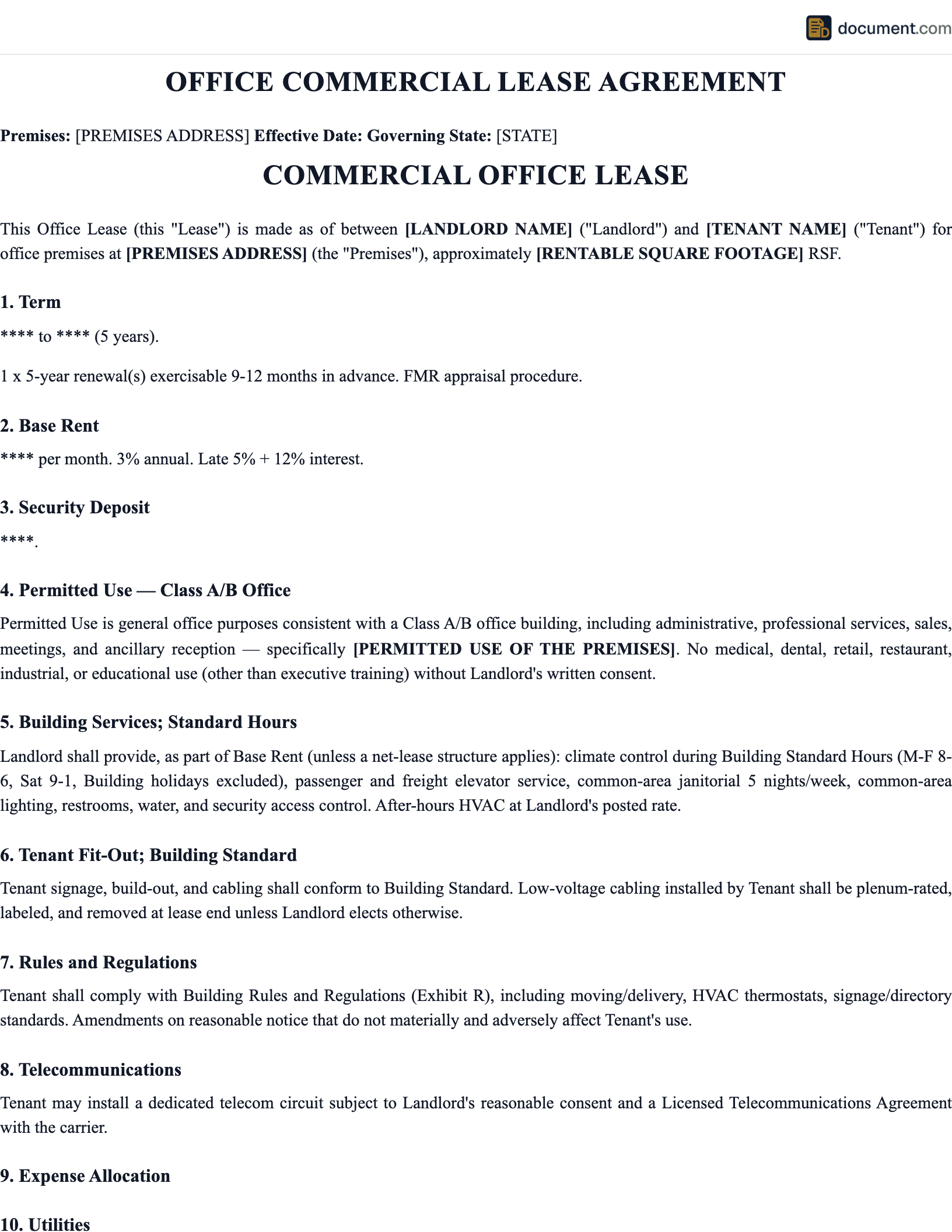



Wisconsin Office Space Lease Agreement Overview
Wisconsin commercial office leases operate under general contract law rather than a dedicated commercial tenancy statute. Wis. Stat. Ch. 704 addresses landlord-tenant relationships in Wisconsin but is primarily oriented toward residential tenancies. Office tenants negotiating space in Milwaukee, Madison, or smaller Wisconsin markets have essentially no statutory protections beyond what they negotiate directly into the lease agreement, which makes careful drafting critical before any tenant commits to a multi-year term.
The Wisconsin office market reflects two distinct realities. Milwaukee's commercial real estate market has maintained elevated vacancy in some submarkets as businesses have shifted footprints following pandemic-era changes, giving tenants meaningful negotiating leverage on TI allowances, CAM caps, and free rent periods. Madison's market is considerably tighter, driven by steady demand from state government agencies, the University of Wisconsin system, and a growing technology sector. Cold-climate considerations, particularly HVAC reliability and snow removal obligations, should be explicitly addressed in any Wisconsin office lease.
$30
Filing fee
Required
Notarization
0
Witnesses required
Register
Filing office
Wisconsin Requirements
Wisconsin commercial office leases must address the unique demands of the state's climate, dual-market dynamics, and business cost structure. No statute fills in missing terms, so every material condition must appear explicitly in the lease.
Wisconsin Specific Note
Wisconsin has no commercial landlord-tenant statute protecting office tenants. Contract law governs entirely. HVAC maintenance and snow removal responsibilities must be clearly defined, as Wisconsin winters can make these provisions material to daily operations. In Milwaukee, vacancy rates give tenants real leverage on concessions; Madison's tighter market favors landlords, particularly near the Capitol and university districts. No sales tax applies to commercial rent payments in Wisconsin.
Lease Requirements
- Written Agreement: While oral commercial leases can be enforceable in Wisconsin for terms under one year, any lease exceeding 12 months must be in writing to satisfy the statute of frauds. A written lease is essential regardless of term length.
- CAM Structure and Caps: Define what is included in CAM charges, establish an annual cap on CAM increases, and secure audit rights. Snow removal and salting costs are a material component of Wisconsin CAM expenses and should be explicitly addressed.
- HVAC Responsibility: Specify who maintains and repairs HVAC systems serving the leased space, who bears costs above defined thresholds, and what response times the landlord guarantees for heating system failures in cold months.
- Parking Terms: Address the number of stalls included, whether heated or enclosed parking is available, and how parking costs are allocated. Parking in downtown Milwaukee and Madison can be a significant cost for tenants and should be fully negotiated.
- Holdover Provisions: Define the rent rate and notice requirements if the tenant remains beyond the lease term. Without explicit provisions, a Wisconsin court may treat the tenancy as month-to-month, but many commercial leases impose penalty rent during holdover periods.
- ADA Compliance Allocation: Establish in writing which party bears responsibility for ADA compliance in common areas versus the leased premises. Landlords typically carry responsibility for common areas, but lease language sometimes shifts this obligation to tenants for modifications to their specific suite.
How to Execute a Wisconsin Commercial Office Lease
Executing a commercial office lease in Wisconsin requires researching the specific submarket, understanding the local landlord leverage dynamic, and negotiating all material terms before signing. Because Wisconsin has no commercial tenant statute, everything depends on the written agreement.
Research the Submarket
Milwaukee and Madison are very different markets with different leverage dynamics for tenants. Research current vacancy rates, comparable rents, and available TI allowances in your specific submarket before beginning negotiations. Milwaukee's elevated vacancy gives tenants more room to negotiate concessions; Madison requires moving faster and accepting less.
Negotiate CAM, HVAC, and Parking
Push for a CAM cap (typically 3 to 5% annual increase), request the prior two years of CAM reconciliation statements to verify accuracy, confirm HVAC maintenance responsibilities and response time commitments in writing, and establish parking allocation and costs. These items can significantly affect total occupancy cost beyond base rent.
Draft and Review the Lease
Use a Wisconsin-specific template that addresses commercial lease terms rather than residential landlord-tenant law. Have a Wisconsin commercial real estate attorney review the final draft, particularly holdover provisions, renewal option mechanics, and TI allowance terms. Attorney fees at this stage are modest compared to the cost of a poorly negotiated multi-year lease.
Execute the Lease
Both parties sign the lease with all exhibits and addenda attached. Wisconsin commercial leases do not require notarization between the parties to be enforceable, but lender requirements or recording purposes may require notarized signatures. Each party should retain a fully executed original or conformed copy.
Complete Pre-Occupancy Requirements
Pay the security deposit and first month's rent per the lease terms, obtain a Wisconsin business license or municipal business registration as required, secure commercial general liability insurance at the coverage levels specified in the lease, and complete a written condition checklist of the space before occupancy begins.
Wisconsin Office Lease Tax Implications and Costs
Wisconsin does not tax commercial rent payments, and the state has no B&O-style gross receipts tax on business activity. Understanding the full cost structure, including CAM passthroughs and parking, is essential for accurate occupancy cost budgeting.
| Cost / Tax Item | Details |
|---|---|
| Sales Tax on Commercial Rent | None. Wisconsin does not impose sales tax on commercial lease payments. |
| Corporate Income Tax | 7.9% on net income for C-corporations with Wisconsin nexus. Pass-through entities pay at individual income tax rates. Wisconsin has no separate gross receipts or B&O tax. |
| Property Tax Passthrough | Common in NNN and modified-gross leases. Milwaukee County property taxes are among the higher rates in the state. Confirm whether property tax is included in base rent or billed as a separate NNN charge. |
| Typical Rents (Milwaukee Class A) | $22 to $32 per square foot per year in CBD and Third Ward. Suburban Milwaukee Class B ranges from $14 to $22 per square foot per year. |
| Typical Rents (Madison) | $24 to $36 per square foot per year downtown. Suburban Madison runs $16 to $24 per square foot per year. Madison's market is tighter and offers fewer tenant concessions. |
| Parking | Downtown Milwaukee and Madison parking can add $100 to $200 per stall per month to occupancy costs. Surface lots in suburban areas are typically included or lower cost. Negotiate parking allocation and cost as part of the base lease deal. |
Sample Wisconsin Office Space Lease Agreement
Below is a preview of our Wisconsin-specific template. Your customized document will include all fields and provisions required for filing in any Wisconsin county.
OFFICE SPACE LEASE AGREEMENT
STATE OF WISCONSIN
Legal Document Template
LANDLORD
Name: [Full Legal Name / Entity]
Address: [Management Office Address]
Contact: [Property Manager Name]
TENANT
Name: [Business Entity Name]
Address: [Current Business Address]
Tax ID: [EIN]
Guarantor: [If Applicable]
PREMISES
Building: [Building Name/Address]
Suite: [Number]
Floor: [Floor Number]
RSF: [Rentable Square Feet]
USF: [Usable Square Feet]
FINANCIAL TERMS
Base Rent: $[Amount]/RSF/year
TI Allowance: $[Amount]/RSF
Expense Stop: $[Amount]/RSF
Parking: [# Spaces]
Deposit: $[Amount]
Wisconsin Office Space Lease Agreement FAQ
Answers to common questions about filing a office space lease agreement in Wisconsin, including requirements, fees, and procedures.
Official Wisconsin Resources
Use these official state resources to verify requirements, find your local filing office, and access government forms for Wisconsin.
Related Wisconsin Documents
Depending on your situation, you may need additional documents alongside your Wisconsin office space lease agreement.
Create your Wisconsin Commercial Office Lease Agreement in under 5 minutes.
Answer a few questions and download a Wisconsin-compliant document, ready for the state agency.