
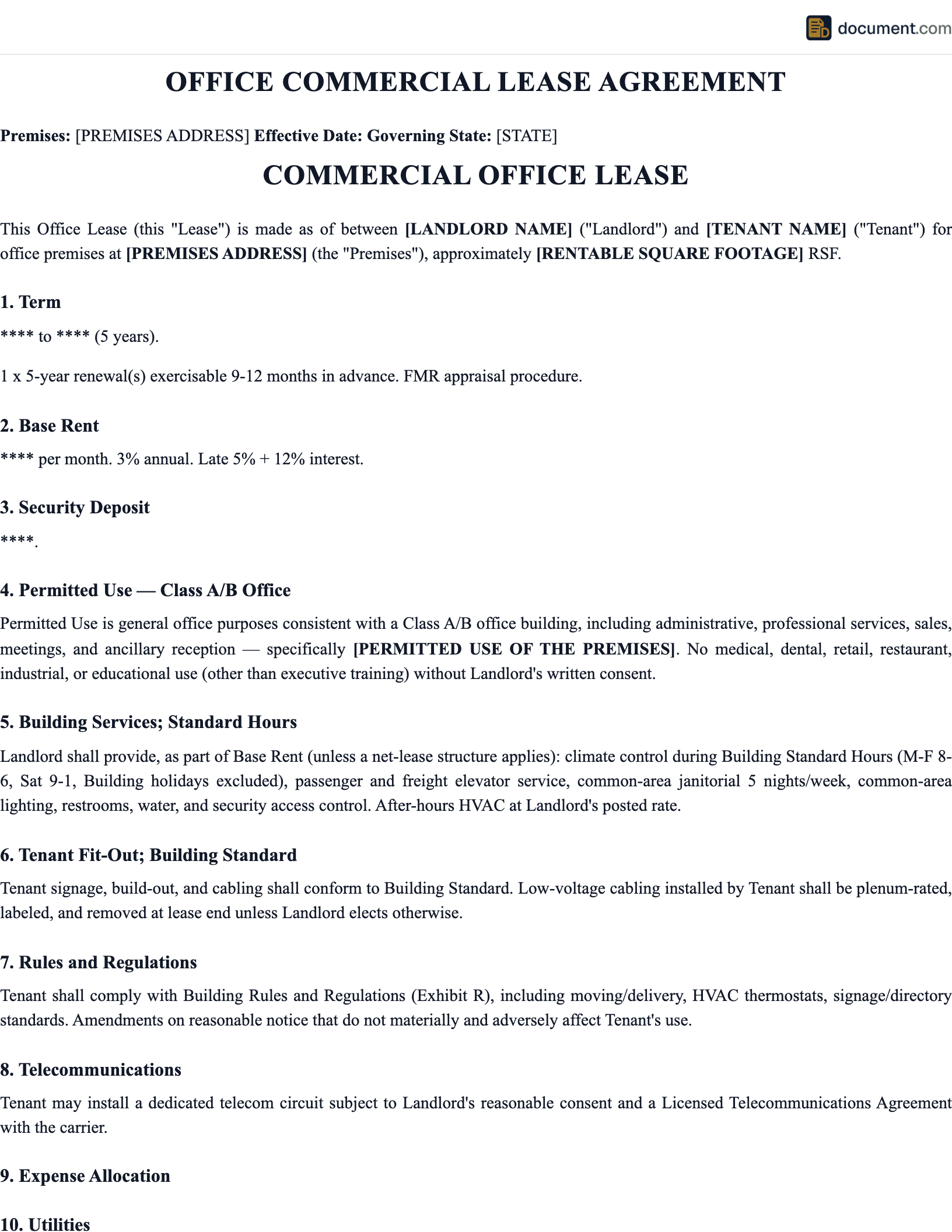



Virginia Office Space Lease Agreement Overview
Virginia does not have a dedicated commercial landlord-tenant statute. Commercial office leases in the state are governed almost entirely by contract law, which means the written lease document is the primary source of each party's rights and obligations. Courts in Virginia generally enforce commercial lease terms as negotiated between sophisticated parties and show little sympathy for tenants who failed to read or negotiate unfavorable provisions before signing.
The Virginia office market is deeply segmented by geography. Northern Virginia, encompassing Fairfax, Loudoun, Arlington, and Alexandria, operates as one of the premier office markets in the country, shaped by decades of federal government expansion, defense contracting, and more recently a data center construction wave that has displaced some traditional office users from Loudoun County entirely. Richmond and Hampton Roads function as separate, more moderately priced markets with their own industry compositions. Virginia's unusual structure of 38 independent cities means that commercial tenants cannot assume that regulations in one jurisdiction apply to a neighboring one. Each city and county sets its own zoning rules, business license fees, and permit processes, and a lease for space in the City of Alexandria is subject to different local rules than space a few blocks away in Arlington County.
$12
Filing fee
Required
Notarization
0
Witnesses required
Circuit
Filing office
Virginia Requirements
Virginia has specific requirements for this type of legal document. Meeting these requirements ensures your document is accepted by the circuit court clerk and is legally enforceable.
Virginia-Specific Note
Virginia has no commercial tenant protection statute, so protections that exist in other states must be written into the lease itself. Virginia also has 38 independent cities, each with separate zoning and permitting requirements. Confirm the specific city or county regulations before finalizing lease terms. Legal review by a Virginia commercial real estate attorney is strongly recommended for any significant office commitment.
Document Requirements
- Written Agreement: Virginia's statute of frauds requires commercial leases exceeding one year to be in writing and signed by both parties
- Authorized Signatories: Entities must sign through an officer or manager with actual authority; Virginia courts will scrutinize unauthorized signatures
- Premises Description: Include building name, street address, suite number, floor, and rentable and usable square footage as measured per BOMA standards
- CAM and Operating Expenses: Specify the calculation method, base year or expense stop, audit rights, and cap on controllable expenses
- Holdover Provision: State the holdover rent rate explicitly; Virginia common law default converts holdover to month-to-month, which many landlords want to override
- Local Compliance: Verify permitted use with the specific city or county zoning authority; independent cities have separate codes from surrounding counties
How to Execute a Virginia Office Space Lease
Virginia commercial office leases do not require court filing to be enforceable between the parties. Execution means getting the document signed properly, distributing copies, and attending to any ancillary requirements like building access setup, insurance certificates, and local business licensing.
Verify Zoning and Permitted Use
Before signing, confirm with the city or county zoning authority that your intended office use is permitted at the specific address. Virginia's 38 independent cities each have separate codes; do not assume that approval in one jurisdiction carries over.
Negotiate and Draft the Lease
Address all material terms including base rent, rent escalations, TI allowance, HVAC hours, parking allocation, CAM structure, holdover provisions, and renewal options. In Northern Virginia, market-specific terms like data center proximity clauses or security clearance provisions may also be relevant.
Obtain Legal Review
Virginia commercial leases are interpreted under contract law with minimal statutory protections for tenants. An attorney familiar with the specific local market, whether Northern Virginia, Richmond, or Hampton Roads, can identify provisions that are out of market and advise on negotiating leverage.
Execute With Authorized Signatures
Both parties sign through their authorized representatives. For leases longer than one year, the statute of frauds requires a written signed agreement. If you plan to record the lease with the Circuit Court Clerk for constructive notice purposes, notarization is required for recording.
Complete Move-In Requirements
Deliver security deposit, provide certificate of insurance naming landlord as additional insured, obtain local business license from the relevant city or county, coordinate building access credentials, and document the condition of the premises at occupancy commencement.
Virginia Tax Implications and Costs
Virginia does not impose a statewide sales tax on commercial rent. However, several tax obligations affect office tenants and should be addressed in the lease or factored into occupancy costs.
| Cost or Tax Item | Details |
|---|---|
| Commercial Rent Sales Tax | Virginia does not impose sales tax on commercial rent at the state level |
| BPOL Tax (Business License) | Each Virginia city and county sets its own Business, Professional and Occupational License rate on gross receipts; rates and thresholds vary significantly |
| Property Tax Passthrough via CAM | Landlords routinely pass real estate tax increases through to tenants via operating expense clauses; negotiate a cap or base year protection |
| Lease Recording Fee (optional) | Circuit Court Clerk recording fees if parties choose to record; typically $25 to $50 for the first page plus additional page fees |
| Attorney Review | $350 to $600 per hour for Northern Virginia commercial real estate attorneys; total review costs vary by lease complexity |
Sample Virginia Office Space Lease Agreement
Below is a preview of our Virginia-specific template. Your customized document will include all fields and provisions required for filing in any Virginia county.
OFFICE SPACE LEASE AGREEMENT
STATE OF VIRGINIA
Legal Document Template
LANDLORD
Name: [Full Legal Name / Entity]
Address: [Management Office Address]
Contact: [Property Manager Name]
TENANT
Name: [Business Entity Name]
Address: [Current Business Address]
Tax ID: [EIN]
Guarantor: [If Applicable]
PREMISES
Building: [Building Name/Address]
Suite: [Number]
Floor: [Floor Number]
RSF: [Rentable Square Feet]
USF: [Usable Square Feet]
FINANCIAL TERMS
Base Rent: $[Amount]/RSF/year
TI Allowance: $[Amount]/RSF
Expense Stop: $[Amount]/RSF
Parking: [# Spaces]
Deposit: $[Amount]
Virginia Office Space Lease Agreement FAQ
Answers to common questions about filing a office space lease agreement in Virginia, including requirements, fees, and procedures.
Official Virginia Resources
Use these official state resources to verify requirements, find your local filing office, and access government forms for Virginia.
Related Virginia Documents
Depending on your situation, you may need additional documents alongside your Virginia office space lease agreement.
Create your Virginia Commercial Office Lease Agreement in under 5 minutes.
Answer a few questions and download a Virginia-compliant document, ready for the state agency.