



Vermont Office Space Lease Agreement Overview
Vermont's commercial office market is defined by Burlington, the state's only true urban center, where demand from healthcare, higher education, technology companies, and state government agencies supports a small but active office leasing market. The Church Street commercial district, the UVM-adjacent research corridor, and the South Burlington suburban office market along Shelburne Road represent the bulk of available inventory. Vermont's creative and outdoor recreation economy brings a distinct tenant mix, including nonprofits, environmental consulting firms, food and beverage companies, and software developers drawn by quality of life rather than cost optimization.
Vermont commercial office leases are governed by contract law, with the Vermont statute of frauds (12 V.S.A. Section 181) requiring leases exceeding one year to be in writing. Vermont's Act 250 land use law can affect significant build-out or improvement projects within leased space, and tenants should confirm with their landlord whether the building carries an existing Act 250 permit and what conditions it imposes. Winter heating provisions are unusually material in Vermont given Burlington's average of over 80 inches of annual snowfall, and leases should address heating obligations, minimum temperatures, and utility cost allocation clearly.
$15
Filing fee
Required
Notarization
2
Witnesses required
Town
Filing office
Vermont Requirements
Vermont has specific requirements for this type of legal document. Meeting these requirements ensures your document is accepted by the town clerk and is legally enforceable.
Vermont Commercial Lease Note
Vermont commercial office leases are governed by contract law and the statute of frauds (12 V.S.A. Section 181), which requires leases exceeding one year to be in writing. Vermont's Act 250 land use law may affect build-out projects. Notarization is not required between private parties for a commercial lease to be enforceable, but is required if the lease will be recorded with the Town Clerk. Tenants planning significant heating system changes or alterations should confirm Act 250 permit status with the landlord before executing.
Document Requirements
- Written Agreement: Vermont's statute of frauds (12 V.S.A. Section 181) requires commercial leases exceeding one year to be in writing and signed by the party against whom enforcement is sought
- Party Identification: Full legal names and entity types for landlord and tenant, with corporate authority documentation where applicable; Vermont LLCs and corporations should confirm signatory authority
- Premises Description: Complete address, suite, square footage, and parking allocations; Vermont office buildings often have shared parking arrangements that should be documented in the lease
- Rent and Escalations: Base rent, annual escalation formula, and whether CAM, property tax, and utility charges are additional obligations or included in the base rent
- Heating and HVAC Obligations: Who is responsible for heating system maintenance, fuel costs, and minimum temperature maintenance during Vermont's extended winter season; this is unusually material given Burlington's climate
- Act 250 Disclosure: Confirm with the landlord whether the building or any planned improvement project requires an Act 250 permit under Vermont's land use law (10 V.S.A. Chapter 151)
How to Execute a Vermont Office Lease
Executing a commercial office lease in Vermont requires understanding the state's limited inventory, its unique land use framework, and the practical realities of leasing in one of New England's smallest markets.
Assess the Burlington and Statewide Market Early
Vermont's office inventory is genuinely constrained. Quality Class A space in Burlington can have very low vacancy rates, and tenants who wait until the last moment before their lease expires often find limited options. Begin your search at least 12 to 18 months before your target move date. Survey downtown Burlington, South Burlington, and if your operations are more distributed, secondary markets in Montpelier, Rutland, or Brattleboro. Be prepared to evaluate build-to-suit options if existing inventory does not meet your needs.
Confirm Act 250 Status and Local Permits
Before committing to a space where significant build-out is planned, ask the landlord whether the building or project has an existing Act 250 permit and what conditions it carries. Vermont's Act 250 (10 V.S.A. Chapter 151) governs commercial development above certain thresholds, and permit conditions can affect the scope of alterations allowed. Additionally, confirm that your intended use complies with local zoning in the relevant Vermont municipality, since Vermont's towns and cities maintain their own zoning bylaws.
Negotiate the Lease Terms
Submit a letter of intent covering rent, term, tenant improvement allowance, free rent period, and key operational provisions. For Vermont office leases, pay particular attention to heating obligations, after-hours HVAC charges, CAM cap and audit rights, and parking allocation. Vermont landlords in tight submarkets carry real leverage, but tenants with strong financials and longer term commitments can often negotiate meaningful concessions on build-out or free rent. Have a Vermont commercial real estate attorney review the landlord's draft before signing.
Execute the Written Lease
Vermont's statute of frauds (12 V.S.A. Section 181) requires commercial leases exceeding one year to be in writing. Authorized representatives of both parties must sign. Notarization is not required between private parties for enforceability, but if you wish to record the lease with the Town Clerk to protect your leasehold interest, notarization will be required. Retain a fully executed original of the complete lease, including all exhibits and addenda.
Deliver Deposit and Monitor Build-Out
Pay the security deposit per the lease timeline. If the landlord is providing a tenant improvement allowance, coordinate the build-out plan with your local Vermont municipality's building department. Vermont towns vary in permitting speed, and some rural and semi-rural communities may take longer to issue building permits than Burlington. Build a realistic timeline before committing to a rent commencement date that depends on completed improvements.
Tax Implications for Vermont Office Leases
Vermont's tax environment is more complex than most states, with a progressive income tax and a unique statewide education property tax that affects commercial tenants through net lease passthroughs.
| Tax / Cost Category | Vermont Treatment |
|---|---|
| State Income Tax | Vermont imposes a progressive income tax on individuals (3.35% to 8.75% depending on income) and a flat 8.5% corporate income tax on net income attributable to Vermont. Businesses operating in Vermont should track Vermont-source income separately for state tax purposes. |
| Sales Tax on Commercial Rent | Vermont does not impose sales tax on commercial real property rental. Vermont's sales tax rate is 6%, but it applies to goods and taxable services, not pure commercial lease payments. This is a meaningful advantage compared to some other New England states. |
| Property Tax Passthrough | Vermont's property tax system is unique because commercial properties are subject to both a municipal property tax and a statewide education tax under Acts 60 and 68. In net leases, both components are typically passed through to tenants. Chittenden County rates on commercial property can be substantial, and the education tax component means Vermont property taxes on commercial real estate are higher than the local mill rate alone would suggest. |
| Heating Cost Exposure | In net leases, heating oil and natural gas costs in Vermont are a meaningful tenant obligation. Burlington's winters are long, and heating costs for poorly insulated older commercial buildings can be substantially higher than initial estimates. Gross leases provide cost certainty but typically come at a premium per square foot that reflects the landlord's assumption of utility risk. |
| Federal Deductibility | Base rent, CAM charges, and most Vermont office lease payments are deductible as ordinary business expenses under IRC Section 162. Vermont conforms to many federal tax provisions, meaning Vermont-deductible treatment generally follows federal treatment for business lease expenses. |
Sample Vermont Office Space Lease Agreement
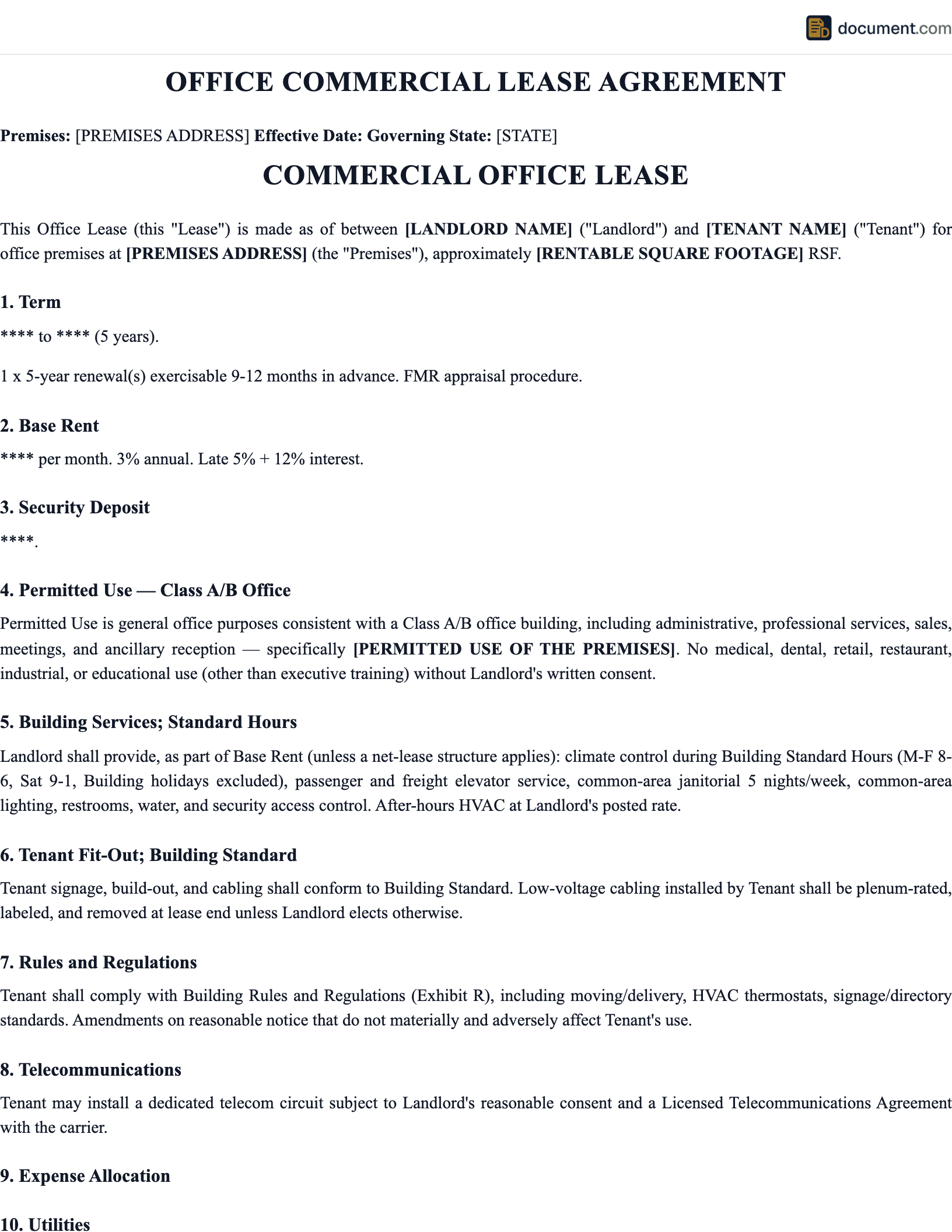
Below is a preview of our Vermont-specific template. Your customized document will include all fields and provisions required for filing in any Vermont county.
OFFICE SPACE LEASE AGREEMENT
STATE OF VERMONT
Legal Document Template
LANDLORD
Name: [Full Legal Name / Entity]
Address: [Management Office Address]
Contact: [Property Manager Name]
TENANT
Name: [Business Entity Name]
Address: [Current Business Address]
Tax ID: [EIN]
Guarantor: [If Applicable]
PREMISES
Building: [Building Name/Address]
Suite: [Number]
Floor: [Floor Number]
RSF: [Rentable Square Feet]
USF: [Usable Square Feet]
FINANCIAL TERMS
Base Rent: $[Amount]/RSF/year
TI Allowance: $[Amount]/RSF
Expense Stop: $[Amount]/RSF
Parking: [# Spaces]
Deposit: $[Amount]
Important Considerations for Vermont Office Tenants
Vermont's small market, harsh winters, and unique land use framework create specific challenges for commercial office tenants that do not exist in most other states.
Very Limited Inventory Means Limited Negotiating Power
Burlington's commercial office market is among the smallest in New England. When quality space becomes available in desirable buildings, multiple tenants often compete for it, and landlords in this environment carry genuine leverage. Unlike larger markets where a tenant can credibly threaten to go to a competing building, Vermont tenants in the Burlington submarket often have few true alternatives. Start your search early, understand the full market before entering negotiations, and recognize that the typical landlord concessions available in larger metros may be harder to extract in Vermont.
Act 250 and Local Zoning Are Both Real
Vermont's two-layer land use system, Act 250 at the state level and municipal zoning bylaws at the local level, means that office tenants planning build-out must confirm compliance with both before beginning work. Act 250 conditions on a building's development permit may limit the scope of alterations or require state agency notification. Local zoning bylaws in Burlington, South Burlington, and other Vermont municipalities can further restrict permitted uses within a given zone. Ignoring either layer can result in stop-work orders and expensive remediation.
Heating Costs Are a Real Line Item
Burlington's climate is among the harshest of any New England city. Heating oil and natural gas costs in Vermont office buildings are significant, and older commercial buildings may have poor insulation that amplifies those costs. If your lease passes heating costs through to you (as most net leases do), ask the landlord for the prior three years of utility bills for the space before signing. A space that looks affordable on a per-RSF basis may have monthly heating costs from November through April that materially change the true cost of occupancy.
Seasonal Patterns Affect Business Operations
Vermont's economy has strong seasonal characteristics driven by ski tourism, summer recreation, foliage season, and agricultural cycles. If your business serves any of these seasonal markets, consider whether your office lease term and rent structure need to account for revenue variability. Month-to-month leases may provide more flexibility but are difficult to find in Burlington's tight market. Fixed-term leases should include provisions that account for business interruption risk during extreme weather events, which are genuinely common in Vermont winters.
Vermont Office Space Lease Agreement FAQ
Answers to common questions about filing a office space lease agreement in Vermont, including requirements, fees, and procedures.
Official Vermont Resources
Use these official state resources to verify requirements, find your local filing office, and access government forms for Vermont.
Related Vermont Documents
Depending on your situation, you may need additional documents alongside your Vermont office space lease agreement.
Create your Vermont Commercial Office Lease Agreement in under 5 minutes.
Answer a few questions and download a Vermont-compliant document, ready for the state agency.