



Utah Office Space Lease Agreement Overview
Salt Lake City anchors Utah's commercial office market, driven by what the state's tech and startup community calls "Silicon Slopes," the corridor of technology companies stretching from Salt Lake City south through Lehi and Provo. Major employers including Adobe, Qualtrics, Domo, and dozens of mid-size SaaS companies have created sustained demand for Class A and Class B office space across the Wasatch Front. The market also benefits from Utah's flat income tax of 4.85% and a cost of living and real estate price point that remains far below comparable coastal tech markets, making it a genuine destination for company relocations and expansions.
Utah commercial office leases are governed by contract law rather than a specific commercial landlord-tenant statute. The state's statute of frauds (Utah Code Section 25-5-1) requires commercial leases exceeding one year to be in writing. Tenants should expect landlords to favor modified gross or triple-net structures in the Wasatch Front market, with property tax, insurance, and CAM passed through on top of base rent. Cold winters create meaningful HVAC costs, and leases should address both heating obligations and after-hours HVAC availability for tenants with extended operating schedules.
$40
Filing fee
Required
Notarization
0
Witnesses required
County
Filing office
Utah Requirements
Utah has specific requirements for this type of legal document. Meeting these requirements ensures your document is accepted by the county recorder and is legally enforceable.
Utah Commercial Lease Note
Utah has no dedicated commercial landlord-tenant statute. Commercial office leases in Utah are governed by general contract law and the state's statute of frauds (Utah Code Section 25-5-1), which requires leases exceeding one year to be in writing. All rights and obligations must be negotiated and stated in the lease document itself. Notarization is not required between private parties but is required if the lease will be recorded with the county recorder.
Document Requirements
- Written Agreement: Utah Code Section 25-5-1 requires commercial leases exceeding one year to be in writing and signed by the party against whom enforcement is sought
- Party Identification: Full legal names and entity types for landlord and tenant, with corporate authority documentation (board resolutions, operating agreements) where applicable
- Premises Description: Complete address, suite number, square footage, and whether measurement follows BOMA or any other standard the landlord is using
- Rent and Escalations: Base rent amount, annual escalation formula (fixed percentage or CPI-tied), and whether net charges such as property tax and CAM are additional
- HVAC and Utilities: Allocation of heating and cooling responsibility is material given Utah's cold winters; specify service hours and tenant responsibility for after-hours usage charges
- Tenant Improvement Allowance: Dollar amount per RSF, scope of permitted build-out, completion timeline, and landlord approval process for plans
How to Execute a Utah Office Lease
Executing a commercial office lease in Utah involves market research, careful negotiation, and attention to provisions that Utah's landlord-favorable legal environment will not supply by default.
Survey the Wasatch Front Market
Tour at least three to five buildings in the submarket that suits your operations, whether that is downtown Salt Lake City, the Airport submarket, or the Silicon Slopes corridor in Lehi and Provo. Understand the difference between Class A rates (currently $28 to $38 per RSF in top Salt Lake buildings) and Class B options at $18 to $26 per RSF. Factor in parking, which can add $50 to $150 per stall per month in downtown buildings.
Submit a Letter of Intent
Once you've identified a preferred space, submit a letter of intent covering base rent, lease term, tenant improvement allowance, free rent period, security deposit amount, and any key use exclusives. Keep the LOI clearly marked as non-binding. Utah landlords generally respond within one to two weeks with a counter or acceptance before proceeding to full lease drafting.
Negotiate the Full Lease
Review the landlord's draft with a commercial real estate attorney. Key negotiation points in Utah include CAM cap and audit rights, holdover rent rate (push for 125% rather than 150% or 200%), HVAC service hours and after-hours cost, permitted assignment and subletting rights, and build-out timeline with rent commencement tied to delivery of a ready space rather than a fixed date.
Execute the Lease in Writing
Utah Code Section 25-5-1 requires leases exceeding one year to be in writing. Both parties' authorized representatives must sign. Notarization is not required between private parties, but if you intend to record the lease with the Salt Lake County or Utah County recorder, notarization will be required. Retain a fully executed original for your records.
Pay the Security Deposit and Monitor Build-Out
Deliver the security deposit per the lease timeline. If the landlord is providing a tenant improvement allowance, confirm the approval process for architectural plans with your local building department, which in Salt Lake City is the Building Services division. Track build-out completion milestones to ensure your rent commencement date reflects actual delivery of a finished space.
Tax Implications for Utah Office Leases
Utah's tax environment is generally favorable for commercial tenants, with a flat income tax and no sales tax on commercial rent. Key passthrough costs come from property taxes and CAM.
| Tax / Cost Category | Utah Treatment |
|---|---|
| State Income Tax | Utah imposes a flat 4.85% income tax on individuals and pass-through entities. C corporations pay a 4.85% corporate income tax rate. No special commercial lease tax applies at the state level. |
| Sales Tax on Commercial Rent | Utah does not impose sales tax on commercial rent. The state's combined sales tax rate (currently 4.85% state plus local additions) applies to goods and taxable services, but pure commercial real property rental is exempt. This is an advantage over states like Arizona and Hawaii. |
| Property Tax Passthrough | Utah property taxes are moderate but are typically passed through in full to tenants under net or modified gross leases. Salt Lake County property tax rates average approximately 1.0% to 1.4% of assessed value. In net leases, tenants receive an annual reconciliation statement from the landlord and may owe additional amounts beyond estimated monthly charges. |
| CAM Reconciliation Costs | CAM charges in Utah office buildings are not regulated by statute. Annual reconciliation can result in significant additional billings if the landlord's operating costs exceeded estimates. Negotiate audit rights and a cap on controllable CAM increases, typically 3% to 5% per year, to limit exposure. |
| Federal Deductibility | Base rent, CAM charges, and most office lease payments are deductible as ordinary business expenses under IRC Section 162. Tenant improvement allowances received from the landlord may be treated as income unless structured as a true tenant improvement allowance under IRS Rev. Proc. 2001-28. Consult a tax advisor for large build-out arrangements. |
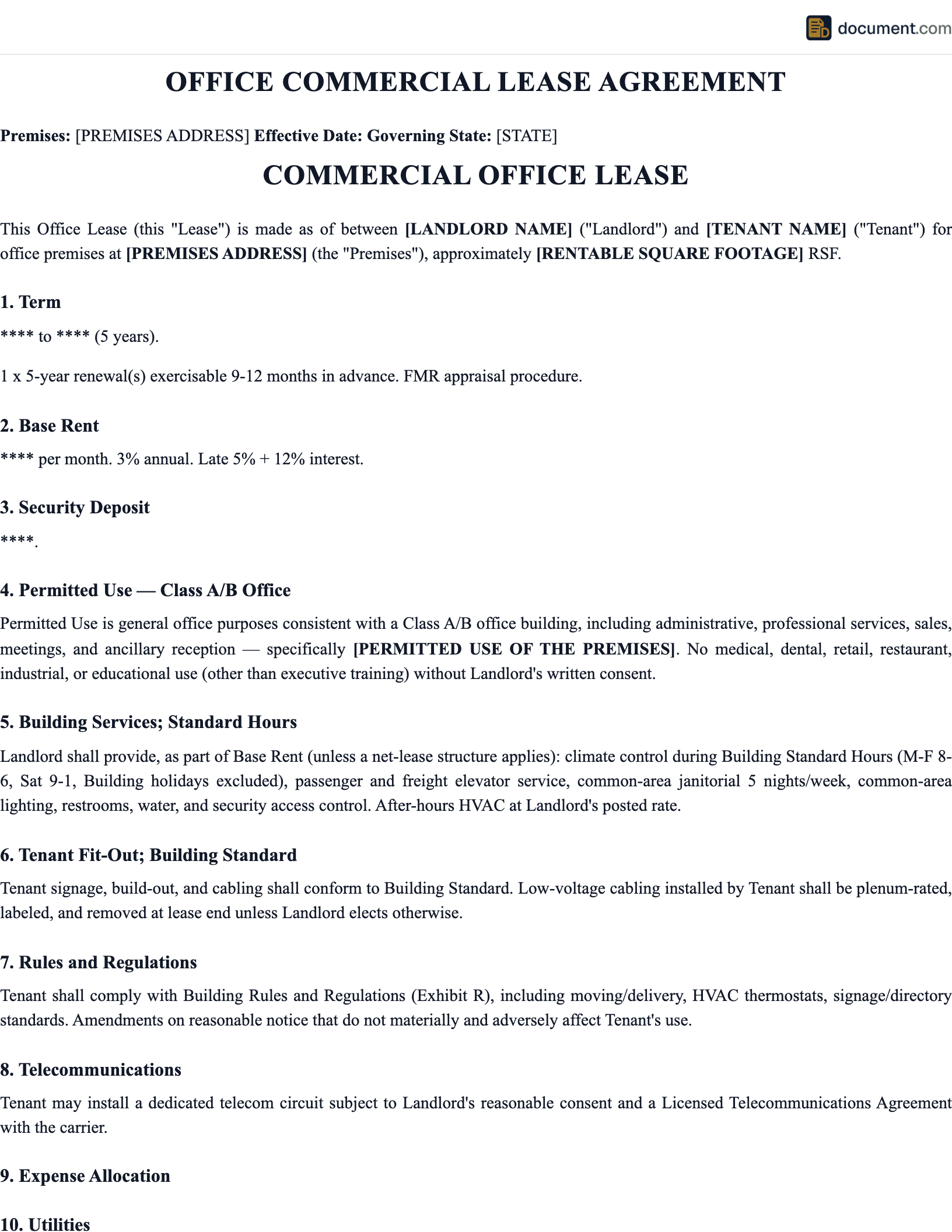
Sample Utah Office Space Lease Agreement
Below is a preview of our Utah-specific template. Your customized document will include all fields and provisions required for filing in any Utah county.
OFFICE SPACE LEASE AGREEMENT
STATE OF UTAH
Legal Document Template
LANDLORD
Name: [Full Legal Name / Entity]
Address: [Management Office Address]
Contact: [Property Manager Name]
TENANT
Name: [Business Entity Name]
Address: [Current Business Address]
Tax ID: [EIN]
Guarantor: [If Applicable]
PREMISES
Building: [Building Name/Address]
Suite: [Number]
Floor: [Floor Number]
RSF: [Rentable Square Feet]
USF: [Usable Square Feet]
FINANCIAL TERMS
Base Rent: $[Amount]/RSF/year
TI Allowance: $[Amount]/RSF
Expense Stop: $[Amount]/RSF
Parking: [# Spaces]
Deposit: $[Amount]
Important Considerations for Utah Office Tenants
The Silicon Slopes market moves quickly, and Utah's legal framework places the burden of protection entirely on what tenants negotiate. These considerations should inform your approach.
No Statutory Tenant Protections
Utah has no commercial landlord-tenant statute that provides default protections for office tenants. There is no statutory security deposit return deadline, no required cure period before eviction, and no mandatory warranty of habitability for commercial spaces. Everything a tenant needs, including audit rights, cure periods, relocation protections, and HVAC guarantees, must be drafted into the lease. Accept no verbal assurances as substitutes for written lease provisions.
Silicon Slopes Lease Dynamics
The Lehi and Provo submarkets along the Silicon Slopes corridor attract significant competition for Class A space, particularly from tech employers and their vendors. Vacancy rates in top Lehi buildings have been among the lowest in the Wasatch Front, and landlords in this submarket carry more leverage than in downtown Salt Lake or suburban office parks. If you need Silicon Slopes proximity, start your search and LOI process well before your current lease expires, as quality spaces can move quickly.
Cold Weather HVAC Provisions
Utah winters are cold, with Salt Lake City averaging over 50 inches of snow per year. HVAC costs in Utah office buildings are material, and standard building hours for HVAC service typically run weekdays from 7 a.m. to 6 p.m. If your operations extend into evenings or weekends, after-hours HVAC can cost $30 to $75 per hour depending on the building. Negotiate the HVAC service hours and after-hours cost upfront and include them in the lease, not in a side letter that may not be binding on future building owners.
Build-Out Timeline and Rent Commencement
Utah landlords often propose that rent commences on a fixed date after lease execution regardless of whether the build-out is complete. Push for rent commencement to be tied to substantial completion of the landlord's work and delivery of the space in the agreed condition. Include a "tenant delay" carve-out that prevents the landlord from claiming rent commencement if delays are caused by the tenant's own late approvals or contractor selections. Build-out delays in Salt Lake City's permitting process can add weeks to the timeline.
Utah Office Space Lease Agreement FAQ
Answers to common questions about filing an office space lease agreement in Utah, including requirements, fees, and procedures.
Official Utah Resources
Use these official state resources to verify requirements, find your local filing office, and access government forms for Utah.
Related Utah Documents
Depending on your situation, you may need additional documents alongside your Utah office space lease agreement.
Create your Utah Commercial Office Lease Agreement in under 5 minutes.
Answer a few questions and download a Utah-compliant document, ready for the state agency.