
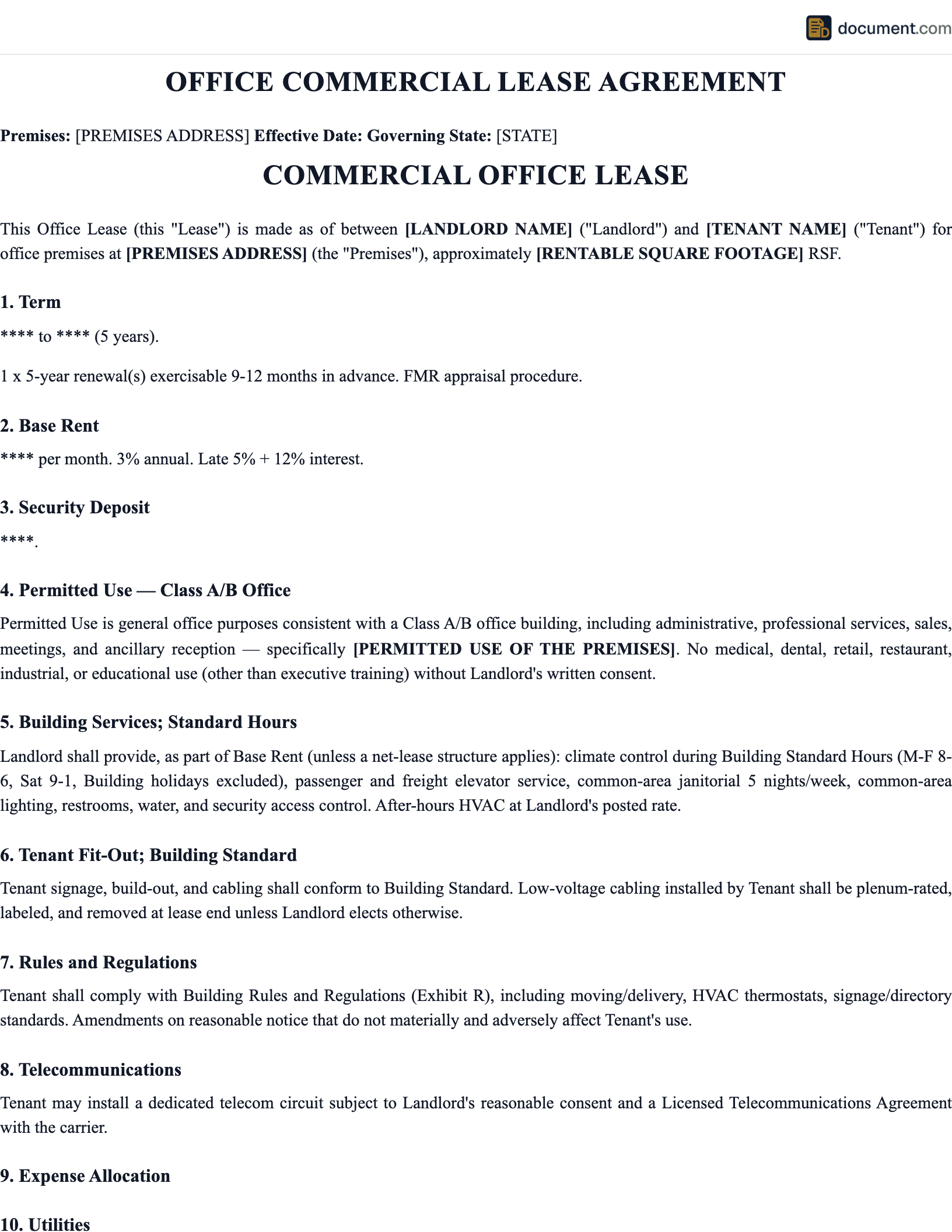



Texas Office Space Lease Agreement Overview
Texas is one of the most active commercial real estate markets in the United States, driven by four major metropolitan economies operating simultaneously. The Dallas-Fort Worth metroplex is a dominant corporate headquarters market with significant financial services, technology, and logistics activity. Houston remains the center of the global energy industry with an office market shaped by oil and gas business cycles. Austin has transformed into a major tech hub with dramatic office rent appreciation driven by corporate relocations from California and organic startup growth. San Antonio provides a lower-cost alternative with stable demand from healthcare, federal government, and regional businesses. Together, these markets generate exceptional volumes of commercial office lease activity under Texas law.
Texas is explicitly landlord-friendly for commercial leases. The Texas Property Code provides commercial tenants with very limited statutory protections, and Texas courts consistently enforce lease terms as negotiated. There is no commercial rent control anywhere in the state, no statutory security deposit cap, and no implied warranty of habitability for commercial purposes. This means every protection the tenant wants must be written into the lease before signing. Given the scale and sophistication of the Texas commercial office market, tenants should expect landlords to use carefully drafted standard form leases that favor the building owner, and should plan to negotiate significant modifications for any material lease commitment.
$26
Filing fee
Required
Notarization
0
Witnesses required
County
Filing office
Texas Requirements
Texas commercial office leases are governed by the Texas Property Code and general contract law. The state deliberately provides landlords with broad latitude and tenants with minimal statutory protections, making the negotiated lease the primary governance document.
Texas Commercial Office Note
Texas is explicitly landlord-friendly for commercial leases. Standard landlord form leases in Dallas, Houston, and Austin are drafted to heavily favor the building owner and include broad landlord remedies, limited tenant rights on landlord default, and expansive CAM definitions. Tenants should negotiate hard and document all agreed modifications in writing. Texas courts do not imply protections that are not stated in the lease, and will not rewrite commercially unreasonable provisions that both parties agreed to in writing.
Document Requirements
- Written Agreement: Texas Business & Commerce Code Section 26.01 requires leases for a term longer than one year to be in writing and signed by the party to be charged
- Party Identification: Full legal names and entity types of landlord and tenant; authorized signatory names, titles, and evidence of authority (e.g., corporate resolution) for larger transactions
- Premises Description: Building address, suite/floor, rentable square footage, and usable square footage if a load factor applies; confirm RSF measurement methodology (BOMA standard vs. landlord-defined)
- CAM and Operating Expenses: Detailed definition of included and excluded expenses, annual reconciliation process, cap on controllable CAM, tenant audit rights with a lookback period
- Property Tax Passthrough: Method for calculating tenant's share of property taxes, given that Texas has no state income tax but relatively high property taxes assessed at the county level
- TI Allowance and Build-Out: Allowance amount, draw process, completion deadline with consequences for late delivery, and ownership of improvements at lease expiration
- Parking: Spaces allocated, reserved vs. unreserved designation, monthly parking cost if separate, and Texas-specific provisions for surface lot maintenance including extreme heat considerations
How to Execute an Office Lease in Texas
Executing a commercial office lease in Texas follows a defined commercial real estate process. Given the landlord-friendly legal environment, preparation and representation matter significantly.
Engage a Tenant Representative Broker
In Dallas, Houston, Austin, and San Antonio, commercial real estate brokers who work exclusively for tenants provide significant leverage in negotiations. Building brokers represent the landlord's interests. Tenant rep brokers know market conditions, comparable rents, and which landlords offer the best terms. Their compensation comes from the landlord, so there is no direct cost to the tenant.
Tour Properties and Compare Total Cost
Compare total occupancy cost across properties, not just base rent. In Texas net leases, property taxes, insurance, and CAM can add $8 to $20 per square foot annually above base rent in major markets. A lower base rent with high CAM may be more expensive than a higher base rent in a gross structure.
Negotiate an LOI and Then the Full Lease
Establish base rent, TI allowance, free rent, term, and parking in a letter of intent before the legal drafting begins. Then negotiate the full lease with specific attention to CAM definitions, holdover provisions, HVAC maintenance, personal guarantee scope, and early termination rights. Texas courts enforce what the parties write, so every important term must be negotiated into the document.
Execute the Lease
Both parties sign the final lease. Texas commercial leases do not require notarization to be binding between parties. Notarization is needed only if the lease is to be recorded with the county clerk's office for constructive notice purposes, which is optional for most office leases but may be required by lenders.
Pay Security Deposit and Monitor Build-Out
Deliver the security deposit and first month's rent upon signing. Monitor the tenant improvement build-out against the agreed timeline. Texas law provides no commercial security deposit return timeline; the lease must define exactly when and under what conditions the deposit is returned.
Tax Implications for Texas Office Leases
Texas offers one of the most business-friendly tax environments in the United States, though commercial office tenants face specific cost drivers that differ from income-tax states.
| Tax / Cost Item | Texas Treatment |
|---|---|
| State Income Tax on Rent | None. Texas has no state income tax on individuals or corporations. Office rent payments have no TX income tax dimension for landlord or tenant |
| Sales Tax on Commercial Rent | Texas does not impose sales tax on commercial office rent itself. However, certain services bundled into rent (janitorial, tech support, certain utilities) may be subject to Texas sales tax depending on how they are invoiced |
| Property Tax Passthrough | Texas has some of the highest property tax rates in the nation (effective rates typically 1.5% to 2.5% of assessed value in major metro counties). In net leases, property tax is passed through to tenants and can be a significant cost item, particularly in Dallas and Houston where commercial assessments have risen with market values |
| Texas Franchise (Margin) Tax | Businesses operating in Texas are subject to the state franchise tax (margin tax) based on revenues, not rent. Office rent is a deductible cost of goods sold or compensation for franchise tax purposes depending on the business's tax calculation method |
| Federal Deductibility | Office rent paid in Texas is deductible as an ordinary business expense for federal tax purposes. Tenant improvements may qualify as qualified improvement property under federal rules. ASC 842 lease accounting may apply to entities with audited financial statements |
Sample Texas Office Space Lease Agreement
Below is a preview of our Texas-specific template. Your customized document will include all fields and provisions required for filing in any Texas county.
OFFICE SPACE LEASE AGREEMENT
STATE OF TEXAS
Legal Document Template
LANDLORD
Name: [Full Legal Name / Entity]
Address: [Management Office Address]
Contact: [Property Manager Name]
TENANT
Name: [Business Entity Name]
Address: [Current Business Address]
Tax ID: [EIN]
Guarantor: [If Applicable]
PREMISES
Building: [Building Name/Address]
Suite: [Number]
Floor: [Floor Number]
RSF: [Rentable Square Feet]
USF: [Usable Square Feet]
FINANCIAL TERMS
Base Rent: $[Amount]/RSF/year
TI Allowance: $[Amount]/RSF
Expense Stop: $[Amount]/RSF
Parking: [# Spaces]
Deposit: $[Amount]
Important Considerations for Texas Office Leases
Texas Is Explicitly Landlord-Favorable
No other major state is more clearly tilted toward commercial landlords than Texas. The Texas Property Code affirmatively eliminates implied tenant protections that exist in other states. Tenants entering a Texas commercial office lease without experienced legal representation and a tenant-side broker are at a significant disadvantage against sophisticated building ownership groups.
Property Tax Is the Hidden CAM Driver
Texas has no income tax but compensates with some of the highest property tax rates in the nation. In net and modified gross office leases, property tax passthroughs can add $5 to $15 per square foot annually to total occupancy cost in Dallas County and Harris County. Tenants should request actual property tax bill history for the building, not just landlord estimates, and negotiate a cap on annual increases.
HVAC and Extreme Heat Provisions Matter
Texas summers are extreme. Office buildings in Houston, Dallas, and San Antonio maintain aggressive HVAC schedules to make space usable from May through September. The lease should specify HVAC hours of operation, after-hours HVAC cost, who is responsible for HVAC maintenance and major system replacement, and what happens if HVAC fails for an extended period. Tenants with server rooms or equipment sensitive to heat should negotiate specific temperature guarantees and backup cooling provisions.
Austin Market Has Fundamentally Changed
Austin's office market has undergone a structural transformation driven by tech company expansion. Rents in downtown Austin and the Domain submarket have approached San Francisco levels for premium space, and the dynamics now resemble coastal markets more than traditional Texas commercial real estate. Tenants new to Austin should not assume the negotiating environment matches what they would encounter in Dallas or Houston.
Texas Office Space Lease Agreement FAQ
Common questions about commercial office leases in Texas, covering security deposits, CAM, property taxes, holdover rules, and market conditions in Dallas, Houston, Austin, and San Antonio.
Official Texas Resources
Use these official state resources to verify requirements, find your local filing office, and access government forms for Texas.
Related Texas Documents
Depending on your situation, you may need additional documents alongside your Texas office space lease agreement.
Create your Texas Commercial Office Lease Agreement in under 5 minutes.
Answer a few questions and download a Texas-compliant document, ready for the state agency.