



Tennessee Office Space Lease Agreement Overview
Tennessee has emerged as one of the most active commercial office markets in the South, driven almost entirely by Nashville's extraordinary population and business growth over the past decade. The Nashville metropolitan area has attracted corporate relocations, regional headquarters, and professional services firms at a pace that has pushed Class A office rents significantly higher and tightened availability in key submarkets including downtown, Midtown, and the Brentwood/Cool Springs corridor. Memphis remains Tennessee's second major office market with a more stable rate environment and significant logistics and healthcare industry presence. Knoxville has a growing commercial office market anchored by University of Tennessee activity and regional professional services demand.
Tennessee provides commercial tenants with minimal statutory protections beyond general contract law. The Tennessee Uniform Residential Landlord and Tenant Act explicitly does not apply to commercial leases. This means there is no statutory cap on security deposits, no required return timeline for deposits, no implied warranty of fitness for commercial purposes, and no rent control. Commercial office tenants in Tennessee are protected only by what their lease says. Given Nashville's competitive market and landlord-favorable conditions in premium buildings, tenants need experienced representation and thorough lease review before signing any long-term office commitment in the state.
$10
Filing fee
Required
Notarization
0
Witnesses required
Register
Filing office
Tennessee Requirements
Tennessee commercial office leases are governed by general contract law and property law principles. The state has deliberately minimal statutory requirements for commercial tenancies, leaving the terms almost entirely to party negotiation.
Tennessee Commercial Office Note
Tennessee has no commercial rent control, no required security deposit cap, and no statutory disclosure requirements specific to commercial tenants. In Nashville's fast-moving market, landlords of premium office space may push back on CAM audit rights, holdover rate multipliers, and early termination provisions. Tenants should not assume Nashville office market customs match what they may have experienced in other states. Every protection the tenant wants must be negotiated and written into the lease before signing.
Document Requirements
- Written Agreement: Tennessee's statute of frauds (TCA 29-2-101) requires leases exceeding one year to be in writing and signed by the party to be charged
- Party Identification: Full legal names and entity types of landlord and tenant; authorized signatory names and authority documentation for corporate entities
- Premises Description: Building address, suite number, floor, rentable square footage, and usable square footage if a load factor applies
- Rent and Escalations: Base rent, annual escalation percentage or CPI adjustment, and whether Nashville-area market rent reset provisions apply at renewal
- CAM and Operating Costs: Detailed definition of included and excluded costs, annual reconciliation process, cap on controllable CAM increases, and tenant audit rights
- TI Allowance and Build-Out: Allowance amount, draw procedures, completion deadline, and ownership of improvements at lease end
- Parking: Number of spaces, location (reserved vs. unreserved), monthly cost if any, and responsibility for parking lot or garage maintenance
How to Execute an Office Lease in Tennessee
Executing a commercial office lease in Tennessee follows the standard commercial real estate process. In Nashville's active market, tenants who understand the steps and move deliberately have better outcomes.
Tour and Compare Properties
In Nashville, compare several properties before committing. Assess HVAC system quality, parking ratios, building amenities, and CAM structure. In Memphis and Knoxville, the market is less competitive, so you typically have more time to evaluate options carefully before making an offer.
Negotiate an LOI
A letter of intent establishes base rent, term, TI allowance, free rent, and parking before the legal drafting begins. In Nashville's market, landlords may include exclusivity and confidentiality provisions in the LOI. The LOI is typically non-binding but sets the framework for the lease document.
Draft and Negotiate the Full Lease
Use a Tennessee-specific office lease template and redline the draft with attention to CAM definitions, holdover rent multiplier, HVAC maintenance allocation, ADA responsibility, personal guarantee scope, and early termination rights. Tennessee courts enforce commercial lease terms as written with limited equitable exception.
Execute the Lease
Both parties sign the final document. Tennessee commercial leases do not require notarization to be valid between parties. Notarization is needed only if the lease is to be recorded with the county Register of Deeds for constructive notice purposes, which is optional for most office leases.
Deliver Security Deposit and First Month's Rent
Upon lease execution, deliver the security deposit and first month's rent as specified. Because Tennessee law provides no commercial deposit return timeline or conditions, the lease must define exactly what conditions justify deposit deductions and when the deposit will be returned after the tenancy ends.
Tax Implications for Tennessee Office Leases
Tennessee's tax structure is favorable for commercial tenants, though there are important distinctions between what the state taxes and what flows through in a net lease structure.
| Tax / Cost Item | Tennessee Treatment |
|---|---|
| State Income Tax on Rent | Tennessee eliminated its Hall Income Tax on investment income in 2021 and has no tax on wages or business income, making it a fully income-tax-free state. Office rent payments have no TN income tax dimension |
| Sales Tax on Commercial Rent | Tennessee does not impose a general sales tax on commercial office rent. However, ancillary services bundled into rent arrangements may trigger TN sales tax; operators and landlords offering service packages should confirm with a Tennessee tax advisor |
| Property Tax Passthrough | In net office leases, tenants pay their proportional share of real property taxes. Davidson County (Nashville) property taxes have risen with market values over the past decade. Tenants should request actual tax bill history and confirm whether the lease caps annual property tax increases passed to tenants |
| CAM Reconciliation Costs | Annual CAM reconciliations in Nashville commercial buildings have become a significant budget item given rising insurance, maintenance, and management costs in the city. Tenants should expect end-of-year additional charges if actual CAM exceeds estimated amounts collected monthly |
| Federal Deductibility | Office rent paid in Tennessee is deductible as a business expense for federal tax purposes. Tenant improvements may qualify as qualified improvement property under federal law. ASC 842 lease accounting may apply to tenants with audited financial statements |
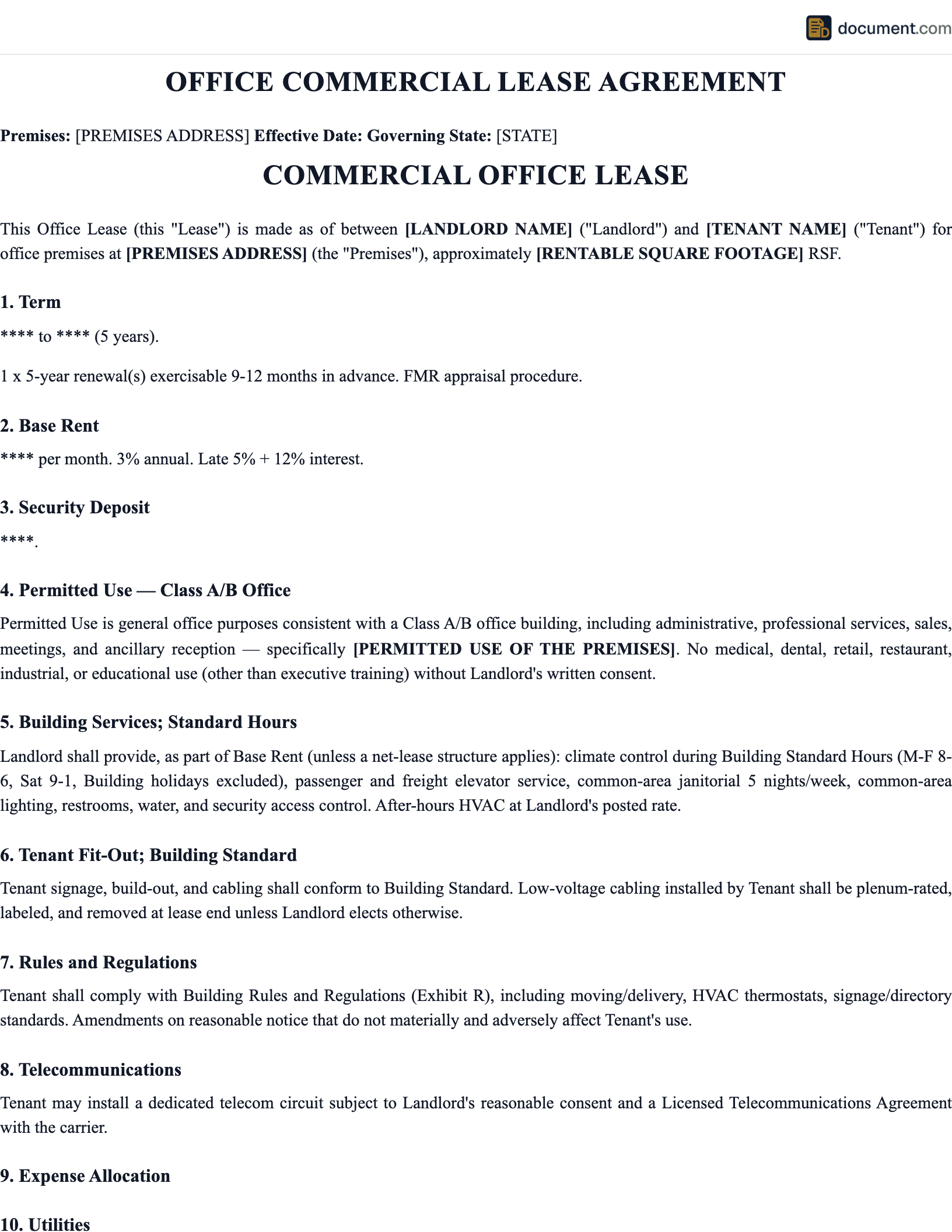
Sample Tennessee Office Space Lease Agreement
Below is a preview of our Tennessee-specific template. Your customized document will include all fields and provisions required for filing in any Tennessee county.
OFFICE SPACE LEASE AGREEMENT
STATE OF TENNESSEE
Legal Document Template
LANDLORD
Name: [Full Legal Name / Entity]
Address: [Management Office Address]
Contact: [Property Manager Name]
TENANT
Name: [Business Entity Name]
Address: [Current Business Address]
Tax ID: [EIN]
Guarantor: [If Applicable]
PREMISES
Building: [Building Name/Address]
Suite: [Number]
Floor: [Floor Number]
RSF: [Rentable Square Feet]
USF: [Usable Square Feet]
FINANCIAL TERMS
Base Rent: $[Amount]/RSF/year
TI Allowance: $[Amount]/RSF
Expense Stop: $[Amount]/RSF
Parking: [# Spaces]
Deposit: $[Amount]
Important Considerations for Tennessee Office Leases
Nashville Market Leverage Dynamics
In Nashville's most desirable submarkets, landlords of Class A space have had significant negotiating leverage. Tenants entering the Nashville market should budget for above-market rents, modest TI packages relative to those available in peer cities, and limited flexibility on lease structure. Engaging a tenant-side commercial real estate broker is particularly important in Nashville because many brokers in the market represent building owners.
CAM Transparency Is Critical
Tennessee has no statute requiring landlords to provide CAM reconciliation detail. The right to audit CAM charges, receive an itemized reconciliation, and challenge management fee inclusions must be written into the lease. Without these rights, tenants in Tennessee have limited recourse when CAM reconciliation bills arrive.
No Implied Commercial Tenant Protections
Tennessee courts consistently enforce commercial lease terms as negotiated. There is no implied warranty of fitness for a commercial purpose, no right to offset rent for landlord failures unless the lease creates that right, and no grace period for defaults beyond what the lease specifies. Understanding exactly what the lease says about landlord obligations is essential before signing.
Market Differences Within Tennessee
Nashville, Memphis, and Knoxville are meaningfully different office markets. Tenants should not assume that conditions, rent levels, or landlord behavior in one Tennessee city reflects conditions elsewhere in the state. A business expanding from Memphis into Nashville, for example, should anticipate a very different lease negotiation environment.
Tennessee Office Space Lease Agreement FAQ
Common questions about commercial office leases in Tennessee, covering security deposits, CAM, holdover rules, taxes, and Nashville market conditions.
Official Tennessee Resources
Use these official state resources to verify requirements, find your local filing office, and access government forms for Tennessee.
Related Tennessee Documents
Depending on your situation, you may need additional documents alongside your Tennessee office space lease agreement.
Create your Tennessee Commercial Office Lease Agreement in under 5 minutes.
Answer a few questions and download a Tennessee-compliant document, ready for the state agency.