



South Dakota Office Space Lease Agreement Overview
South Dakota is one of the most landlord-friendly states in the country for commercial leasing. The state has no equivalent to many other states' commercial tenant protection statutes, which means nearly every material term in an office lease is governed by what the parties negotiate and write into the contract. Sioux Falls is the dominant commercial office market, with a growing inventory of Class A and Class B office buildings concentrated along the I-29 corridor and downtown. The absence of a state income tax has made South Dakota a magnet for financial services and credit card companies, creating steady demand for professional office space from firms that need to maintain a physical presence here.
Office leases in South Dakota are primarily structured as modified gross or triple-net agreements depending on building class and landlord preference. Rents remain significantly more affordable than coastal markets, with Class A office space in Sioux Falls typically ranging from $18 to $28 per square foot annually. Leases exceeding one year must be in writing under SD's statute of frauds. Build-out allowances, tenant improvement packages, HVAC responsibility, and cold-weather utility provisions are all critical negotiating points given the state's climate and the typical tenant profile seeking corporate-grade office space.
$30
Filing fee
Required
Notarization
0
Witnesses required
Register
Filing office
South Dakota Requirements
South Dakota commercial office leases are governed by general contract law and a handful of specific statutory provisions. The state provides minimal statutory baseline protections for commercial tenants, so the lease document itself carries enormous weight. Every material obligation must be written clearly and completely.
South Dakota Commercial Office Note
South Dakota has no commercial rent control, no mandatory disclosure statutes specific to commercial tenants, and no cap on security deposits. The tenant's protection comes entirely from the lease contract. A poorly drafted office lease in SD leaves tenants with very limited recourse. Build-out responsibilities, CAM audit rights, HVAC maintenance, and holdover rent rates should all be addressed explicitly in the document rather than left to implied terms.
Document Requirements
- Written Agreement: Required by South Dakota's statute of frauds for any commercial lease with a term exceeding one year (SDCL 53-8-2)
- Party Identification: Full legal name and entity type of landlord and tenant, including the state of organization and authorized signatory names
- Premises Description: Street address, suite or floor number, and rentable square footage; usable square footage if the lease uses a load factor
- Rent and Escalations: Base rent, any annual escalation percentage or CPI adjustment, and the date rent is due each month
- CAM and Operating Expenses: Definition of included costs, calculation method (gross or net), cap on controllable CAM increases, and tenant audit rights
- HVAC and Utilities: Allocation of responsibility for HVAC maintenance, repair, and replacement; utility payment structure given South Dakota's cold winters
- Build-Out and TI Allowance: Scope of tenant improvements, landlord's contribution, timeline, and ownership of improvements upon lease expiration
How to Execute an Office Lease in South Dakota
Executing a commercial office lease in South Dakota is a negotiation-first process. Unlike residential rentals, there is no standard government form. Follow these steps to move from initial interest to a signed, binding agreement.
Issue or Respond to a Letter of Intent
Most South Dakota office transactions begin with a non-binding letter of intent (LOI) that establishes the key economic terms: base rent, term, tenant improvement allowance, and any free rent period. The LOI is not the lease, but it sets the framework for drafting.
Draft the Full Lease Agreement
Use a South Dakota-specific office lease template that addresses CAM, HVAC responsibility, parking, build-out, ADA compliance, holdover rates, and permitted use. Generic national forms often miss SD-specific provisions or contain clauses that are unenforceable under SD law.
Negotiate and Redline
Both parties review and mark up the draft. Focus on CAM audit rights, HVAC maintenance allocation, holdover rent multiplier, early termination rights, and personal guarantee scope. South Dakota courts enforce commercial leases as written, so negotiation before signing is the only protection available.
Sign and Deliver the Executed Lease
Both landlord and tenant execute the final document. In South Dakota, commercial leases do not require notarization to be binding between parties, but notarization is needed if the lease will be recorded with the county Register of Deeds for constructive notice purposes.
Pay Security Deposit and First Month's Rent
Upon signing, the tenant typically delivers the security deposit and first month's rent (and sometimes last month's rent). Because South Dakota law sets no return timeline or interest requirement for commercial deposits, the lease must define exactly when and how the deposit is returned after the tenancy ends.
Tax Implications for South Dakota Office Leases
South Dakota's tax environment is one of the most favorable in the United States for commercial office tenants. Understanding each layer of potential taxation helps both landlords and tenants structure the lease in a way that is financially clear and compliant.
| Tax / Cost Item | South Dakota Treatment |
|---|---|
| State Income Tax on Rent | None. South Dakota has no corporate or individual state income tax, so rent payments are not subject to SD income tax at either the landlord or tenant level |
| Sales Tax on Commercial Rent | South Dakota does not impose a general sales tax on commercial office rent. However, some ancillary services bundled into rent (like janitorial, parking, or technology) may be taxable depending on how they are structured |
| Property Tax Passthrough | In net and modified gross leases, landlords pass property taxes through to tenants as a component of CAM or as a separate line item. SD property taxes are set at the county level and affect annual operating cost projections; tenants should request actual tax figures for the building |
| CAM Reconciliation | Annual CAM reconciliations can result in additional charges or credits. Snow removal, parking lot maintenance, and shared HVAC costs are common CAM line items in South Dakota office buildings and should be reviewed carefully |
| Federal Deductibility | Office rent paid in South Dakota remains deductible as a business expense for federal tax purposes. Tenants should consult a CPA regarding lease accounting under ASC 842 if the lease is subject to financial reporting requirements |
Sample South Dakota Office Space Lease Agreement
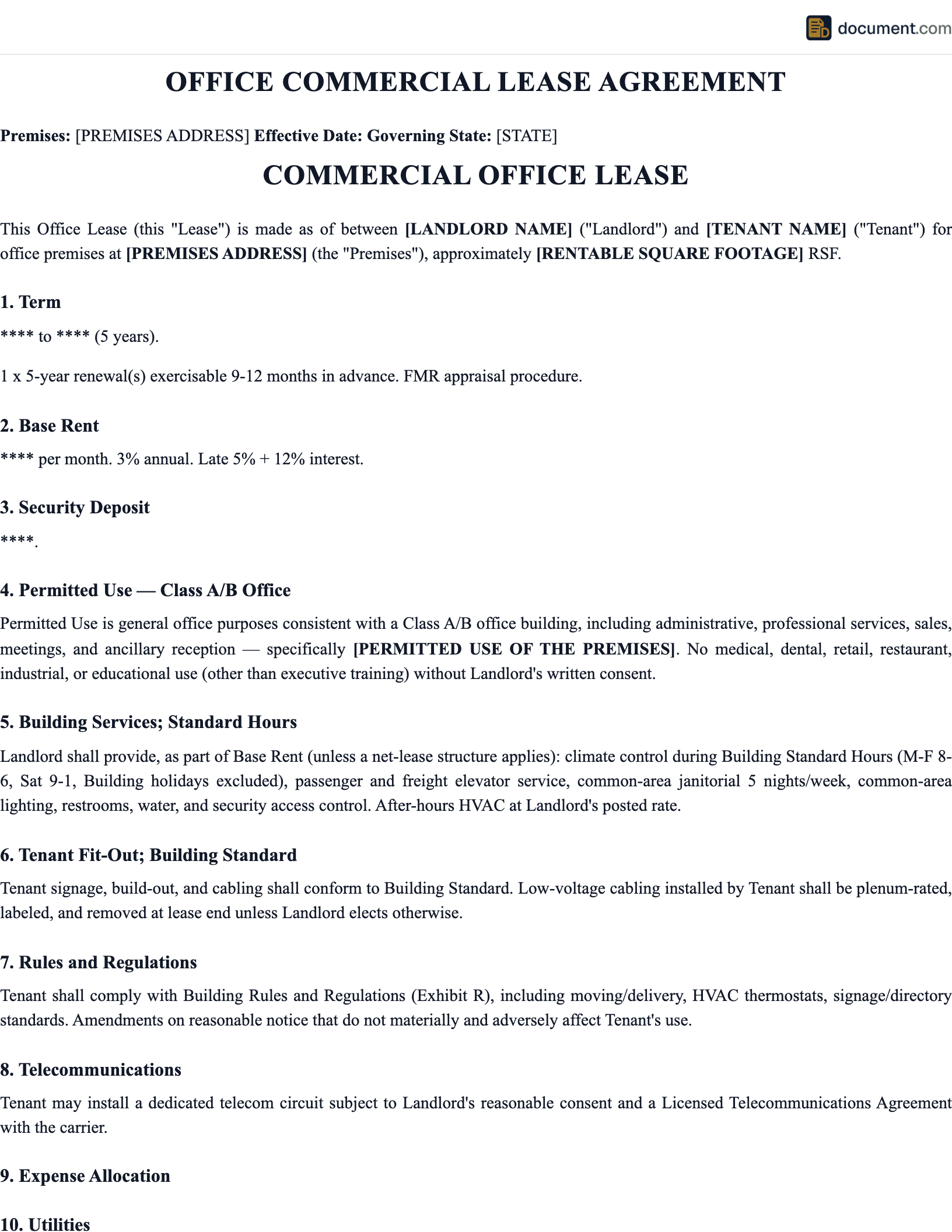
Below is a preview of our South Dakota-specific template. Your customized document will include all fields and provisions required for filing in any South Dakota county.
OFFICE SPACE LEASE AGREEMENT
STATE OF SOUTH DAKOTA
Legal Document Template
LANDLORD
Name: [Full Legal Name / Entity]
Address: [Management Office Address]
Contact: [Property Manager Name]
TENANT
Name: [Business Entity Name]
Address: [Current Business Address]
Tax ID: [EIN]
Guarantor: [If Applicable]
PREMISES
Building: [Building Name/Address]
Suite: [Number]
Floor: [Floor Number]
RSF: [Rentable Square Feet]
USF: [Usable Square Feet]
FINANCIAL TERMS
Base Rent: $[Amount]/RSF/year
TI Allowance: $[Amount]/RSF
Expense Stop: $[Amount]/RSF
Parking: [# Spaces]
Deposit: $[Amount]
Important Considerations for South Dakota Office Leases
No Tenant Protections Beyond the Contract
South Dakota provides commercial tenants with essentially no statutory safety net. If a landlord fails to maintain common areas, cuts HVAC in winter, or disputes the security deposit return, the tenant's remedy is whatever the lease says. This makes thorough upfront drafting non-negotiable.
Financial Services Tenant Profile
Sioux Falls office buildings that cater to financial services, credit card, and banking tenants often have more sophisticated lease structures. These tenants frequently bring national real estate counsel to the table, so landlords negotiating with them should expect detailed riders and extensive ADA, data security, and signage provisions.
Cold Climate Provisions Are Material
South Dakota winters are among the harshest in the lower 48 states. An office lease that is silent on who pays for heating during a building HVAC failure, or what happens when a burst pipe closes the premises, creates real financial and operational risk for tenants. Business interruption provisions and landlord repair timelines matter here in a way they simply do not in warmer states.
Build-Out and TI Allowance Timing
Supply chain and contractor availability issues have made build-out timelines less predictable in Sioux Falls. Office leases should include a clear rent commencement date tied to substantial completion of tenant improvements, not just possession, with defined consequences if the landlord delivers late.
South Dakota Office Space Lease Agreement FAQ
Common questions about commercial office leases in South Dakota, covering security deposits, CAM, holdover, taxes, and lease execution.
Official South Dakota Resources
Use these official state resources to verify requirements, find your local filing office, and access government forms for South Dakota.
Related South Dakota Documents
Depending on your situation, you may need additional documents alongside your South Dakota office space lease agreement.
Create your South Dakota Commercial Office Lease Agreement in under 5 minutes.
Answer a few questions and download a South Dakota-compliant document, ready for the state agency.