



South Carolina Office Space Lease Agreement Overview
South Carolina's commercial office market is defined by three distinct regional economies. Charleston is a coastal market with constrained inventory, strong tourism and hospitality sector demand, and a growing technology cluster anchored by the Boeing facility and a wave of remote workers relocating from higher-cost metros. Columbia operates as the state government and University of South Carolina hub, with demand concentrated in professional services, healthcare, and state contracting. Greenville has become the Upstate's breakout market, driven by BMW's regional presence and an influx of advanced manufacturing headquarters. Each market has materially different rent levels, building stock characteristics, and lease dynamics.
South Carolina has no specific commercial tenant protection statute. Commercial office leases are governed by general contract law and the South Carolina Code of Laws, with the residential Landlord and Tenant Act (S.C. Code Section 27-40-410 et seq.) explicitly excluded from commercial transactions. This means security deposit caps, rent escalation limits, and habitability standards are entirely negotiated terms. Charleston office tenants face the additional complexity of historic district regulations that can affect improvement rights and permitting, and coastal tenants everywhere in the state should address hurricane force majeure and casualty provisions with care.
3 Markets
Charleston, Columbia, Greenville
No Cap
Security deposit
Contract
Law governs
6%
SC sales tax (not on rent)
South Carolina Requirements
South Carolina commercial office leases must be in writing for terms exceeding one year under the state's statute of frauds (S.C. Code Section 32-3-10). There is no commercial tenant protection statute in South Carolina, so the lease document is the tenant's primary protection. Include all material terms explicitly, particularly those affecting CAM costs, improvement rights, holdover rates, and storm casualty obligations in coastal markets.
Charleston Historic District and Coastal Storm Provisions
Charleston office tenants in historic district buildings should confirm which modifications require approval from the Board of Architectural Review before signing, particularly for signage, exterior HVAC equipment, and facade changes. Separately, all coastal South Carolina office tenants should carefully review force majeure, casualty, and rent abatement provisions to ensure adequate protection during hurricane events. CAM definitions that include storm preparation and restoration costs should be capped or excluded from annual CAM increases.
Key Lease Provisions
- Written agreement: Required for terms over one year under S.C. Code Section 32-3-10; include all material terms since no SC commercial tenant statute provides fallback protections
- Security deposit: No SC statutory cap for commercial leases; Charleston Class A market typically requests 3 to 6 months, Columbia and Greenville typically 2 to 3 months; negotiate return timeline and withholding conditions explicitly
- CAM caps and audit rights: Negotiate annual CAM increase caps (3 to 5 percent); exclude capital improvements and landlord administrative fees; include audit right with 90 to 180 day lookback after each annual statement
- Coastal casualty provisions: Include hurricane force majeure clause, rent abatement during unusable periods, and termination right if landlord fails to restore within a defined period; confirm insurance obligations for wind and flood coverage
- Holdover rate: Specify 125 to 150 percent of final month's base rent; SC law treats holdover tenants as periodic tenants at original rent without an explicit holdover clause
- ADA and improvement rights: Allocate ADA compliance costs between landlord (common areas) and tenant (tenant improvement areas); address Board of Architectural Review approval obligations for Charleston historic district buildings
How to Execute a South Carolina Office Lease
South Carolina office lease transactions follow a negotiation process similar to other Southeastern markets, but with Charleston-specific complexity around historic district approvals and coastal risk provisions that require extra diligence.
Define Market and Building Requirements
Charleston, Columbia, and Greenville are each distinct markets with different rent levels, building quality, and tenant profiles. Charleston Class A downtown runs $32 to $45 per RSF annually; Columbia ranges from $20 to $30; Greenville has been tightening and now runs $22 to $35 for Class A. Identify your preferred submarket and confirm zoning for your specific use before engaging landlords. For Charleston historic district buildings, flag any planned improvements early, as Board of Architectural Review approvals can affect timeline and cost.
Issue Letter of Intent with SC-Specific Economic Terms
Include base rent, lease term, TI allowance (Charleston Class A build-outs typically run $40 to $75 per RSF), CAM cap methodology, holdover rate, deposit amount, and any renewal or expansion options. For coastal markets, note your expectation that the LOI will include hurricane force majeure and rent abatement provisions in the final lease. Charleston landlords increasingly expect this language from sophisticated tenants.
Draft with SC-Specific Provisions
Address the holdover rate explicitly at 125 to 150 percent of final-month base rent, CAM definitions that cap or exclude storm preparation and restoration costs for coastal properties, ADA compliance allocation, and permitted use language that matches your actual business activities. For Columbia government contractors, confirm that the permitted use covers any regulated activities and that the landlord's consent process for subletting is workable given federal contract assignment restrictions.
Legal Review and Execution
Have a South Carolina commercial real estate attorney review the lease before signing. The South Carolina Bar Lawyer Referral Service can connect you with attorneys experienced in Charleston, Columbia, or Greenville commercial transactions. Execute with authorized signatories for both parties, and for recording purposes confirm whether the county Register of Deeds requires a witness and notarization on the memorandum of lease, if you elect to record.
Optional Recording with Register of Deeds
Commercial leases in South Carolina do not require recording to be enforceable between the parties, but long-term tenants with purchase options or significant improvement investments should consider recording a memorandum of lease with the county Register of Deeds to provide constructive notice to subsequent purchasers or lenders. Recording fees in South Carolina are based on consideration rather than a flat per-page rate, so confirm current fee schedules with the applicable county office before recording.
South Carolina Tax Implications for Office Tenants
South Carolina imposes no commercial rent tax on office lease payments. The state's 6 percent sales tax applies to tangible personal property and certain services but not to commercial real property rent. Office tenants should confirm whether any services bundled into their lease, such as conference room access, parking, or technology infrastructure, are separately subject to SC sales tax based on how the landlord structures the billing. Property tax passthroughs are the main ongoing tax-related cost variable in SC commercial leases, particularly in Charleston where municipal property tax rates affect CAM costs for NNN tenants.
| Cost / Fee | Amount |
|---|---|
| Base rent (Charleston Class A) | $32 - $45 per RSF annually |
| Base rent (Columbia / Greenville Class A) | $20 - $35 per RSF annually |
| SC commercial rent tax | None |
| Property tax passthrough (NNN leases) | Varies; negotiate annual CAM cap of 3-5% |
| TI allowance (Charleston Class A build-out) | $40 - $75 per RSF |
| Security deposit | 2 - 6 months' gross rent (no SC cap) |
| Attorney review | $750 - $3,000 typical for SC commercial leases |
Important Considerations for South Carolina Office Tenants
Charleston's historic district constraints are genuinely distinctive. Buildings in the Old and Historic Charleston District and the Old City District are subject to Board of Architectural Review oversight that can affect signage placement, exterior HVAC installation, and facade modifications. Tenants in historic buildings who plan any exterior-visible improvements should start the BAR approval process before lease execution, not after, since approval timelines can run months and could delay occupancy or force redesign of build-out plans.
The coastal storm risk in Charleston and the broader Lowcountry is a real operational consideration. Leases should address not just hurricane force majeure but the practical scenario of extended business disruption following a storm: how quickly must the landlord commence restoration, what is the tenant's rent abatement right during periods of reduced or no access, and at what point does the tenant have the right to terminate rather than wait indefinitely for repairs. Review your business interruption insurance coverage alongside your lease obligations, and confirm that the landlord's property insurance covers wind and flood, not just fire.
Greenville is worth watching separately from Charleston and Columbia. The BMW manufacturing presence and growing professional services sector have driven significant Class A absorption in recent years, and Greenville's office market is now competitive enough that tenants can no longer assume as much negotiating leverage as they might have had five years ago. Renewal options, expansion rights, and right-of-first-offer clauses on adjacent space have become important protections for growing Greenville tenants who want to secure long-term position in a building without committing to more space than they need today.
Sample South Carolina Office Space Lease Agreement
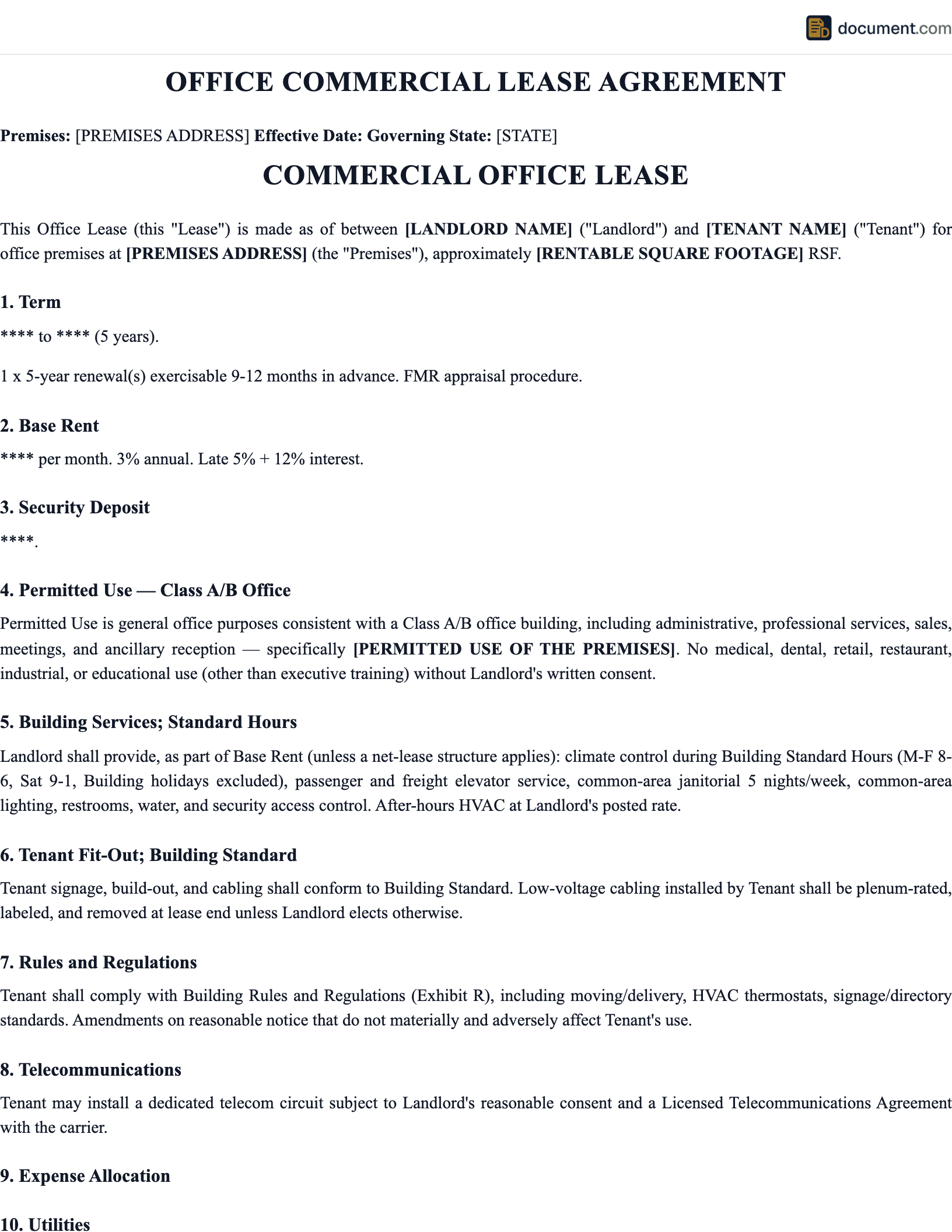
Below is a preview of our South Carolina-specific template. Your customized document will include all fields and provisions required for filing in any South Carolina county.
OFFICE SPACE LEASE AGREEMENT
STATE OF SOUTH CAROLINA
Legal Document Template
LANDLORD
Name: [Full Legal Name / Entity]
Address: [Management Office Address]
Contact: [Property Manager Name]
TENANT
Name: [Business Entity Name]
Address: [Current Business Address]
Tax ID: [EIN]
Guarantor: [If Applicable]
PREMISES
Building: [Building Name/Address]
Suite: [Number]
Floor: [Floor Number]
RSF: [Rentable Square Feet]
USF: [Usable Square Feet]
FINANCIAL TERMS
Base Rent: $[Amount]/RSF/year
TI Allowance: $[Amount]/RSF
Expense Stop: $[Amount]/RSF
Parking: [# Spaces]
Deposit: $[Amount]
South Carolina Office Space Lease Agreement FAQ
Answers to common questions about filing a office space lease agreement in South Carolina, including requirements, fees, and procedures.
Official South Carolina Resources
Use these official state resources to verify requirements, find your local filing office, and access government forms for South Carolina.
Related South Carolina Documents
Depending on your situation, you may need additional documents alongside your South Carolina office space lease agreement.
Create your South Carolina Commercial Office Lease Agreement in under 5 minutes.
Answer a few questions and download a South Carolina-compliant document, ready for the state agency.