
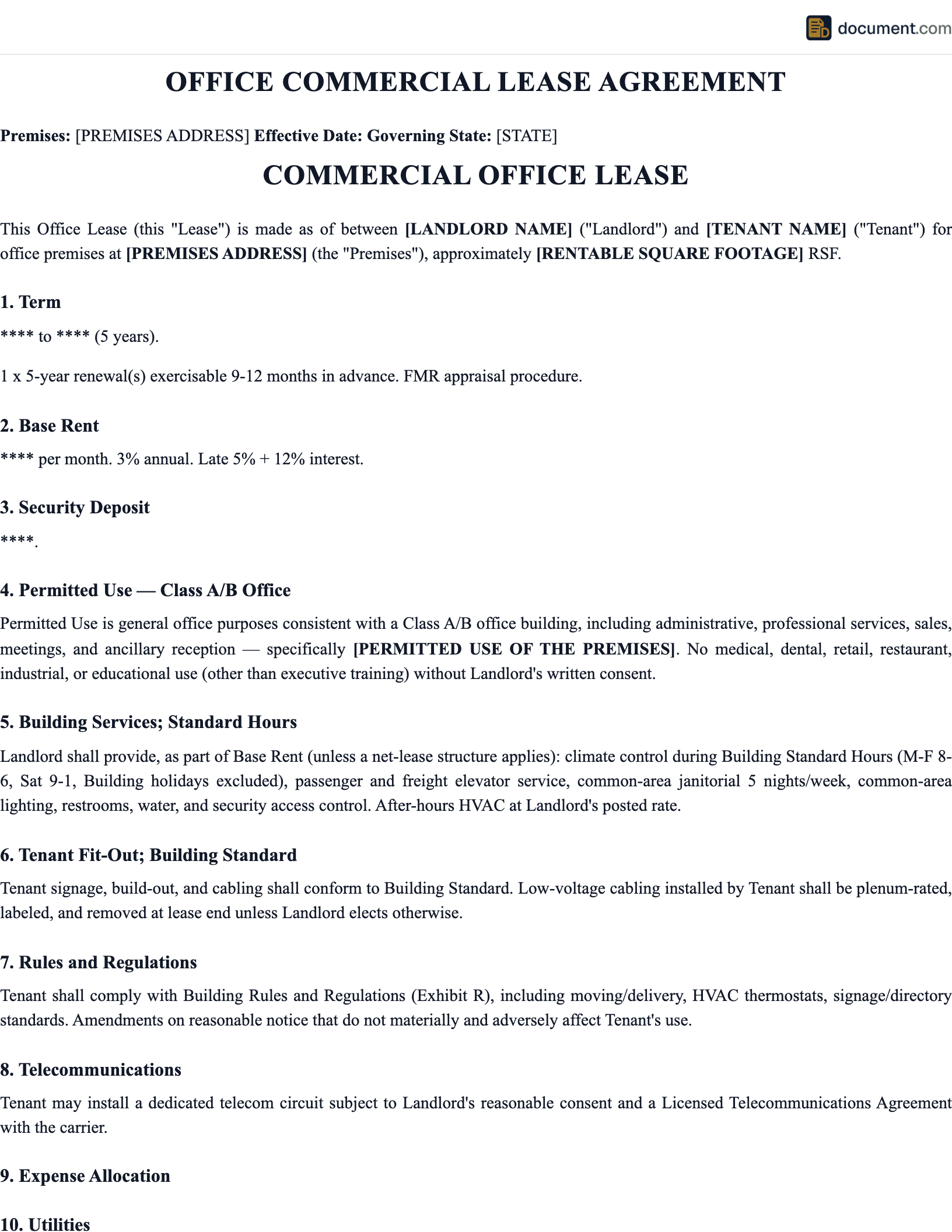



Rhode Island Office Space Lease Agreement Overview
Rhode Island is the smallest state by area, but its commercial office market punches above its weight. Providence is the only true metro, and proximity to Boston shapes everything: businesses that might occupy Class A space in Boston often land in Providence at 40 to 60 percent of the rent, while still drawing from a workforce anchored by Brown University, the Rhode Island School of Design, and Providence College. The Capital Center District and the I-195 Redevelopment District are the two growth nodes that define modern Providence office demand, particularly for life sciences and biotech tenants seeking proximity to Brown and Rhode Island Hospital. Outside Providence, Warwick and East Providence offer suburban alternatives, but the market is thin enough that a single large tenant can meaningfully move vacancy rates.
Rhode Island has no dedicated commercial tenant protection statute. Commercial leases are governed by general contract law and the Rhode Island General Laws covering property and conveyancing. The residential-specific Rhode Island Residential Landlord and Tenant Act (RIGL Chapter 34-18) does not apply to commercial transactions. That means security deposits, rent escalations, permitted use restrictions, and holdover rates are entirely a matter of negotiation. Because the market is small and deals are relationship-driven, landlords in Providence often have less leverage than their counterparts in major markets, but tenants should not assume favorable terms will arise automatically without diligent negotiation.
No Cap
Security deposit
Contract
Law governs
Providence
Primary market
No Tax
Commercial rent tax
Rhode Island Requirements
Rhode Island commercial office leases are governed by general contract principles. There is no commercial-specific landlord-tenant code, which means the lease document itself must be thorough: anything not addressed in writing defaults to whatever a Rhode Island court would imply from common law and custom, which may not favor either party. Well-drafted RI office leases address security deposits, CAM definitions and audit rights, holdover rates, permitted use precision, and HVAC responsibility explicitly.
Rhode Island Statute of Frauds
Under Rhode Island General Laws, leases for more than one year must be in writing to be enforceable (RIGL Section 9-1-4). This applies to all commercial office leases extending beyond twelve months. Recording is not mandatory for most commercial leases, but a memorandum of lease can be recorded with the City or Town Recorder to provide constructive notice to third parties, particularly for long-term tenants who have negotiated options to renew or purchase.
Key Lease Provisions
- Written agreement: Required for all terms exceeding one year under RIGL Section 9-1-4; negotiate all material terms in the lease document itself
- Security deposit: No statutory cap for commercial leases; market practice in Providence runs two to four months' gross rent depending on credit quality
- CAM and property tax passthrough: Providence property taxes are among the highest in New England; negotiate annual CAM increase caps (typically 3 to 5 percent) and audit rights with 90-day lookback
- ADA compliance allocation: Federal ADA applies; supplement with Rhode Island Accessibility Requirements Act (RIGL Chapter 37-8); negotiate which party bears cost for alterations to common areas versus tenant improvements
- Holdover rate: Specify an agreed holdover rate (125 to 150 percent of base rent is market standard) to avoid indefinite month-to-month exposure under RI common law
- Permitted use: Be specific about regulated industries; healthcare and life sciences tenants in the I-195 District should ensure the permitted use clause covers lab operations, patient-facing activities, or research protocols as applicable
How to Execute a Rhode Island Office Lease
Rhode Island office leases follow a negotiation and execution process similar to other New England markets, though the state's small size and relationship-driven brokerage community means deals often move more informally than in Boston or Hartford. Here is how to approach the process carefully.
Define Your Submarket and Building Requirements
Identify whether you need Providence Capital Center (financial and professional), the I-195 Redevelopment District (life sciences, biotech, university-adjacent), or suburban Warwick and East Providence (lower cost, highway access). Building class matters more in RI than in larger metros because the Class A inventory is thin, and Class B buildings dominate the market.
Issue a Letter of Intent with RI-Specific Economic Terms
Include base rent per RSF, lease term, tenant improvement allowance (Providence market typically $30 to $60 per RSF for build-out), CAM cap methodology, holdover rate, security deposit amount, and any options to renew or expand. Providence landlords generally negotiate LOI terms more flexibly than institutional landlords in Boston, but get key economic points in the LOI before the lease draft stage.
Draft with Rhode Island-Specific Provisions
Address Providence property tax passthroughs explicitly (rates are high relative to other RI municipalities), include a CAM audit right, define the holdover rate at 125 to 150 percent of final-month base rent, and address RIGL Chapter 37-8 accessibility compliance allocation. If the space is in the I-195 District or subject to the I-195 Redevelopment District Commission regulations, include any applicable regulatory compliance obligations in the permitted use section.
Legal Review and Execution
Have a Rhode Island commercial real estate attorney review the lease before signing. The Rhode Island Bar Association referral service can connect you with attorneys experienced in Providence commercial transactions. Execute with authorized signatories for both parties; corporate tenants should ensure the signing officer has board authority, and include entity formation documents if the landlord requests them as part of credit underwriting.
Optional Recording and Document Retention
Recording is not required for commercial leases in Rhode Island, but long-term tenants (10 years or more) or those with purchase options should consider recording a memorandum of lease with the Providence City Recorder or applicable town's land evidence records office. Recording fees are modest, and notice of occupancy protects against subsequent liens or transfers affecting your tenancy.
Rhode Island Tax Implications for Office Tenants
Rhode Island imposes no commercial rent tax or sales tax on office rent payments, which simplifies the tax picture compared to states like Florida or Connecticut. The primary tax concern for RI office tenants is property tax passthrough, which can be significant in Providence where rates are among the highest in New England. CAM charges typically include property tax recovery, so understanding the base year, exclusions, and audit rights is essential before signing.
| Cost / Fee | Amount |
|---|---|
| Base rent (Providence Class A) | $20 - $34 per RSF annually |
| Base rent (Providence Class B / suburban) | $13 - $22 per RSF annually |
| RI commercial rent tax | None |
| Providence property tax passthrough | Varies; negotiate annual CAM cap of 3-5% |
| Security deposit | 2 - 4 months' gross rent (no statutory cap) |
| Tenant improvement allowance | $30 - $60 per RSF for Providence build-outs |
| Attorney review | $750 - $2,500 typical for RI commercial leases |
Important Considerations for Rhode Island Office Tenants
The I-195 Redevelopment District deserves specific attention. Since the relocation of Interstate 195 freed up 19 acres of land adjacent to Brown University and Rhode Island Hospital, Providence has been building a deliberate life sciences and innovation corridor. Tenants in this district may be subject to I-195 Redevelopment District Commission design and use approvals that go beyond standard zoning, and life sciences tenants should confirm that their intended laboratory or research use is compatible with the district's development agreements before committing to a lease.
Providence property taxes are a real cost driver. The city's tax rate on commercial property is substantially higher than surrounding communities like East Providence or Warwick, and many Providence commercial leases pass property taxes through as a CAM component. Tenants should request the prior three years of actual CAM reconciliations before signing, push for a hard cap on annual CAM increases, and negotiate an audit right allowing them to review the landlord's supporting records within 90 to 180 days after each annual statement.
Rhode Island is a small, tight market where personal guarantees are common for smaller tenants and early-stage companies. If the landlord requires a personal guarantee, negotiate a burn-off provision that reduces or eliminates the guarantee after 12 to 24 months of on-time payment, or after the tenant achieves a revenue or asset threshold. The Boston proximity dynamic also means that rapidly growing RI tenants often face pressure to relocate to larger Boston-area space mid-lease; negotiate an early termination right tied to specific growth milestones if your space needs are likely to change significantly during the term.
Sample Rhode Island Office Space Lease Agreement
Below is a preview of our Rhode Island-specific template. Your customized document will include all fields and provisions required for filing in any Rhode Island county.
OFFICE SPACE LEASE AGREEMENT
STATE OF RHODE ISLAND
Legal Document Template
LANDLORD
Name: [Full Legal Name / Entity]
Address: [Management Office Address]
Contact: [Property Manager Name]
TENANT
Name: [Business Entity Name]
Address: [Current Business Address]
Tax ID: [EIN]
Guarantor: [If Applicable]
PREMISES
Building: [Building Name/Address]
Suite: [Number]
Floor: [Floor Number]
RSF: [Rentable Square Feet]
USF: [Usable Square Feet]
FINANCIAL TERMS
Base Rent: $[Amount]/RSF/year
TI Allowance: $[Amount]/RSF
Expense Stop: $[Amount]/RSF
Parking: [# Spaces]
Deposit: $[Amount]
Rhode Island Office Space Lease Agreement FAQ
Answers to common questions about filing a office space lease agreement in Rhode Island, including requirements, fees, and procedures.
Official Rhode Island Resources
Use these official state resources to verify requirements, find your local filing office, and access government forms for Rhode Island.
Related Rhode Island Documents
Depending on your situation, you may need additional documents alongside your Rhode Island office space lease agreement.
Create your Rhode Island Commercial Office Lease Agreement in under 5 minutes.
Answer a few questions and download a Rhode Island-compliant document, ready for the state agency.