



Pennsylvania Office Space Lease Agreement Overview
Pennsylvania has two major commercial office markets that operate very differently. Philadelphia is one of the largest office markets on the East Coast, anchored by financial services, law, healthcare, and a rapidly growing biotech cluster around University City and the Navy Yard. Center City Philadelphia commands some of the highest office rents in the Mid-Atlantic region, particularly for Class A space with modern amenities. Pittsburgh has undergone a major economic transition, shifting from steel to technology, healthcare, autonomous vehicle research, and robotics, which has driven demand for modern office space in the Downtown Golden Triangle and the Strip District. Pennsylvania has no specific commercial tenant protection statute, making the negotiated lease terms essentially the entire legal framework for the tenancy.
Pennsylvania commercial office leases are governed by general contract law and the Landlord and Tenant Act of 1951, which applies some baseline provisions but primarily defers to the parties' negotiated terms for commercial relationships. Philadelphia's high property tax rates mean that net lease structures with property tax passthroughs are particularly significant cost items for tenants to understand and negotiate. Philadelphia's biotech sector has also created demand for lab-office hybrid space with specialized infrastructure needs that require custom lease provisions beyond what standard office templates address.
$188.50
Filing fee
Required
Notarization
0
Witnesses required
Recorder
Filing office
Pennsylvania Requirements
Pennsylvania has specific requirements for this type of legal document. Meeting these requirements ensures your document is accepted by the recorder of deeds and is legally enforceable.
Pennsylvania Commercial Office Lease Note
Pennsylvania has no specific commercial tenant protection statute. Commercial leases are governed by general contract law and the Pennsylvania Landlord and Tenant Act of 1951, which primarily defers to negotiated terms. The statute of frauds requires leases over three years to be in writing (68 P.S. Section 250.202). Philadelphia's high real estate tax rates make property tax passthrough provisions particularly significant cost items for tenants to review carefully.
Key Lease Provisions for Pennsylvania Office Tenants
- Written Agreement: Pennsylvania statute of frauds (68 P.S. Section 250.202) requires leases over three years to be in writing; best practice is to put all commercial leases in writing regardless of term
- Philadelphia Property Tax Passthrough: Philadelphia real estate taxes are among Pennsylvania's highest; negotiate a base year, annual cap on increases, and audit rights for tax reconciliation
- Security Deposit: No Pennsylvania statutory cap for commercial leases; negotiate amount, return timeline (30 days is standard), and itemized accounting requirement for deductions
- ADA and Pennsylvania Accessibility: Pennsylvania Uniform Construction Code enforces federal ADA standards; permit-triggering build-outs may require path of travel accessibility upgrades
- Lab-Office Hybrid Provisions: Philadelphia biotech tenants need explicit provisions covering lab HVAC, electrical capacity, hazardous waste compliance, and restoration obligations under Pennsylvania DEP standards
- Holdover Rate: Pennsylvania treats commercial holdover as month-to-month absent a lease provision; specify an express holdover rate of 125 to 150 percent of final base rent to discourage overstaying
How to Execute a Pennsylvania Office Lease
Pennsylvania commercial office leases are executed as contracts, not government filings. These steps reflect best practice for Philadelphia and Pittsburgh office lease transactions.
Negotiate the Letter of Intent
Establish key economic terms in a non-binding letter of intent: base rent, rent escalation schedule, term, tenant improvement allowance, security deposit, and renewal options. Philadelphia biotech tenants should include lab infrastructure parameters in the LOI. Pittsburgh tenants should establish whether the lease structure is gross or net before LOI execution.
Draft with Pennsylvania-Specific Provisions
Include property tax passthrough provisions with a Philadelphia base year and annual cap, CAM audit rights, an express holdover rate, ADA compliance allocation, and a governing law clause specifying Pennsylvania law and the applicable county court venue. Biotech tenants should include lab infrastructure provisions and Pennsylvania DEP compliance obligations.
Conduct Legal Review
Pennsylvania commercial leases, particularly in Philadelphia, involve complex financial terms and property tax provisions. Have a Pennsylvania commercial real estate attorney review the lease before signing. Philadelphia Bar Association and Allegheny County Bar Association maintain attorney referral services.
Execute the Lease
Both parties execute the lease with authorized signatures. Pennsylvania's statute of frauds requires a written agreement for leases over three years. Notarization is not required for enforceability between the parties but is needed if you want to record a memorandum of lease with the Pennsylvania Recorder of Deeds.
Consider Optional Recording
For leases of five years or longer, recording a memorandum of lease with the Pennsylvania Recorder of Deeds in the county where the property is located protects the tenant against subsequent buyers and lenders. Philadelphia County recording fees include a base recording fee plus the Philadelphia Realty Transfer Tax if applicable (commercial leases exceeding 30 years may trigger this tax).
Tax Implications for Pennsylvania Office Tenants
Pennsylvania and Philadelphia both impose taxes that significantly affect commercial office tenancy costs. Understanding these before signing a lease in Philadelphia or Pittsburgh is essential for accurate occupancy cost budgeting.
| Tax / Cost Item | Notes |
|---|---|
| Pennsylvania Sales Tax on Rent | Pennsylvania does not impose a general commercial rent tax |
| Philadelphia Property Tax Passthrough | High Philadelphia real estate tax rates make this a major cost in NNN and modified gross leases; negotiate base year and annual cap |
| Philadelphia Business Income and Receipts Tax (BIRT) | Applies to businesses conducting operations in Philadelphia; not a rent tax but affects total occupancy cost planning |
| Philadelphia Realty Transfer Tax | Commercial leases exceeding 30 years (including options) may trigger this tax; structure lease terms carefully |
| Attorney Review | $750 - $3,500 depending on lease complexity; higher for Philadelphia lab-office hybrid leases |
Important Considerations for Pennsylvania Office Leases
Philadelphia's historic building stock creates distinctive leasing considerations that newer Sun Belt markets do not face. Many Center City office buildings are historic structures with limited floor plate sizes, older HVAC systems, and lower electrical capacity than modern builds. Tenants doing technology-intensive work or requiring significant cooling for server rooms should audit building infrastructure before committing to a lease. The historic preservation overlay on some Center City buildings may also restrict the scope of build-out modifications that are otherwise contractually permitted.
Pittsburgh's office market is evolving rapidly with the Strip District emerging as a hub for tech and AI tenants attracted by Carnegie Mellon University proximity and relatively affordable rents compared to the Golden Triangle. Pittsburgh landlords in this submarket are generally willing to offer tenant-friendly terms, including strong TI allowances and reasonable CAM structures, to attract quality tech tenants. Negotiating a right of first offer on adjacent expansion space is particularly valuable in Pittsburgh given the growth trajectory of technology tenants.
Pennsylvania's court of common pleas handles commercial lease disputes, and Pennsylvania commercial landlords have access to a relatively efficient confession of judgment mechanism (cognovit note) that can be included in commercial lease documents to allow landlords to obtain judgment without full trial proceedings. Tenants should understand whether the lease they are signing contains a confession of judgment clause, which is enforceable in Pennsylvania commercial transactions, and negotiate its deletion or limitation where possible.
Sample Pennsylvania Office Space Lease Agreement
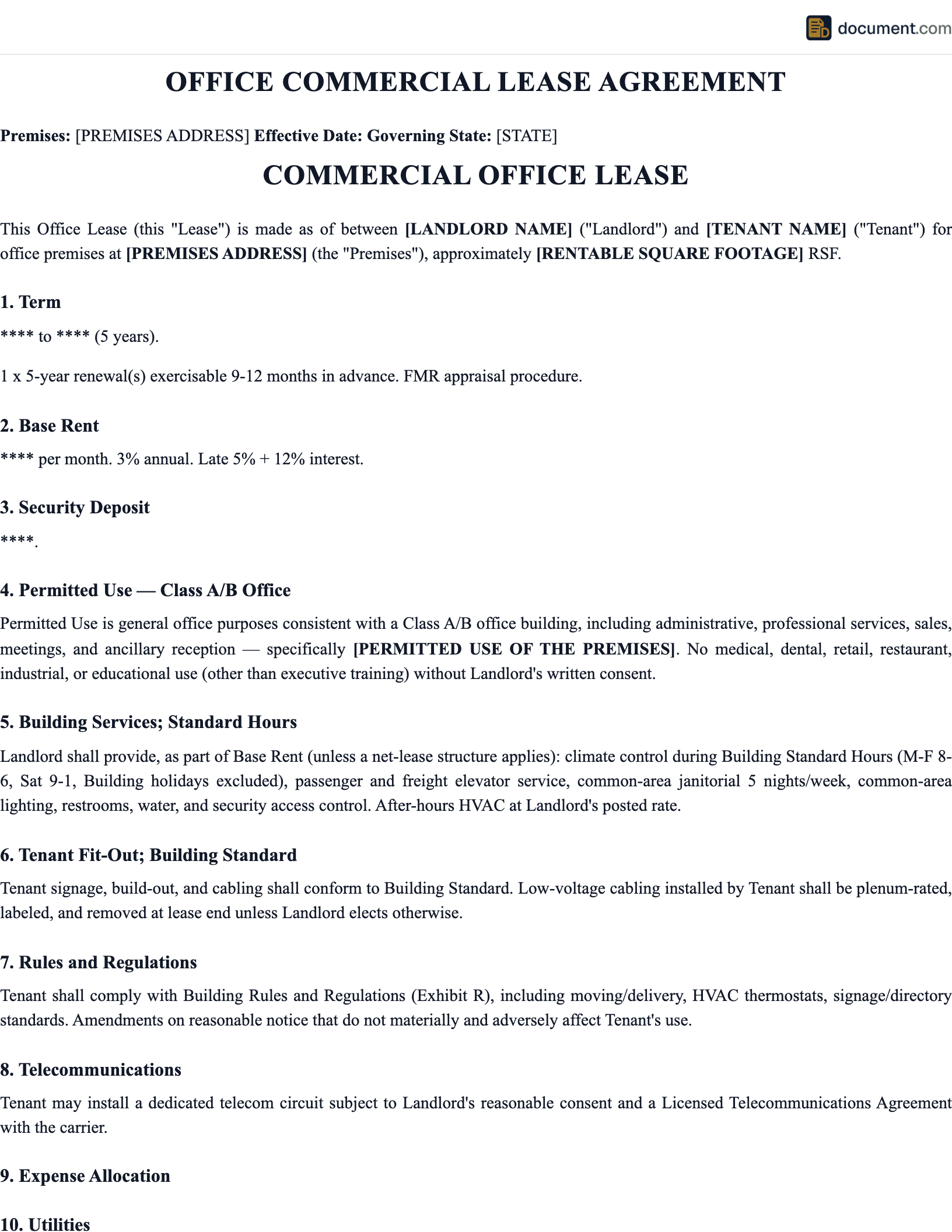
Below is a preview of our Pennsylvania-specific template. Your customized document will include all fields and provisions required for filing in any Pennsylvania county.
OFFICE SPACE LEASE AGREEMENT
STATE OF PENNSYLVANIA
Legal Document Template
LANDLORD
Name: [Full Legal Name / Entity]
Address: [Management Office Address]
Contact: [Property Manager Name]
TENANT
Name: [Business Entity Name]
Address: [Current Business Address]
Tax ID: [EIN]
Guarantor: [If Applicable]
PREMISES
Building: [Building Name/Address]
Suite: [Number]
Floor: [Floor Number]
RSF: [Rentable Square Feet]
USF: [Usable Square Feet]
FINANCIAL TERMS
Base Rent: $[Amount]/RSF/year
TI Allowance: $[Amount]/RSF
Expense Stop: $[Amount]/RSF
Parking: [# Spaces]
Deposit: $[Amount]
Pennsylvania Office Space Lease Agreement FAQ
Answers to common questions about filing a office space lease agreement in Pennsylvania, including requirements, fees, and procedures.
Official Pennsylvania Resources
Use these official state resources to verify requirements, find your local filing office, and access government forms for Pennsylvania.
Related Pennsylvania Documents
Depending on your situation, you may need additional documents alongside your Pennsylvania office space lease agreement.
Create your Pennsylvania Commercial Office Lease Agreement in under 5 minutes.
Answer a few questions and download a Pennsylvania-compliant document, ready for the state agency.