



Oklahoma Office Space Lease Agreement Overview
Oklahoma is a strongly landlord-favorable state for commercial real estate. There is no specific commercial tenant protection statute in Oklahoma, which means the negotiated lease terms govern nearly every aspect of the relationship. The two primary office markets are Oklahoma City and Tulsa, and they behave quite differently. Oklahoma City's energy corridor along North Lincoln Boulevard and the Midtown district sees demand driven by oil, gas, and now wind energy companies. Tulsa's office market is more diversified, with aerospace, healthcare, and financial services tenants filling older Class B and C inventory downtown alongside newer suburban product.
Because Oklahoma commercial leases are governed almost entirely by contract law, what you negotiate matters more than what statutes protect. Security deposits carry no cap, holdover terms are freely negotiated, and CAM reconciliation procedures are whatever the parties agree to. Oklahoma's relatively affordable commercial rents compared to coastal markets sometimes lead tenants to sign leases without full diligence on operating expense passthrough, HVAC maintenance responsibility, and build-out obligations. A well-drafted Oklahoma office lease addresses all of these points in specific detail, particularly if your business is in the energy sector where lease flexibility during commodity price downturns can be valuable.
$8
Filing fee
Required
Notarization
0
Witnesses required
County
Filing office
Oklahoma Requirements
Oklahoma has specific requirements for this type of legal document. Meeting these requirements ensures your document is accepted by the county clerk and is legally enforceable.
Oklahoma Commercial Lease Note
Oklahoma has no specific commercial tenant protection statute. Commercial leases are governed by general contract law under Oklahoma statutes Title 15 (Contracts) and Title 41 (Landlord and Tenant). The statute of frauds requires leases longer than one year to be in writing. Neither notarization nor recording is required for enforceability between the parties, but recording with the county clerk provides protection against subsequent encumbrances.
Key Lease Requirements
- Written Agreement: Required for any term exceeding one year under Oklahoma's statute of frauds (15 O.S. Section 136)
- Security Deposit: No statutory cap for commercial leases; negotiate amount, return timeline, and permitted deductions in writing
- CAM Provisions: Define the base year or base stop, controllable expense cap, and audit rights; Oklahoma courts enforce these as drafted
- Permitted Use: Oklahoma courts interpret permitted use clauses narrowly; energy industry tenants should define ancillary uses (lab space, equipment storage) explicitly
- Holdover Terms: Specify the holdover rent rate (typically 125-150% of final month base rent) and required notice period to avoid uncertain at-sufferance treatment
- ADA Compliance: Allocate federal ADA responsibilities between landlord (common areas) and tenant (leased premises improvements) in writing
How to Execute an Oklahoma Office Lease
Oklahoma does not require commercial leases to be recorded or filed with a government office to be enforceable between the parties. The execution process is a contract signing, not a filing. These steps reflect best practice for Oklahoma office lease transactions.
Negotiate the Letter of Intent
Oklahoma commercial transactions typically begin with a non-binding letter of intent covering the major economic terms: rent, term, TI allowance, security deposit, and renewal options. Agree on these before drafting the full lease.
Draft the Lease with Oklahoma-Specific Provisions
Include CAM audit rights, a controllable expense cap, an explicit holdover rate, permitted use language that accounts for your industry operations, and ADA allocation provisions. Energy sector tenants should address force majeure in detail.
Conduct Legal Review
Have an Oklahoma commercial real estate attorney review the lease before signing. Oklahoma City and Tulsa bar associations maintain referral services. Attorney review typically runs $500 to $2,500 depending on lease complexity.
Execute the Lease
Both parties execute the lease with authorized signatures. For leases over one year, Oklahoma's statute of frauds requires a written, signed agreement. Notarization is not required for enforceability but is needed if you plan to record the lease with the county clerk.
Consider Optional Recording
Recording a memorandum of lease with the Oklahoma county clerk provides constructive notice to third parties and protects the tenant against subsequent liens and encumbrances. This is advisable for leases of five years or longer. Recording fees run approximately $13 for the first page at most Oklahoma county clerks.
Oklahoma Fees & Costs
Below is a breakdown of the typical costs associated with filing this document in Oklahoma. Actual fees may vary by county.
| Fee / Cost | Amount |
|---|---|
| Filing Fee | $8 first page |
| Notarization | $5 - $25 per signature |
| Certified Copy | $1 - $10 per page |
| Attorney Review (optional) | $150 - $500 |
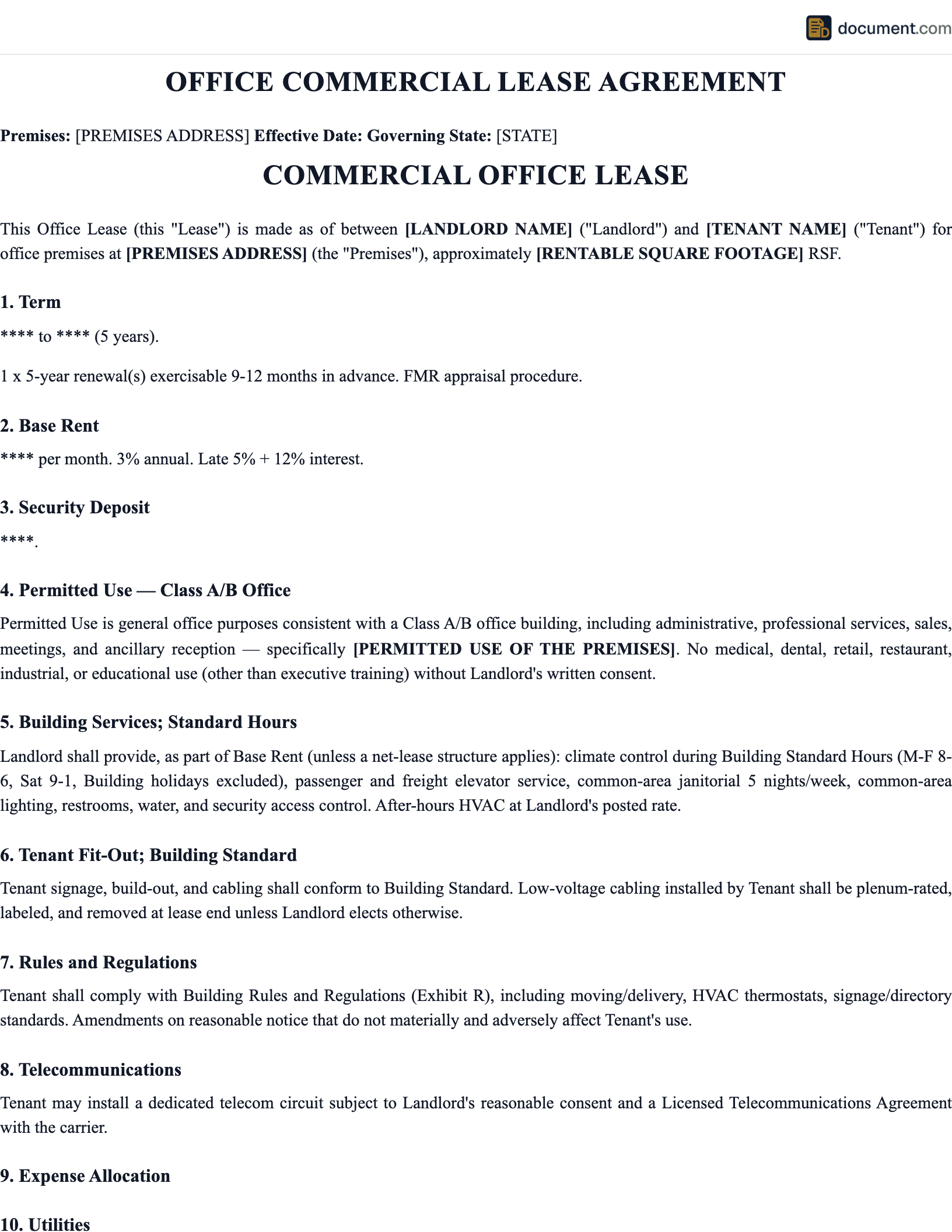
Sample Oklahoma Office Space Lease Agreement
Below is a preview of our Oklahoma-specific template. Your customized document will include all fields and provisions required for filing in any Oklahoma county.
OFFICE SPACE LEASE AGREEMENT
STATE OF OKLAHOMA
Legal Document Template
LANDLORD
Name: [Full Legal Name / Entity]
Address: [Management Office Address]
Contact: [Property Manager Name]
TENANT
Name: [Business Entity Name]
Address: [Current Business Address]
Tax ID: [EIN]
Guarantor: [If Applicable]
PREMISES
Building: [Building Name/Address]
Suite: [Number]
Floor: [Floor Number]
RSF: [Rentable Square Feet]
USF: [Usable Square Feet]
FINANCIAL TERMS
Base Rent: $[Amount]/RSF/year
TI Allowance: $[Amount]/RSF
Expense Stop: $[Amount]/RSF
Parking: [# Spaces]
Deposit: $[Amount]
Tax Implications for Oklahoma Office Tenants
Oklahoma does not impose a statewide commercial rent tax, which makes it more favorable than states like Florida or Texas in that respect. However, several tax pass-through mechanisms commonly appear in Oklahoma office leases and tenants should understand them.
Property tax passthrough is standard in triple-net and modified gross Oklahoma office leases. Landlords in Oklahoma City and Tulsa typically establish a base year property tax amount and pass increases to tenants proportionate to their rentable square footage. Oklahoma's ad valorem tax rates vary by county and can increase meaningfully when a property is reassessed after a sale. Negotiate a cap on year-over-year property tax increases passed to the tenant, or at minimum an audit right to verify the tax calculations.
CAM charges in Oklahoma office leases commonly include management fees (typically 3 to 5 percent of base rent), insurance premiums, janitorial services, HVAC maintenance, and parking structure upkeep. Negotiate to exclude capital expenditures from CAM, cap controllable expenses at 5 percent annual increases, and secure annual reconciliation statements with supporting documentation.
Tenant improvement allowances received from a landlord are generally not taxable income if they reduce the tenant's basis in the leasehold improvements. Consult an Oklahoma CPA regarding depreciation of build-out costs and the treatment of any cash TI allowance that exceeds actual construction spending.
Important Considerations for Oklahoma Office Leases
The Oklahoma City and Tulsa office markets operate differently enough that submarket research matters before you commit to lease terms. Oklahoma City's energy corridor submarkets tend to see demand spikes correlated with oil prices, while Tulsa's downtown has undergone significant revitalization investment that has tightened quality inventory. Understand your submarket's vacancy rate before accepting the landlord's first offer on rent or concessions.
Energy industry tenants specifically should negotiate HVAC provisions carefully. Oklahoma summers push Class B buildings hard, and older Tulsa and Oklahoma City stock sometimes has inadequate cooling capacity for dense workforces. Specify the HVAC maintenance responsibility, after-hours HVAC rates, and whether the building can support server room or lab cooling requirements before signing.
Personal guarantees are common in the Oklahoma office market, particularly for small and mid-size businesses without an established credit history in the state. Negotiate a guarantee burn-off provision where the personal guarantee reduces or terminates after two to three years of on-time payments. Oklahoma courts enforce personal guarantees robustly, so limiting exposure in the lease document is far easier than disputing a guarantee in litigation.
Oklahoma Office Space Lease Agreement FAQ
Answers to common questions about commercial office leases in Oklahoma, including market conditions, key provisions, and landlord-tenant law.
Official Oklahoma Resources
Use these official state resources to verify requirements, find your local filing office, and access government forms for Oklahoma.
Related Oklahoma Documents
Depending on your situation, you may need additional documents alongside your Oklahoma office space lease agreement.
Create your Oklahoma Commercial Office Lease Agreement in under 5 minutes.
Answer a few questions and download a Oklahoma-compliant document, ready for the state agency.