



Ohio Office Space Lease Agreement Overview
Ohio has three distinct major commercial office markets that operate quite differently from one another. Columbus is the state's economic engine and has the most dynamic office market, with tech companies, insurance giants, and financial services firms competing for space in the Short North, Arena District, and Easton. The Columbus market has remained competitive even as remote work has affected CBD occupancy nationally, largely because of the city's population growth and the presence of major employers like Nationwide, JPMorgan Chase, and a growing startup ecosystem. Cleveland's downtown has significant Class A inventory at rents that compare favorably to major coastal markets, with healthcare, legal, and professional services as the dominant tenant categories. Cincinnati is anchored by large consumer brands, financial institutions, and the growing Kenwood and Blue Ash suburban corridors, where tech and professional services firms have established significant suburban campus presences.
Ohio has no dedicated commercial tenant statute, and commercial office leases are governed by general contract law principles. Ohio courts enforce lease terms as written and give substantial weight to the negotiated agreement between sophisticated parties. There is no commercial rent control, no statutory cap on security deposits for commercial tenants, and no mandatory disclosure requirements unique to commercial office leases in Ohio beyond general fraud and misrepresentation principles. What this means practically is that the lease document itself is the primary source of your rights as a tenant, which makes careful negotiation and attorney review more important, not less, than in states with more regulatory frameworks.
$34
Filing fee
Required
Notarization
0
Witnesses required
County
Filing office
Ohio Requirements
Ohio's commercial office lease requirements come from the contract itself and general Ohio contract law principles. There is no statutory checklist of required provisions, which means thorough drafting is essential. These are the elements a well-structured Ohio office lease should contain.
Guaranty Requirements and CAM Structure Are Key Negotiating Points
Ohio landlords frequently require personal or corporate guaranties for commercial office leases, particularly for newer businesses or tenants without substantial credit history. Negotiate the guaranty scope carefully: a "good guy" clause that burns off personal liability when you vacate and hand over keys is significantly more favorable than an unconditional guaranty that survives the lease term. Separately, CAM structure and audit rights are important in Ohio where property tax increases in Franklin County (Columbus) have pushed CAM reconciliation amounts up significantly in recent years.
What an Ohio Office Lease Should Include
- Written agreement: Ohio's statute of frauds requires leases exceeding one year to be in writing. All commercial office leases should be written regardless of term, and signed by parties with actual authority to bind their respective entities.
- CAM structure and audit rights: Define whether the lease is gross, modified gross, or net. If operating expenses are passed through, specify what is included and excluded from CAM, negotiate a CAM cap on controllable expenses, and confirm audit rights so you can verify landlord-reported figures against actual costs.
- Tenant improvement work letter: Document the TI allowance amount per rentable square foot, the scope of landlord-funded work, the construction timeline, and what happens to unused allowance. Attach the work letter as a lease exhibit rather than leaving these terms in side email correspondence.
- SNDA agreement: If the building is mortgaged, request a Subordination, Non-Disturbance, and Attornment agreement from the lender before signing the lease. An SNDA protects your right to remain in the space if the landlord defaults on the mortgage and the lender forecloses.
- Parking provisions: Parking is a significant operational factor in Columbus's Arena District, Cleveland's CBD, and Cincinnati's downtown. Confirm the number of spaces, cost per space, whether spaces are reserved or unreserved, and what happens to parking availability if the building's parking structure is modified.
- Holdover and renewal notice provisions: Specify the holdover rate (typically 125 to 150 percent of base rent in Ohio) and the notice period required to exercise renewal options. Ohio courts enforce these provisions as written.
How to Execute an Ohio Office Lease
Ohio's three major office markets are competitive but approachable, and following a structured process from space search through execution reduces costly mistakes.
Engage a Tenant Broker
A tenant broker represents your interests at no cost to you (landlords pay broker commissions). In Columbus, Cleveland, and Cincinnati, tenant brokers have market data on available inventory, recent comparable leases, and landlord concession levels that give you a significant advantage in negotiations. Start the broker relationship three to six months before your lease expires or you need to occupy.
Submit a Letter of Intent Covering Key Economic Terms
Before a full lease draft, negotiate a letter of intent addressing base rent, rent escalation schedule, TI allowance, rent abatement period, parking, CAM structure, and renewal options. An LOI locks in the economic terms before either party incurs significant legal drafting costs, and it protects against terms being revised late in the negotiation process.
Review CAM History and Request Audit Rights
Before signing, request the prior two years of actual CAM reconciliation statements. Franklin County property tax increases and Cleveland CBD assessments have pushed CAM costs up for tenants in those markets. Negotiate a CAM cap on controllable expenses and confirm audit rights in the lease language itself, not just as a verbal assurance.
Obtain SNDA and Review Guaranty Scope
If the building is mortgaged, request an SNDA from the lender before signing. Separately, if a personal or corporate guaranty is required, negotiate a "good guy" clause that limits personal liability upon vacating and surrendering the space in good condition. Ohio courts enforce guaranty language strictly, and unlimited personal guaranties create substantial risk for business owners.
Execute with Authorized Signatories and Document Conditions
Sign the lease using the proper legal name of the tenant entity, supported by a corporate resolution or operating agreement if signing on behalf of an LLC or corporation. Photograph the space before move-in and attach a written condition exhibit to the lease. These steps matter when the lease ends and deposit disputes arise.
Tax Implications of an Ohio Office Lease
Ohio has no commercial rent tax, which keeps the baseline tax burden on office tenants relatively low. The relevant tax considerations are primarily federal, with Ohio-specific nuances worth understanding before signing.
| Tax / Cost Item | Notes |
|---|---|
| No commercial rent tax | Ohio does not impose a statewide tax on commercial rent. Tenants pay only base rent and any CAM charges without an additional rent tax layer, unlike states such as Florida that levy a direct tax on commercial leases. |
| Rent deductibility | Office rent paid for business purposes is deductible as a business expense for federal income tax and Ohio Commercial Activity Tax (CAT) purposes. Ohio's CAT taxes gross receipts rather than net income, and rent is not directly subject to CAT, but understanding your overall Ohio tax exposure helps with lease vs. buy decisions. |
| Property tax pass-through via CAM | Net and modified gross Ohio office leases typically pass real property taxes through as CAM. Franklin County (Columbus) and Cuyahoga County (Cleveland) have experienced property tax reassessments in recent years that have meaningfully increased CAM reconciliation amounts. Request the prior two years of actual statements before signing. |
| Tenant improvement allowance treatment | TI allowances received from a landlord may constitute taxable income depending on how the arrangement is structured. Work with a CPA to determine whether the TI should be treated as a lease incentive, a rental concession, or separately allocated improvement costs, as each has different federal and Ohio tax consequences. |
| Ohio municipal income taxes | Ohio municipalities levy their own income taxes, and your office location determines which municipality's tax applies to employee income earned there. Columbus levies a 2.5% municipal income tax. Cleveland's rate is 2.5%. Cincinnati is 1.8%. If you are moving from one Ohio municipality to another, confirm the change in municipal tax obligations before relocating. |
Important Considerations for Ohio Office Tenants
Ohio's three major markets each have characteristics that affect lease strategy, and what works in Columbus may not be the right approach in Cleveland or Cincinnati.
- Columbus is the state's most competitive market, and timing matters: Columbus vacancy rates in desirable submarkets like the Short North and Arena District are relatively low, and quality space moves quickly. Start your search and engage a broker at least six months before your desired occupancy date. Waiting until your current lease is close to expiration significantly weakens your negotiating leverage.
- Cleveland has significant office inventory at competitive rents: Cleveland's downtown and inner-ring suburbs have experienced elevated vacancy in some buildings due to remote work trends, which means tenants currently have more leverage than they have had in years. Landlords in some CBD buildings have offered substantial TI allowances and rent abatement periods to attract creditworthy tenants. If your business can operate from Cleveland, the economics are favorable.
- Cincinnati's suburban markets are often more cost-effective than downtown: Cincinnati's Blue Ash and Kenwood corridors have modern office parks with ample parking, lower rents than downtown, and easier employee commutes for workers coming from Ohio's northern and eastern suburbs. Downtown Cincinnati has seen some revitalization, but suburban markets remain competitive options for businesses that do not require a downtown address.
- Subletting rights matter more in Ohio than in many states: Ohio office markets can shift quickly, particularly in tech-heavy Columbus submarkets where startup growth and contraction can create sudden space-use changes. Negotiate broad subletting and assignment rights in your lease so that if your business scales up, contracts, or is acquired, you have options that do not require landlord approval for every scenario.
- Parking provisions are a significant operational factor: Ohio's major cities are predominantly car-dependent, and parking availability and cost are material lease considerations that get underweighted by tenants focused on rent. In Columbus's Arena District and Cleveland's CBD, parking garages serve multiple buildings and spaces are not always guaranteed. Confirm the number of spaces, whether they are reserved, and what happens if the parking structure is sold or converted.
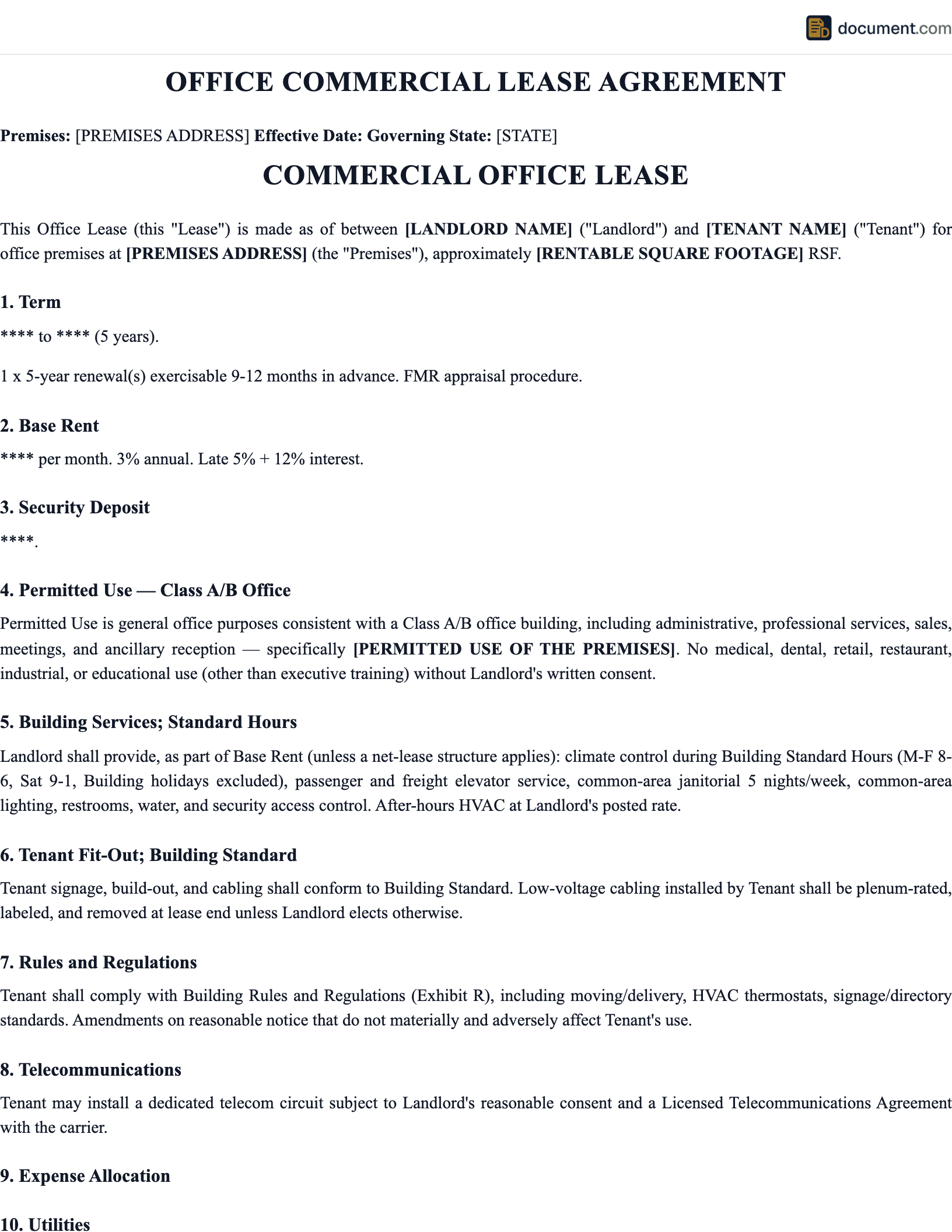
Sample Ohio Office Space Lease Agreement
Below is a preview of our Ohio-specific template. Your customized document will include all fields and provisions required for filing in any Ohio county.
OFFICE SPACE LEASE AGREEMENT
STATE OF OHIO
Legal Document Template
LANDLORD
Name: [Full Legal Name / Entity]
Address: [Management Office Address]
Contact: [Property Manager Name]
TENANT
Name: [Business Entity Name]
Address: [Current Business Address]
Tax ID: [EIN]
Guarantor: [If Applicable]
PREMISES
Building: [Building Name/Address]
Suite: [Number]
Floor: [Floor Number]
RSF: [Rentable Square Feet]
USF: [Usable Square Feet]
FINANCIAL TERMS
Base Rent: $[Amount]/RSF/year
TI Allowance: $[Amount]/RSF
Expense Stop: $[Amount]/RSF
Parking: [# Spaces]
Deposit: $[Amount]
Ohio Office Space Lease Agreement FAQ
Answers to common questions about filing an office space lease agreement in Ohio, including requirements, fees, and procedures.
Official Ohio Resources
Use these official state resources to verify requirements, find your local filing office, and access government forms for Ohio.
Related Ohio Documents
Depending on your situation, you may need additional documents alongside your Ohio office space lease agreement.
Create your Ohio Commercial Office Lease Agreement in under 5 minutes.
Answer a few questions and download a Ohio-compliant document, ready for the state agency.