



North Dakota Office Space Lease Agreement Overview
North Dakota has two distinct commercial office markets operating under very different economic conditions. Fargo, the state's largest city, is home to a diverse professional economy anchored by healthcare systems, financial services, technology, and regional corporate headquarters. Bismarck, the capital, has a more stable base driven by state government, healthcare, and agriculture-related services. Both cities offer affordable office rents compared to national benchmarks, and the commercial real estate market has historically favored tenants willing to sign multi-year commitments. Western North Dakota, centered on Williston and the Bakken oil formation, runs on an entirely different clock: office demand and rents there track closely with oil prices and drilling activity, and the lease terms appropriate in Fargo may not make sense in a market that can shift from tight to vacant within a few quarters.
North Dakota has no dedicated commercial tenant statute, which means office lease terms are governed almost entirely by the contract itself and general North Dakota contract law. Courts enforce commercial leases as written, and there is limited judicial appetite for rewriting agreements between sophisticated parties. Cold climate provisions deserve particular attention in any ND office lease. HVAC responsibilities, snow removal for parking and entrances, utility costs during heating season, and after-hours heating availability are not minor details in a state where temperatures regularly reach minus 20 degrees Fahrenheit. Getting these elements into the lease clearly protects both landlords and tenants from expensive disputes.
$10
Filing fee
Required
Notarization
0
Witnesses required
Register
Filing office
North Dakota Requirements
North Dakota imposes no commercial-tenant-specific requirements on office leases beyond general contract law principles. The lease itself is the primary source of tenant rights and obligations. That means the requirements below are about what a well-drafted ND office lease should contain, not what the state mandates you must file or register.
Cold Climate and Energy Sector Provisions Are Critical
In North Dakota, HVAC responsibilities, snow removal, utility costs, and heating system maintenance are not boilerplate details. A lease that leaves these provisions vague creates real financial exposure in a state where winters are severe and heating costs are significant. If your space is in a western ND energy market, also include provisions addressing what happens to the lease if oil activity causes dramatic shifts in local market conditions.
What a North Dakota Office Lease Should Include
- Written agreement: While not all commercial leases require writing under North Dakota law, any lease over one year should be documented in writing. Commercial office leases in ND are always written, and oral arrangements of any meaningful term are unenforceable as a practical matter.
- HVAC responsibilities and specifications: Define who maintains the heating system, what temperature the landlord is obligated to maintain during business hours, whether after-hours HVAC is available and at what cost, and what the tenant's remedy is if the system fails during winter months.
- Snow removal and exterior maintenance: Specify who is responsible for parking lot plowing, sidewalk clearing, and ice treatment. In North Dakota, this is a frequent source of CAM cost disputes if not clearly allocated. Request a CAM cap or audit right to verify that snow removal charges are reasonable.
- Utility structure: Clarify whether heat and electricity are metered separately to the tenant or included in base rent as a gross lease component. Separately metered utilities in cold climates can create unexpected operating cost spikes and should be budgeted carefully.
- Tenant improvement provisions: In Fargo and Bismarck, landlords often offer TI allowances for multi-year commitments. Document the work letter, construction timeline, allowance amount, and whether unused allowances are forfeited or credited against rent.
- Holdover rent provision: Specify the holdover rate, which in ND office leases is typically 125 to 150 percent of base rent, and the notice period required for renewal decisions. Clear holdover terms protect both sides when a lease renewal is being negotiated near its deadline.
How to Execute a North Dakota Office Lease
Leasing office space in North Dakota is more straightforward than in major coastal markets, but the cold climate and energy market dynamics create issues that require specific attention during negotiation and execution.
Tour Space and Assess Building Systems
Visit the building during both business hours and after hours if possible. Check the age and condition of the HVAC system, ask about utility costs from current or prior tenants, and inspect parking lot access and condition. In North Dakota, building mechanical systems and snow management infrastructure directly affect your operating costs.
Submit LOI Covering Economic and Climate Terms
A letter of intent for a North Dakota office should address base rent, TI allowance, rent-free period, HVAC responsibility and specifications, utility metering structure, snow removal allocation, and parking. Getting these terms agreed in the LOI prevents later disputes during full lease drafting.
Review CAM Structure and Cap Exposure
Request the prior two years of actual CAM reconciliation statements. North Dakota CAM charges often include significant winter maintenance costs that vary year to year based on snowfall and heating degree days. Negotiate a CAM cap or audit right, and exclude capital expenditures from CAM pass-throughs.
Negotiate SNDA and Assignment Rights
If the building is mortgaged, request an SNDA (Subordination, Non-Disturbance, and Attornment) agreement from the lender before signing. Also clarify subletting and assignment rights, particularly if your business may grow, contract, or be acquired during the lease term. ND courts enforce these provisions strictly as written.
Execute with Proper Authority and Document the Space
Sign the lease using the correct legal name of the tenant entity, confirmed by operating agreement or corporate resolution. Photograph the space thoroughly before move-in. Attach a condition exhibit to the lease. These steps are simple but protect you significantly at lease end when security deposit disputes arise.
Tax Implications of a North Dakota Office Lease
North Dakota has no commercial rent tax, making the state one of the simpler jurisdictions from a lease tax perspective. The relevant tax considerations are primarily federal, with some state-level nuances worth understanding.
| Tax / Cost Item | Notes |
|---|---|
| No commercial rent tax | North Dakota does not impose a statewide tax on commercial rent. Tenants pay base rent and CAM charges without any additional rent tax layer, unlike states such as Florida which levy a commercial rent tax directly on the lease. |
| Rent deductibility | Office rent paid for business purposes is deductible as a business expense for federal income tax and North Dakota income tax purposes. ND's individual income tax rate has been reduced significantly in recent years, and ND corporate income tax is competitive nationally. |
| Property tax pass-through via CAM | Net and modified gross leases in North Dakota typically pass real property taxes through to tenants as part of CAM. Cass County (Fargo) and Burleigh County (Bismarck) have had increasing assessed values in recent years, which can push CAM reconciliation amounts up at year end. |
| Tenant improvement allowance treatment | TI allowances received from a landlord may constitute taxable income to the tenant depending on how the arrangement is structured. Work with a CPA to determine whether the TI should be treated as a rental concession, a lease incentive, or separately allocated improvement costs, as each has different federal and state income tax consequences. |
| Heating and utility costs | Utility costs paid directly by the tenant under a net or modified gross lease are fully deductible as business expenses. In North Dakota, heating costs can be a meaningful annual expense and should be budgeted separately from base rent, particularly in multi-tenant buildings with shared systems. |
Important Considerations for North Dakota Office Tenants
North Dakota's office markets have characteristics that tenants coming from other states may not anticipate. These considerations reflect the practical realities of leasing in a cold climate, small-population state with an economy shaped by agriculture, energy, and healthcare.
- Fargo is the dominant commercial market and has the most options: Fargo and the broader Cass County area account for the majority of North Dakota's professional office inventory. If your business can operate from Fargo, you will find a wider range of building quality, more competitive pricing, and more favorable lease terms than in smaller ND cities. Suburban West Fargo has seen significant new office development in recent years.
- Bismarck's government and healthcare anchor creates stable demand: State government agencies, healthcare systems including Sanford and CHI, and agriculture-related businesses drive Bismarck's office market. Vacancy rates are generally low and long-term tenants have historically enjoyed stable rents. New development is limited, so availability can be constrained.
- Western ND office markets are cyclical and require caution: If you are leasing in Williston, Minot, or Dickinson, understand that these markets move with oil prices. Signing a five-year office lease in Williston during a drilling boom can leave you significantly over-market during the next downturn. Consider shorter initial terms with renewal options when leasing in energy-dependent markets.
- Heating system age and reliability is a material due diligence item: Unlike most states, North Dakota building mechanical system failure during winter can create genuine hardship for office operations. Before signing any lease, ask for records of heating system maintenance and age, and make sure the lease clearly establishes landlord repair obligations with a reasonable cure period during winter months.
- Attorney review is affordable and worthwhile: Commercial real estate attorneys in Fargo and Bismarck charge significantly less than their counterparts in major coastal markets. Given that ND courts enforce commercial leases strictly as written, spending a few hundred dollars on attorney review before signing can prevent expensive problems over a multi-year lease term.
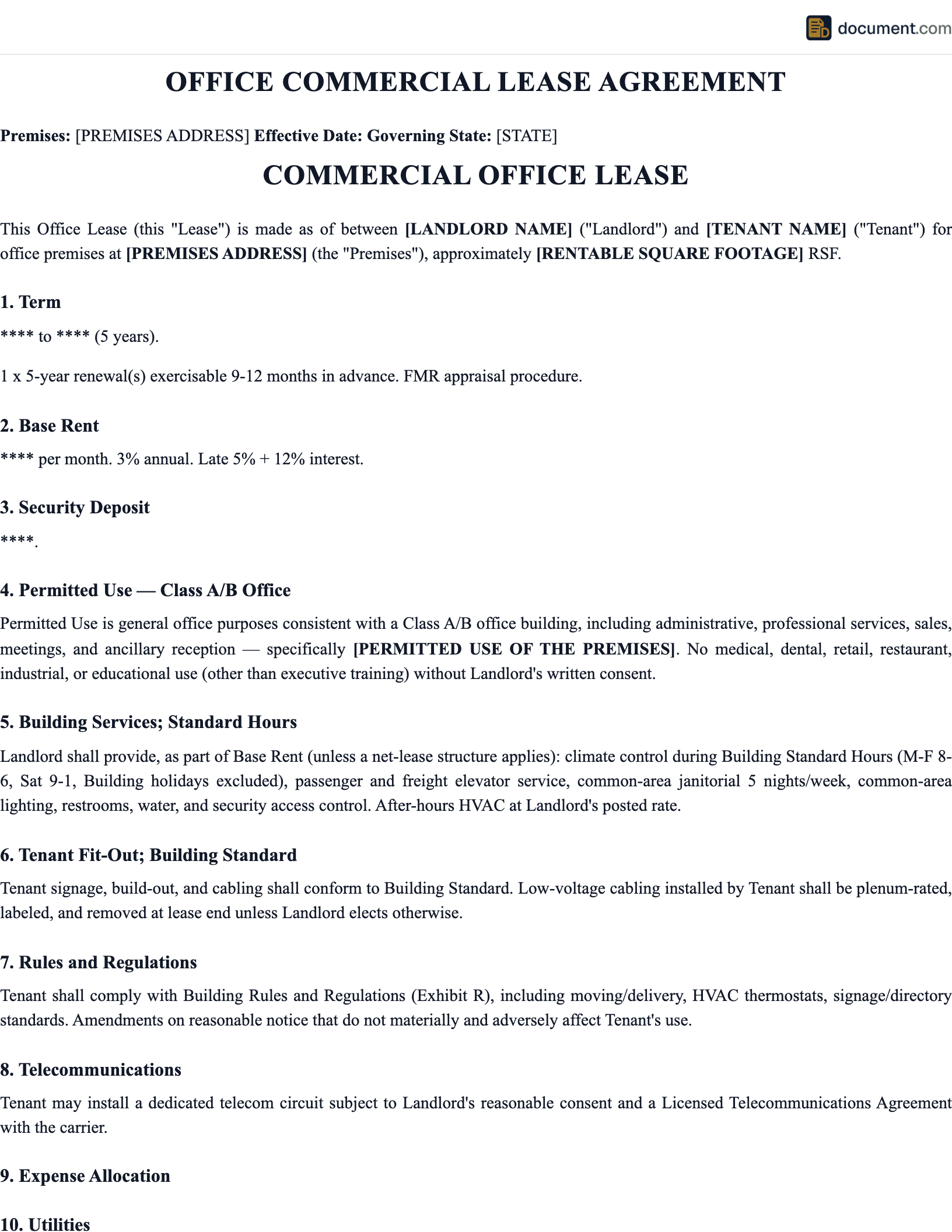
Sample North Dakota Office Space Lease Agreement
Below is a preview of our North Dakota-specific template. Your customized document will include all fields and provisions required for filing in any North Dakota county.
OFFICE SPACE LEASE AGREEMENT
STATE OF NORTH DAKOTA
Legal Document Template
LANDLORD
Name: [Full Legal Name / Entity]
Address: [Management Office Address]
Contact: [Property Manager Name]
TENANT
Name: [Business Entity Name]
Address: [Current Business Address]
Tax ID: [EIN]
Guarantor: [If Applicable]
PREMISES
Building: [Building Name/Address]
Suite: [Number]
Floor: [Floor Number]
RSF: [Rentable Square Feet]
USF: [Usable Square Feet]
FINANCIAL TERMS
Base Rent: $[Amount]/RSF/year
TI Allowance: $[Amount]/RSF
Expense Stop: $[Amount]/RSF
Parking: [# Spaces]
Deposit: $[Amount]
North Dakota Office Space Lease Agreement FAQ
Answers to common questions about filing a office space lease agreement in North Dakota, including requirements, fees, and procedures.
Official North Dakota Resources
Use these official state resources to verify requirements, find your local filing office, and access government forms for North Dakota.
Related North Dakota Documents
Depending on your situation, you may need additional documents alongside your North Dakota office space lease agreement.
Create your North Dakota Commercial Office Lease Agreement in under 5 minutes.
Answer a few questions and download a North Dakota-compliant document, ready for the state agency.