



North Carolina Office Space Lease Agreement Overview
North Carolina's office market has emerged as one of the fastest-growing in the Southeast, driven by two distinct economic engines. Charlotte's banking and financial services concentration around Uptown has created strong demand for Class A office space in the central business district and the booming South End neighborhood. The Research Triangle, anchored by Raleigh, Durham, and Chapel Hill with three major research universities within 30 miles of each other, has become a national hub for biotech, pharmaceutical research, software development, and healthcare organizations seeking proximity to University of North Carolina, Duke, and NC State talent pipelines.
North Carolina has no dedicated commercial landlord-tenant statute, leaving office leases governed primarily by contract law and the state's general property statutes. This business-friendly legal environment gives landlords and tenants significant flexibility in structuring lease terms, but it also means that statutory protections for commercial tenants are minimal. Rent levels in North Carolina remain substantially more affordable than comparable markets in Washington DC, New York, or California, making the state attractive for companies expanding their footprint or relocating operations. Tenants entering multi-year lease commitments in the active Charlotte and Raleigh markets should negotiate carefully on CAM caps, TI allowances, and renewal option terms while the market is competitive.
$26
Filing fee
Required
Notarization
0
Witnesses required
Register
Filing office
North Carolina Requirements
North Carolina's statute of frauds (NCGS 22-2) requires leases with terms exceeding three years to be in writing. Most commercial office leases already satisfy this as written agreements. North Carolina has no specific commercial tenant protection statute, so the lease document itself carries all the legal weight.
Research Triangle Life Sciences and Lab Office Consideration
Biotech and pharmaceutical tenants in the Research Triangle frequently require specialized HVAC, utility capacity, and ventilation systems beyond what a standard office lease addresses. If your office use includes any laboratory or life sciences component, the lease must specifically address HVAC specifications, utility capacity, wet lab provisions, and who is responsible for specialized infrastructure as part of the TI allowance or build-out process. Standard office lease forms are inadequate for these needs.
Core Lease Requirements
- Written Agreement: Required by NCGS 22-2 for leases exceeding three years; recommended in writing for all office lease terms
- CAM Structure and Audit Right: Define the expense stop or triple-net structure; negotiate an annual CAM audit right and management fee pass-through cap
- TI Allowance and Work Letter: Document the TI dollar amount, submission deadlines, and landlord approval process in a detailed work letter exhibit
- Parking Provisions: Specify space count, rate, reserved vs. unreserved allocation; Charlotte Uptown parking is separately metered and can add meaningful monthly cost
- Renewal Options: Lock in renewal options with predetermined rent escalation rates or a fair market rent procedure with a cap to protect against runaway renewal costs in NC's fast-appreciating markets
- Holdover Provisions: Specify the holdover penalty rate explicitly; North Carolina has no statute governing commercial holdovers, so the lease terms control entirely
How to Execute a North Carolina Office Lease
North Carolina's active office markets in Charlotte and Raleigh-Durham move at a pace that rewards prepared tenants. Having your broker, attorney, and entity documents ready before starting negotiations prevents delays that can cost negotiating leverage.
Engage a Tenant-Side Broker
Both Charlotte and Raleigh-Durham have experienced commercial broker communities. A tenant rep with submarket knowledge can benchmark proposed rents against recent comparable transactions and run a competitive process among multiple landlords. Broker fees are paid by the landlord.
Submit a Detailed LOI Covering Economic Terms
A strong LOI in the NC market addresses base rent, TI allowance, free rent, lease term, renewal option terms, parking, and whether the lease is gross or modified-gross. Getting these agreed before the full lease is drafted saves significant negotiation time.
Review CAM Definitions and Negotiate Caps
North Carolina property taxes and maintenance costs have risen with the state's rapid growth. The lease's CAM definition determines what costs flow through to the tenant. Negotiate exclusions for capital expenditures, a management fee cap, and annual CAM reconciliation audit rights.
Address After-Hours HVAC and Access Control
North Carolina summers are hot and humid. Technology and biotech tenants in the Research Triangle frequently work evenings and weekends. Confirm the after-hours HVAC request process, hourly rate, and whether 24/7 building access via card system is included before signing.
Execute with Authorized Signatories and Distribute Copies
Both parties sign the fully executed lease with authorized signatories. Distribute copies to all parties, broker, and any lender requiring a lease copy as part of a financing package.
North Carolina Tax Implications for Office Tenants
North Carolina offers a relatively straightforward tax environment for office tenants, with no commercial rent tax and a declining corporate income tax rate that has improved the state's attractiveness for business operations.
| Tax or Cost Item | Details |
|---|---|
| No Commercial Rent Tax | NC does not impose a commercial rent tax; office rent is not subject to NC sales tax; business-friendly compared to states with GRT or CRT regimes |
| Property Tax Pass-Through (CAM) | NC property taxes pass through to tenants in triple-net leases; Charlotte and Raleigh-Durham assessments have risen with market appreciation; negotiate property tax escalation caps |
| Rent Deductibility | Office rent and CAM charges are deductible as ordinary business expenses for federal and NC state income tax; NC's corporate income tax rate has declined significantly in recent legislative sessions |
| TI Allowance Treatment | Tenant improvement allowances may be treated as rent reduction, taxable income, or capitalized improvement costs; consult a CPA about the appropriate tax treatment for your specific TI structure |
Important Considerations for North Carolina Office Tenants
North Carolina's population growth and corporate relocation activity have created competitive conditions for quality office space in Charlotte and the Research Triangle. Tenants who delayed renewals hoping for post-pandemic softening found that NC's strong in-migration continued to support demand. Starting lease renewal conversations 12 to 18 months before expiration maximizes leverage while you still have time to relocate if renewal terms are unfavorable.
The Research Triangle's biotech and life sciences growth is creating specialized demand that standard office lease forms do not address. If your office use includes any laboratory component, wet lab space, or specialized HVAC requirements, work with a commercial real estate attorney and potentially a technical consultant to ensure the lease addresses these needs explicitly. The Research Triangle Park, Cary, and Morrisville submarkets have seen significant life sciences development and have landlords experienced with these specialized lease requirements.
Smaller North Carolina cities like Greensboro, Winston-Salem, and Asheville offer significantly more affordable office options with much less competition for quality space. Companies that do not require a Charlotte or Research Triangle address will find landlords more negotiable on rent, TI allowances, and lease terms in these secondary markets, where landlords are actively competing for creditworthy tenants.
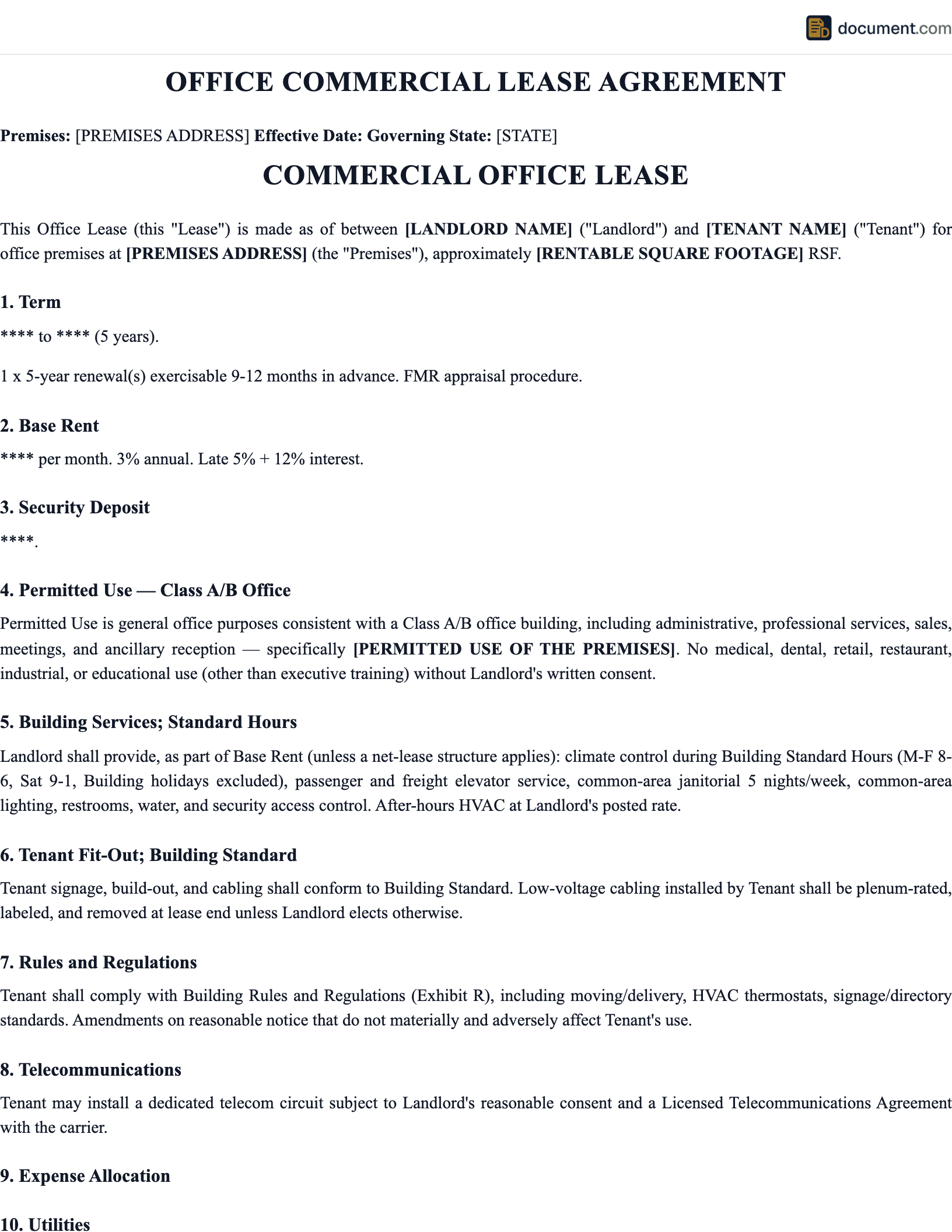
Sample North Carolina Office Space Lease Agreement
Below is a preview of our North Carolina-specific template. Your customized document will include all fields and provisions required for filing in any North Carolina county.
OFFICE SPACE LEASE AGREEMENT
STATE OF NORTH CAROLINA
Legal Document Template
LANDLORD
Name: [Full Legal Name / Entity]
Address: [Management Office Address]
Contact: [Property Manager Name]
TENANT
Name: [Business Entity Name]
Address: [Current Business Address]
Tax ID: [EIN]
Guarantor: [If Applicable]
PREMISES
Building: [Building Name/Address]
Suite: [Number]
Floor: [Floor Number]
RSF: [Rentable Square Feet]
USF: [Usable Square Feet]
FINANCIAL TERMS
Base Rent: $[Amount]/RSF/year
TI Allowance: $[Amount]/RSF
Expense Stop: $[Amount]/RSF
Parking: [# Spaces]
Deposit: $[Amount]
North Carolina Office Space Lease Agreement FAQ
Answers to common questions about filing a office space lease agreement in North Carolina, including requirements, fees, and procedures.
Official North Carolina Resources
Use these official state resources to verify requirements, find your local filing office, and access government forms for North Carolina.
Related North Carolina Documents
Depending on your situation, you may need additional documents alongside your North Carolina office space lease agreement.
Create your North Carolina Commercial Office Lease Agreement in under 5 minutes.
Answer a few questions and download a North Carolina-compliant document, ready for the state agency.