



New York Office Space Lease Agreement Overview
New York City is the most complex commercial office lease market in the world, full stop. A Manhattan office lease for a modest amount of space can run well over a hundred pages before the exhibits, involve a half-dozen negotiating cycles, and carry financial commitments that dwarf the total lease values in entire upstate New York counties. The rent-setting, CAM structure, TI allowance, personal guaranty expectations, and access control provisions in a Midtown Manhattan office lease look almost nothing like what you would see in a typical three-year office deal in Buffalo or Albany. Understanding that divide is the starting point for any New York office tenant.
New York State has no dedicated commercial landlord-tenant statute comparable to its robust residential tenant protection framework. Commercial office leases in New York are governed by the Real Property Law and general contract principles, and the courts strongly enforce the terms as negotiated between commercially sophisticated parties. NYC adds specific regulatory layers that do not exist elsewhere in the state: the Commercial Rent Tax in Manhattan south of 96th Street, co-op and condo board approval requirements in certain buildings, and a highly liquid subletting and assignment market that affects how much flexibility a tenant can realistically build into a longer-term commitment.
$55
Filing fee
Required
Notarization
0
Witnesses required
County
Filing office
New York Requirements
New York's Real Property Law requires leases for terms exceeding one year to be in writing. NYC office leases are almost always extensive written agreements negotiated between attorneys, so this baseline is easily satisfied. The critical requirements are the deal-specific ones embedded in the lease document itself.
NYC Commercial Rent Tax and Guaranty Exposure
Two issues catch New York office tenants off guard: the NYC Commercial Rent Tax, which applies in Manhattan south of 96th Street for tenants paying over $500,000 in annual base rent, and personal guaranty demands from NYC landlords. NYC landlords routinely require principals of smaller tenants to sign personal guarantees. Under New York's Guaranty Law (RPL Section 220-c), certain personal guarantees on commercial leases of small businesses may have pandemic-related limitations, but standard multi-year guarantees on new leases are generally enforceable in full. Negotiate guaranty scope carefully.
Core Lease Requirements
- Written Agreement: Required by NY Real Property Law for leases exceeding one year; standard practice for all commercial office leases regardless of term length
- Base Year and Expense Stop: NYC leases typically specify a base year for operating expense calculations; the base year choice significantly affects cost exposure over a long lease term
- Work Letter and TI Allowance: A detailed work letter specifying the build-out scope, TI dollar amount, submission deadlines, and landlord approval process is essential for any office lease involving significant improvements
- SNDA from Lender: For leases in leveraged buildings, request a Subordination, Non-Disturbance, and Attornment agreement from the building's lender before signing to protect occupancy rights in a foreclosure scenario
- Access Control and HVAC Hours: NYC office buildings have specific after-hours HVAC charge rates and access card systems; document the included hours, overage rates, and access provisions as lease exhibits
- 421-a and Tax Abatement Disclosure: If the building benefits from a 421-a or other NYC tax abatement, confirm how that affects the operating expense base year calculation and what happens when the abatement expires
How to Execute a New York Office Lease
NYC office lease negotiations are a professional process with established market conventions. Rushing any stage creates risk. The following steps reflect how a well-represented tenant typically moves through the process in Manhattan and major New York office markets.
Engage a Tenant-Side Broker
In NYC's commercial office market, tenant representation brokers are compensated by the landlord and cost the tenant nothing. A tenant broker with market knowledge of your target submarket can identify off-market opportunities, benchmark rents against comparable transactions, and run a competitive process among multiple landlords. For upstate NY markets, a local commercial broker performs the same function at much lower transaction complexity.
Negotiate the Letter of Intent
NYC office LOIs address base rent, lease term, TI allowance, free rent, escalation schedule, renewal option terms, and subletting rights. The LOI is typically non-binding but sets the economic framework for the full lease. NYC landlords expect prompt response to LOI counteroffers. A tenant attorney should review the LOI before signing to avoid inadvertently binding yourself to unfavorable terms or waiving rights.
Conduct Legal Review of the Full Lease and Exhibits
NYC office leases are long and detailed. An experienced NYC commercial real estate attorney reviews the base lease, work letter, building rules, guaranty, and any SNDA. Key NYC-specific issues include operating expense base year election, CRT exposure, assignment and subletting consent standards, holdover rent (often 200 percent in NYC), and the scope and burndown schedule of any personal guaranty.
Obtain SNDA from the Building's Lender
Before finalizing the lease, request a Subordination, Non-Disturbance, and Attornment agreement from the lender if the building carries a mortgage. NYC buildings regularly refinance, sell, or enter foreclosure proceedings. An SNDA protects your right to continue in occupancy as long as you are not in default. Most institutional NYC landlords will facilitate this process; smaller landlords may need to be pushed.
Execute and Confirm Access, Systems, and Build-Out Timeline
After both parties sign the fully executed lease, confirm your access card count and key collection date, the start date of the TI build-out, and the landlord's construction approval process. Document the condition of the existing space with photographs and a written punchlist to establish the baseline before your build-out begins.
New York Tax Implications for Office Tenants
New York office tenants face a unique set of tax considerations that have no equivalent in most other states, primarily driven by New York City's Commercial Rent Tax and the complexity of operating expense escalation in a high-cost, high-tax environment.
| Tax or Cost Item | Details |
|---|---|
| NYC Commercial Rent Tax | Applies in Manhattan south of 96th Street; 6 percent of taxable base rent for tenants paying over $500,000 annually; tenants with lower rents may qualify for a partial credit |
| Property Tax Pass-Through | NYC property taxes are among the highest in the nation; lease's operating expense escalation provisions determine how much of annual property tax increases land on the tenant versus landlord |
| 421-a Abatement Impact | Buildings with 421-a abatements have lower property tax bases that expire over time; when the abatement burns off, property taxes can spike substantially, increasing the tenant's operating expense pass-through mid-lease |
| Rent Deductibility | Base rent and operating expense pass-throughs are generally deductible for federal and NY state income tax; CRT payments may also be deductible as a business expense |
| TI Allowance Tax Treatment | NYC construction costs are high; how the TI is structured (as an allowance vs. rent abatement) has income tax implications; consult a CPA familiar with NY commercial real estate taxation |
Important Considerations for New York Office Tenants
Holdover rent in NYC office leases is a serious financial risk that many tenants underestimate. NYC landlords routinely include holdover clauses requiring tenants to pay 150 to 200 percent of the last month's base rent for any holdover period, sometimes on a month-to-month basis and sometimes calculated as a daily rate. In a market where base rent may be $80 to $100 per square foot annually, a month of holdover at 200 percent can cost a 5,000-square-foot tenant $65,000 or more. Plan your move timeline conservatively and build buffer into your construction and move schedule.
Subletting and assignment rights matter enormously in NYC because businesses grow, shrink, and pivot faster than most office leases run. A restrictive subletting clause that requires landlord consent with broad landlord discretion to withhold can trap a tenant in a space that no longer fits the business. Push for a "not to be unreasonably withheld, conditioned, or delayed" standard on subletting consent, and specify the maximum time the landlord has to respond before consent is deemed given. Also negotiate recapture rights carefully: many NYC landlords can recapture subleased space and deal directly with the proposed subtenant, effectively taking the space back from the tenant.
Upstate New York tenants operate in a far more tenant-friendly environment than their NYC counterparts. Markets like Buffalo, Rochester, Syracuse, and Albany have significantly higher vacancy rates, lower rents, shorter standard lease terms, and landlords who are willing to be flexible on almost every economic point to secure creditworthy tenants. If your business is location-agnostic within New York State, the upstate office markets offer excellent value relative to the regulatory and cost complexity of a Manhattan lease.
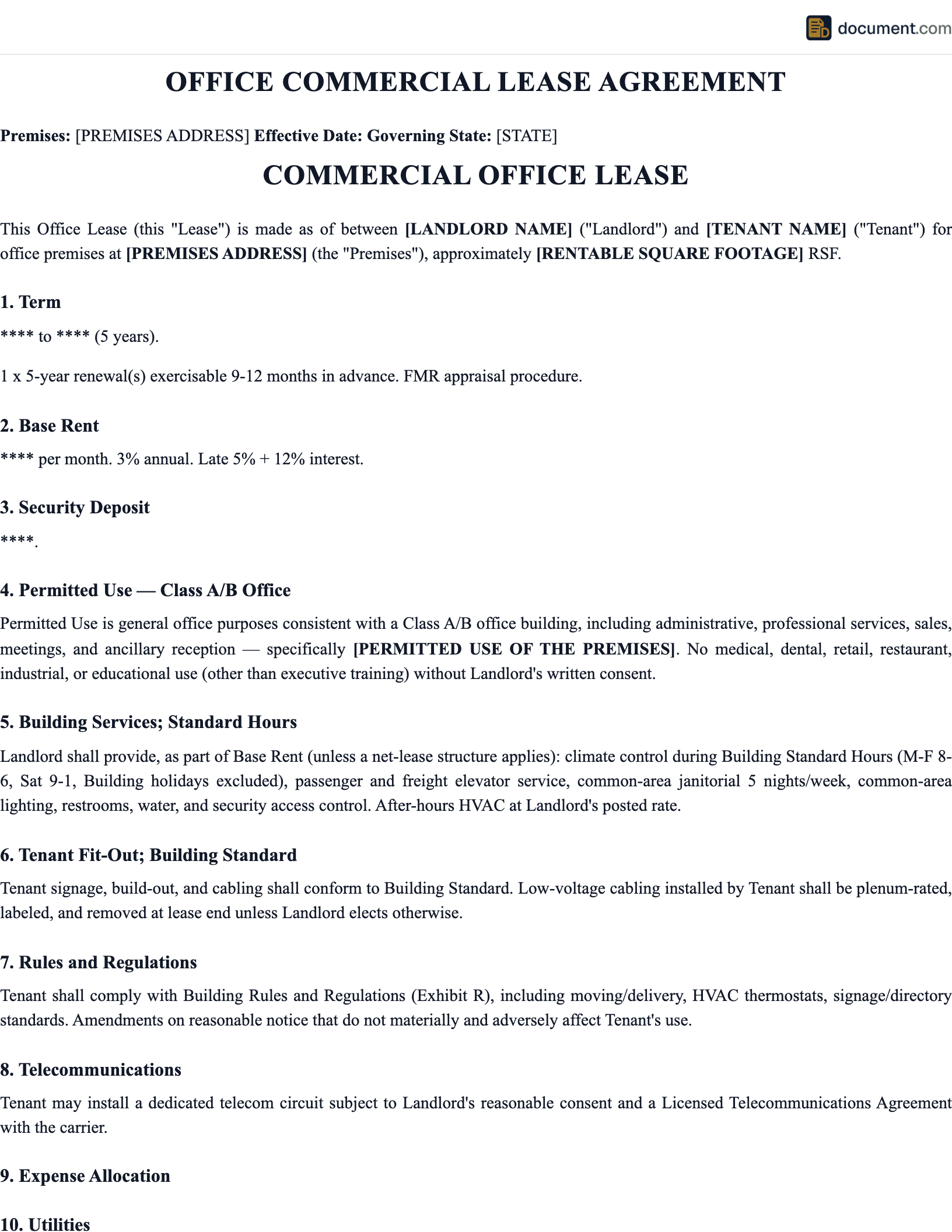
Sample New York Office Space Lease Agreement
Below is a preview of our New York-specific template. Your customized document will include all fields and provisions required for filing in any New York county.
OFFICE SPACE LEASE AGREEMENT
STATE OF NEW YORK
Legal Document Template
LANDLORD
Name: [Full Legal Name / Entity]
Address: [Management Office Address]
Contact: [Property Manager Name]
TENANT
Name: [Business Entity Name]
Address: [Current Business Address]
Tax ID: [EIN]
Guarantor: [If Applicable]
PREMISES
Building: [Building Name/Address]
Suite: [Number]
Floor: [Floor Number]
RSF: [Rentable Square Feet]
USF: [Usable Square Feet]
FINANCIAL TERMS
Base Rent: $[Amount]/RSF/year
TI Allowance: $[Amount]/RSF
Expense Stop: $[Amount]/RSF
Parking: [# Spaces]
Deposit: $[Amount]
New York Office Space Lease Agreement FAQ
Answers to common questions about filing a office space lease agreement in New York, including requirements, fees, and procedures.
Official New York Resources
Use these official state resources to verify requirements, find your local filing office, and access government forms for New York.
Related New York Documents
Depending on your situation, you may need additional documents alongside your New York office space lease agreement.
Create your New York Commercial Office Lease Agreement in under 5 minutes.
Answer a few questions and download a New York-compliant document, ready for the state agency.