



New Mexico Office Space Lease Agreement Overview
New Mexico is one of the few states that truly has two distinct commercial office markets operating under the same law. Albuquerque, the state's largest city, functions like a mid-size Sun Belt market with suburban office parks along the I-25 corridor, Class A high-rises in the Uptown and Downtown submarkets, and significant demand from healthcare, government, and energy sectors tied to the state's oil and gas economy in the southeastern Permian Basin region. Santa Fe, by contrast, is a smaller, arts-and-culture-driven market where professional office space often occupies historic adobe buildings and newer mixed-use developments near the Plaza. Rents statewide are considerably more affordable than coastal markets, making New Mexico attractive for regional headquarters and back-office operations.
New Mexico commercial lease law provides minimal statutory intervention. The state has no dedicated commercial landlord-tenant act, so office leases are governed almost entirely by general contract principles and whatever the parties negotiate into the document. That flexibility cuts both ways: landlords can structure favorable terms around CAM reconciliation, holdover penalties, and assignment restrictions, while tenants who negotiate carefully can secure meaningful protections around build-out allowances, HVAC maintenance obligations, and access control systems. New Mexico's gross receipts tax on commercial rent is an important cost that many tenants overlook during lease negotiations.
$25
Filing fee
Required
Notarization
0
Witnesses required
County
Filing office
New Mexico Requirements
New Mexico's statute of frauds requires any commercial office lease with a term exceeding one year to be in writing. Beyond that basic requirement, the state does not prescribe a mandatory form or mandatory disclosure checklist for commercial tenancies. The lease itself carries nearly all the legal weight, which means leaving anything vague creates risk for whoever negotiated less carefully.
New Mexico Gross Receipts Tax Alert
New Mexico charges its gross receipts tax on commercial rent. The effective rate in Albuquerque and Santa Fe is typically between 7.5 and 9 percent on top of base rent. Most landlords pass this through to tenants contractually. Confirm the applicable GRT rate for the property's municipality before signing, and include a clear GRT pass-through clause in the lease to avoid disputes at reconciliation time.
Core Lease Requirements
- Written Agreement: Required by the New Mexico statute of frauds for any office lease exceeding one year; oral leases are unenforceable beyond that threshold
- Authorized Signatures: Corporate tenants and LLCs must sign through a properly authorized officer or manager; attach a certificate of authority or operating agreement excerpt if the landlord requests it
- Premises Description: Include the building address, suite number, rentable square footage, and any dedicated storage or parking included in the lease
- CAM and Expense Structure: Specify whether the lease is gross, modified-gross, or triple-net; define the base year expense stop if applicable and include an annual CAM audit right
- Build-Out and HVAC: Document any tenant improvement allowance, construction timeline, HVAC maintenance responsibilities, and after-hours HVAC charge rates in the lease or an exhibit
- Zoning Verification: Confirm the intended office use is permitted under local zoning for the specific Bernalillo, Santa Fe, or other NM county where the property sits
How to Execute a New Mexico Office Lease
Office lease negotiations in New Mexico typically move through a letter of intent phase before the formal lease is drafted. Understanding the full process helps tenants avoid being rushed into unfavorable terms.
Submit a Letter of Intent
A non-binding LOI lays out the key economic terms: base rent, lease term, TI allowance, free rent period, and parking. New Mexico landlords expect a signed LOI before commissioning a full lease draft. Keep the LOI non-binding except for any agreed exclusivity or confidentiality provisions.
Review the Lease Draft and Exhibits
New Mexico office leases typically include a base lease plus exhibits covering the floor plan, build-out specifications, HVAC maintenance schedules, parking license, and rules and regulations. Review all exhibits as carefully as the base lease itself, because HVAC and CAM obligations are often buried in the work letter or building rules.
Negotiate Access Control and Security
Larger Albuquerque office buildings typically have card access systems. Confirm the number of access cards included, the cost of additional cards, whether tenants have 24/7 access to the building and parking, and who controls after-hours HVAC and lighting. Santa Fe buildings often have simpler key-based systems but similar access questions.
Confirm GRT Rate and Pass-Through Language
Before signing, verify the current New Mexico gross receipts tax rate applicable to the property location and make sure the lease clearly states whether the quoted rent includes or excludes GRT. The difference between a rent quoted plus GRT versus all-inclusive can meaningfully affect your monthly occupancy cost.
Execute with Authorized Signatories and Distribute Copies
Both parties sign the executed lease. If either party is a corporation or LLC, confirm the signatory has authority under the entity's operating agreement or corporate resolutions. Distribute fully executed copies to both parties. If the lease term exceeds the building's existing lender loan term, request an SNDA from the lender before taking occupancy.
New Mexico Tax Implications for Office Leases
Tax costs are a significant and sometimes underestimated component of office occupancy in New Mexico. Unlike states that have a clean separation between base rent and taxes, New Mexico's gross receipts tax system applies directly to commercial rent and affects every office tenant in the state.
| Tax or Cost Item | Details |
|---|---|
| Gross Receipts Tax on Rent | NM GRT applies to commercial rent; Albuquerque and Santa Fe combined rates typically 7.5 to 9 percent; passed through to tenant by lease |
| Property Tax Pass-Through (CAM) | Triple-net leases pass the tenant's pro-rata share of property taxes through as a CAM line item; NM property tax is relatively low compared to coastal states |
| CAM Reconciliation | Annual true-up of estimated vs. actual CAM charges; negotiate a CAM cap and audit right to limit exposure |
| TI Allowance Tax Treatment | Tenant improvement allowances may have income tax implications for the tenant; consult a CPA on whether the TI is treated as a rent reduction or taxable income |
| Rent Deductibility | Base rent and NM GRT pass-through are generally deductible business expenses for federal and NM state income tax purposes |
Important Considerations for New Mexico Office Tenants
The Albuquerque and Santa Fe office markets are fundamentally different, and what is a reasonable lease term in one city may be unusual in the other. Albuquerque's larger inventory and more liquid market gives tenants more leverage in multi-floor negotiations and for credit-quality companies with long-term commitments. Santa Fe's constrained supply and strong tourism economy mean landlords hold more leverage, particularly in the downtown historic district where commercial space is scarce and desirable for professional firms wanting the Santa Fe address.
HVAC is a meaningful operational concern in New Mexico's climate. Albuquerque summers routinely exceed 95 degrees Fahrenheit, and cooling costs for a poorly insulated or undersized system can be significant. The lease should clearly address who is responsible for HVAC maintenance and replacement, whether the building system is shared or dedicated to the tenant's suite, and what after-hours HVAC costs if the tenant needs climate control outside standard building hours.
New Mexico's oil and gas economy creates periodic demand spikes in markets like Hobbs, Carlsbad, and Roswell that look nothing like the Albuquerque and Santa Fe markets. If you are leasing office space in southeastern New Mexico energy country, expect shorter standard lease terms, more landlord-favorable holdover provisions, and less standardized lease documentation than you would find in the state's larger cities.
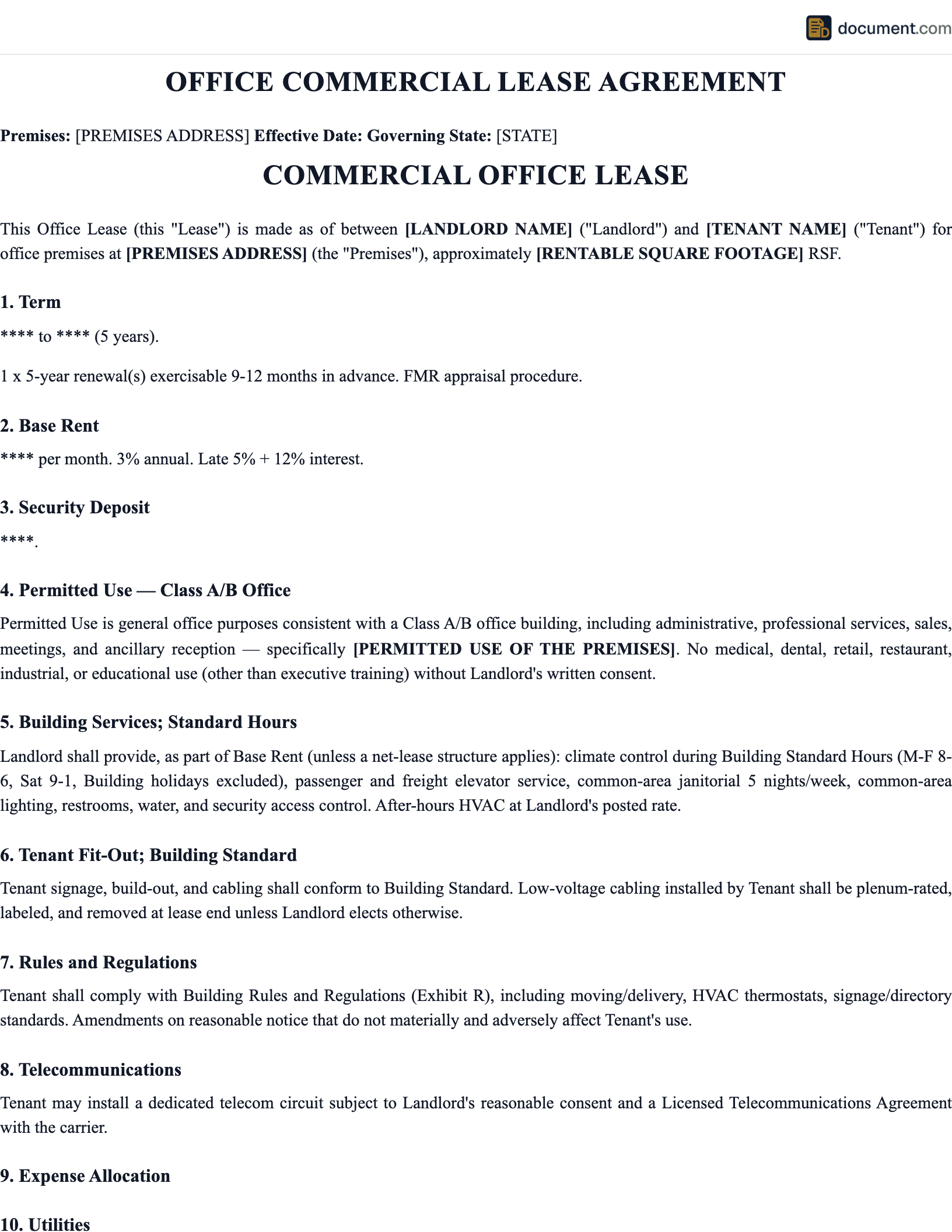
Sample New Mexico Office Space Lease Agreement
Below is a preview of our New Mexico-specific template. Your customized document will include all fields and provisions required for filing in any New Mexico county.
OFFICE SPACE LEASE AGREEMENT
STATE OF NEW MEXICO
Legal Document Template
LANDLORD
Name: [Full Legal Name / Entity]
Address: [Management Office Address]
Contact: [Property Manager Name]
TENANT
Name: [Business Entity Name]
Address: [Current Business Address]
Tax ID: [EIN]
Guarantor: [If Applicable]
PREMISES
Building: [Building Name/Address]
Suite: [Number]
Floor: [Floor Number]
RSF: [Rentable Square Feet]
USF: [Usable Square Feet]
FINANCIAL TERMS
Base Rent: $[Amount]/RSF/year
TI Allowance: $[Amount]/RSF
Expense Stop: $[Amount]/RSF
Parking: [# Spaces]
Deposit: $[Amount]
New Mexico Office Space Lease Agreement FAQ
Answers to common questions about filing a office space lease agreement in New Mexico, including requirements, fees, and procedures.
Official New Mexico Resources
Use these official state resources to verify requirements, find your local filing office, and access government forms for New Mexico.
Related New Mexico Documents
Depending on your situation, you may need additional documents alongside your New Mexico office space lease agreement.
Create your New Mexico Commercial Office Lease Agreement in under 5 minutes.
Answer a few questions and download a New Mexico-compliant document, ready for the state agency.