



New Jersey Office Space Lease Agreement Overview
New Jersey's commercial office market divides into two fundamentally different regions. Northern New Jersey, anchored by Jersey City, Newark, and the Hudson waterfront, functions as an extension of Manhattan with rents, tenant expectations, and competitive dynamics that track closely with New York City. Companies lease in Northern NJ primarily to access the same labor pool as New York while saving on rent per square foot and avoiding New York City commercial rent tax. Southern New Jersey, with its suburban campuses in Cherry Hill, Mount Laurel, and Moorestown, reflects the Philadelphia metro market with lower base rents, larger floor plates, and a workforce that drives rather than commutes by train.
New Jersey commercial leases are governed by general contract law. The state has no commercial landlord-tenant statute comparable to its residential Anti-Eviction Act, which means the lease document itself controls nearly every aspect of the relationship. New Jersey does impose some of the highest property taxes in the United States, and in NNN or modified-gross leases those taxes pass through to tenants as operating expenses, sometimes adding $10 or more per square foot annually in counties like Bergen, Essex, and Hudson. Understanding total occupancy cost, not just base rent, is essential for any NJ office lease.
10.75%
Top income tax rate
No cap
Commercial deposit
High
Property tax burden
NJ Transit
Key location driver
New Jersey Requirements for Office Leases
New Jersey office leases are governed primarily by contract law. No statute caps security deposits for commercial tenants, no mandatory CAM disclosure format is required, and no commercial tenant protection statute establishes a baseline set of rights. What the parties agree to in the lease document is what applies.
New Jersey Commercial Lease Note
New Jersey has among the highest property tax burdens in the country. In NNN or modified-gross leases, property tax passthroughs can add $8 to $20 per RSF per year in Bergen, Essex, and Hudson counties. The lease must also be in writing for terms over one year under the NJ Statute of Frauds (N.J.S.A. 25:1-12). Transit access provisions and parking ratio are major negotiating points in Northern NJ markets.
Key Lease Provisions to Negotiate
- Written agreement: Required under N.J.S.A. 25:1-12 for leases exceeding one year; all commercial leases should be in writing regardless of term length
- Property tax passthrough cap: New Jersey's high property tax environment makes negotiating a cap on property tax expense increases critical; try to limit annual property tax passthrough increases to a base year comparison amount
- Parking provisions: Specify the number of dedicated parking spaces, their cost if separate from rent, and any transit shuttle services; parking is a significant issue in Northern NJ markets near train stations
- CAM audit rights: Negotiate annual reconciliation with the right to audit landlord CAM expense records within 90 to 120 days of the annual statement
- Holdover rate: Define the holdover premium explicitly (125 to 200 percent of final base rent in competitive NJ markets); establish whether holdover creates month-to-month tenancy or tenancy at sufferance
- ADA and NJ LAD compliance: Specify ADA and New Jersey Law Against Discrimination accessibility obligations and allocate improvement responsibilities between landlord and tenant
How to Execute a New Jersey Office Lease
Executing a commercial office lease in New Jersey follows a structured sequence, with important regional differences between Northern NJ (New York metro) and Southern NJ (Philadelphia metro) markets.
Survey the Submarket
Define your target submarket before touring: Jersey City and Hoboken for NYC-adjacent pricing with PATH access; Newark and the Meadowlands for larger floor plates at lower rents; Parsippany and Morris County for suburban campuses; Cherry Hill and Mount Laurel for Southern NJ Philadelphia access. Each submarket has distinct parking norms, transit access, and labor pool considerations.
Submit a Letter of Intent
The LOI establishes base rent, term, TI allowance, free rent period, parking allocation, renewal options, and the holdover premium before either party commits to lease drafting costs. In competitive Northern NJ markets, landlords often receive multiple LOIs for available space; move quickly once you identify a preferred property. Include any transit or shuttle service expectations in the LOI so they are addressed in the lease.
Review the Lease Carefully
New Jersey attorneys experienced in commercial real estate should review the full lease. Focus on property tax passthrough structure (how increases are calculated and whether they are capped), CAM audit rights, ADA and NJ LAD compliance obligations, holdover rate, personal guarantee scope and burn-down provisions, and the sublease and assignment consent standards. New Jersey courts enforce commercial leases as written; there is no safety net in state statute for provisions that were not negotiated.
Execute with Proper Authority
Corporations and LLCs must sign through an authorized officer or member. New Jersey landlords routinely request a certificate of good standing from the NJ Division of Revenue and Enterprise Services confirming the entity is current. Personal guarantors should receive independent legal advice on the scope of the guarantee; in Northern NJ where rents are high, guarantees represent substantial personal liability.
Coordinate Build-Out and Occupancy
Coordinate TI construction with landlord-approved contractors and the local building department. In Jersey City, building permits are issued by the Division of Building. In Newark, the Building Division handles commercial permits. Document the premises condition at occupancy with photographs and written notes to protect the security deposit at the end of the lease term.
New Jersey Tax Implications for Office Tenants
New Jersey imposes significant state tax obligations on businesses and individuals. Understanding these costs alongside base rent is essential for accurate total occupancy cost analysis.
| Tax / Cost Item | New Jersey Treatment |
|---|---|
| State Income Tax | New Jersey has a graduated personal income tax with a top rate of 10.75% on income over $1 million. Business income is subject to the NJ Corporation Business Tax at 9% for corporations or pass-through treatment for LLCs and S-corps taxed to individual members. |
| Sales Tax on Rent | New Jersey does not impose sales tax on commercial rent. Base rent payments to the landlord are not subject to NJ state sales tax (currently 6.625% for other taxable services). |
| Property Tax Passthrough | New Jersey has among the highest property taxes in the country. In Bergen, Essex, and Hudson counties, NNN and modified-gross lease tenants may see property tax passthroughs of $8 to $20 per RSF per year. Always analyze the current assessed value and effective tax rate before signing a lease with property tax exposure. |
| Commercial Rent Deductibility | Office rent paid by a business is deductible as an ordinary and necessary business expense against both New Jersey Corporation Business Tax and federal income tax. NJ does not have a separate commercial rent tax like New York City. |
| TI Allowance Treatment | Tenant improvement allowances funded by the landlord are generally treated as income to the tenant for federal tax purposes unless structured as a qualified leaseholder improvement or loan. Work with a tax advisor on the most favorable treatment before finalizing the lease structure. |
| NJ Transit Benefit | Employers can provide pre-tax transit benefits up to the federal limit (currently $315/month) for NJ Transit, PATH, or other qualified mass transit. This effectively subsidizes commuting costs for NJ office employees and can be a meaningful recruiting tool in Northern NJ markets. |
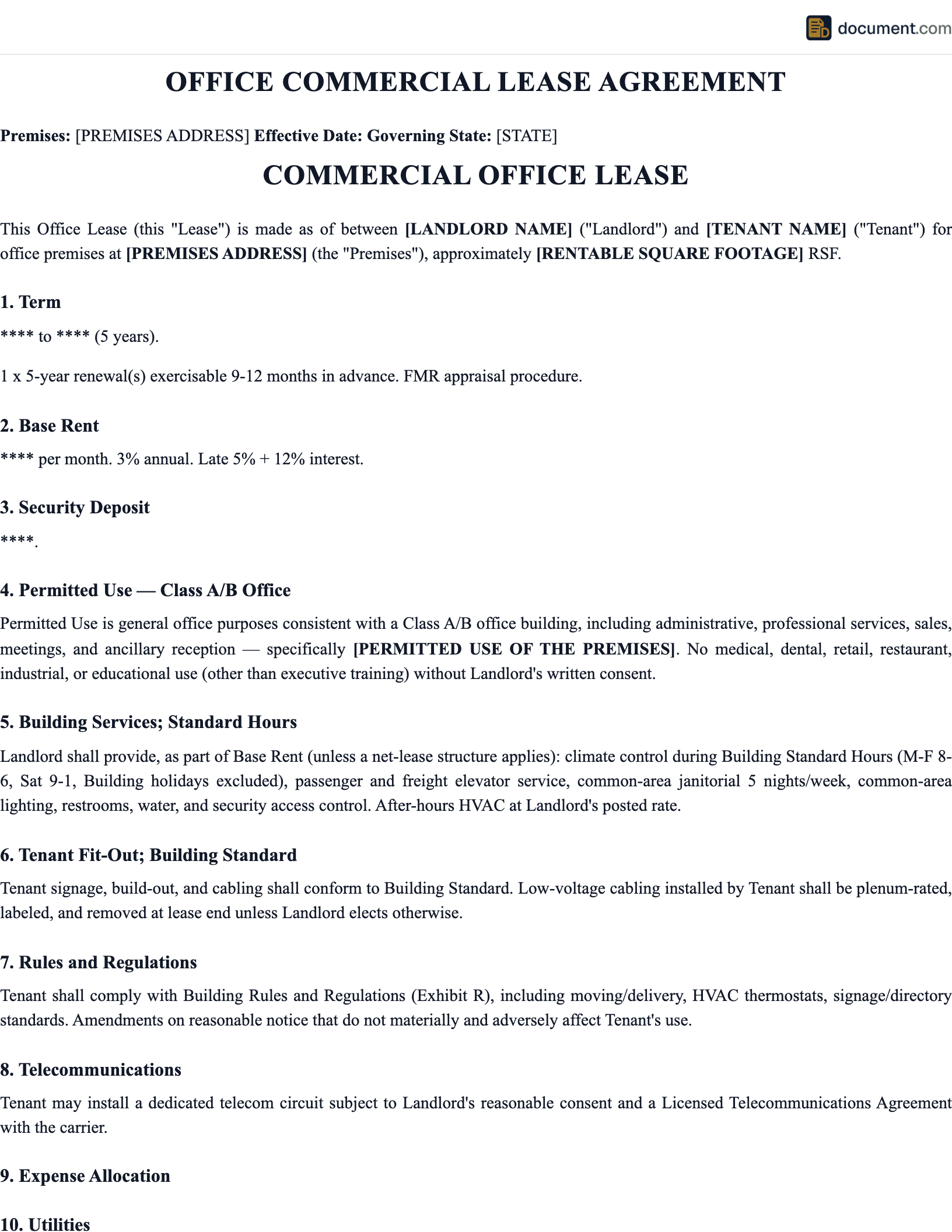
Sample New Jersey Office Space Lease Agreement
Below is a preview of our New Jersey-specific template. Your customized document will include all fields and provisions required for filing in any New Jersey county.
OFFICE SPACE LEASE AGREEMENT
STATE OF NEW JERSEY
Legal Document Template
LANDLORD
Name: [Full Legal Name / Entity]
Address: [Management Office Address]
Contact: [Property Manager Name]
TENANT
Name: [Business Entity Name]
Address: [Current Business Address]
Tax ID: [EIN]
Guarantor: [If Applicable]
PREMISES
Building: [Building Name/Address]
Suite: [Number]
Floor: [Floor Number]
RSF: [Rentable Square Feet]
USF: [Usable Square Feet]
FINANCIAL TERMS
Base Rent: $[Amount]/RSF/year
TI Allowance: $[Amount]/RSF
Expense Stop: $[Amount]/RSF
Parking: [# Spaces]
Deposit: $[Amount]
New Jersey Office Space Lease Agreement FAQ
Answers to common questions about filing a office space lease agreement in New Jersey, including requirements, fees, and procedures.
Official New Jersey Resources
Use these official state resources to verify requirements, find your local filing office, and access government forms for New Jersey.
Related New Jersey Documents
Depending on your situation, you may need additional documents alongside your New Jersey office space lease agreement.
Create your New Jersey Commercial Office Lease Agreement in under 5 minutes.
Answer a few questions and download a New Jersey-compliant document, ready for the state agency.