



New Hampshire Office Space Lease Agreement Overview
New Hampshire has carved out a distinct position in the New England commercial real estate market by combining no personal income tax, no general sales tax, and relatively low regulatory overhead. Portsmouth anchors the Seacoast office market, drawing defense contractors, professional services firms, and tech companies clustered around the Pease International Tradeport. Manchester, the state's largest city, offers a broad inventory of Class A and Class B office space at rates substantially below comparable Boston suburban product. Nashua and Salem see strong demand from Massachusetts-based businesses establishing NH offices to capture the income tax differential for commuting employees.
Commercial office leases in New Hampshire are governed by general contract law rather than a dedicated commercial landlord-tenant statute. RSA 477:7 requires leases with a term exceeding one year to be in writing to be enforceable under the statute of frauds, but beyond that formality, the parties have broad freedom to negotiate every material term. No statute caps security deposits, mandates specific CAM disclosure formats, or limits holdover penalties. The lease document itself defines the relationship in nearly every relevant respect, which makes careful drafting and thorough negotiation essential for both landlords and tenants.
None
Income tax
None
Sales tax on rent
No cap
Security deposit
RSA 477
Governing statute
New Hampshire Requirements
New Hampshire office leases are defined almost entirely by what the parties put in writing. The state imposes no security deposit limits, no mandatory CAM disclosure requirements, and no commercial tenant protection statutes beyond general contract law. That absence of regulation places the burden on tenants to negotiate favorable terms before signing.
New Hampshire Commercial Lease Note
New Hampshire has no income tax on wages and no general sales tax, which affects how tenants budget total occupancy costs. The Business Profits Tax (8.5%) and Business Enterprise Tax (0.55%) still apply to NH businesses. Leases over one year must be in writing under RSA 477:7. No statute caps security deposits or holdover penalties for commercial tenants.
Key Lease Provisions to Negotiate
- Written agreement: Required by RSA 477:7 for any lease term exceeding one year; commercial leases should always be written regardless of term length
- CAM cap and audit rights: New Hampshire law does not limit CAM charges; negotiate an annual cap on controllable expense increases (typically 3 to 5 percent) and the right to audit landlord records within 60 days of the annual reconciliation
- HVAC provisions: Specify who maintains the HVAC system, what after-hours access costs, and how heating costs are allocated in shared systems during New Hampshire's long heating season
- Personal guarantee scope: Many NH landlords require personal guarantees from LLC or corporate tenants; negotiate a burn-down provision that reduces the guarantee amount over the lease term
- Holdover rate: Define whether holdover creates a month-to-month tenancy or tenancy at sufferance, and set the holdover rent premium explicitly (typically 125 to 150 percent of final base rent)
- ADA allocation: Specify in the lease that landlord is responsible for ADA compliance in common areas and the tenant is responsible within the leased premises; address any planned build-out obligations explicitly
How to Execute a New Hampshire Office Lease
Executing a commercial office lease in New Hampshire follows the same general sequence as other New England markets, with a few state-specific considerations around tax planning and cold-climate building systems.
Survey the Submarket
Identify whether Portsmouth (Seacoast), Manchester (central NH), Nashua (southern border), or a secondary market best fits your team. Each submarket has different parking ratios, transit access, and labor pool characteristics. Companies targeting Massachusetts commuters typically focus on Nashua, Salem, or Derry, where employees capture the income tax savings.
Submit a Letter of Intent
A letter of intent (LOI) establishes the key commercial terms before either party spends money on lease drafting: base rent, term length, TI allowance, parking allocation, renewal options, and free rent period. LOIs are typically non-binding, but they set the negotiating baseline. New Hampshire landlords often counter on TI allowance and holdover rent premium in the LOI phase.
Review the Lease Document
Have an attorney review the full lease before signing. Focus on CAM structure and audit rights, HVAC maintenance allocation (critical given NH winters), personal guarantee burn-down terms, ADA responsibility, holdover rate, and any use clause restrictions. New Hampshire does not regulate these terms by statute, so they are entirely what the lease says they are.
Execute with Proper Authority
Corporate or LLC tenants should ensure the signatory has authority to bind the entity, which typically requires a board resolution or operating agreement provision. Landlords routinely request a certificate of authority or corporate resolution at signing. Personal guarantors should receive independent legal advice on the scope and duration of the guarantee.
Coordinate Build-Out and Occupancy
Once the lease is signed, coordinate TI construction with the landlord's approved contractor list. Confirm that any permits required by the local municipality (Manchester Building Department, Portsmouth Building Division, etc.) are pulled before work begins. Document the premises condition at move-in with written notes and photographs to protect the deposit at the end of the term.
New Hampshire Tax Implications for Office Tenants
New Hampshire's tax profile is one of the most favorable in New England for commercial tenants. Understanding which taxes apply and which do not is critical for accurate occupancy cost modeling.
| Tax / Cost Item | New Hampshire Treatment |
|---|---|
| State Income Tax on Wages | None. New Hampshire has no personal income tax on wages or salary, a major draw for businesses relocating from Massachusetts or Connecticut. |
| Sales Tax on Rent | None. New Hampshire has no general sales tax, so commercial rent payments are not subject to any state or local sales tax. |
| Business Profits Tax | 8.5% on net income for businesses with more than $50,000 in gross income. Rent paid is deductible as a business expense against BPT liability. |
| Business Enterprise Tax | 0.55% on enterprise value (compensation, interest, and dividends paid). Applies to businesses with gross receipts over $250,000. A separate tax from BPT. |
| Property Tax Passthrough | New Hampshire has no state property tax, but municipalities levy some of the highest property taxes in New England. In NNN and modified-gross leases, property tax increases pass through to tenants as a CAM or operating expense. |
| TI Allowance Treatment | Tenant improvement allowances funded by the landlord are generally treated as income to the tenant for federal tax purposes unless structured as a loan or qualified leaseholder improvement. Consult a tax advisor on the appropriate treatment. |
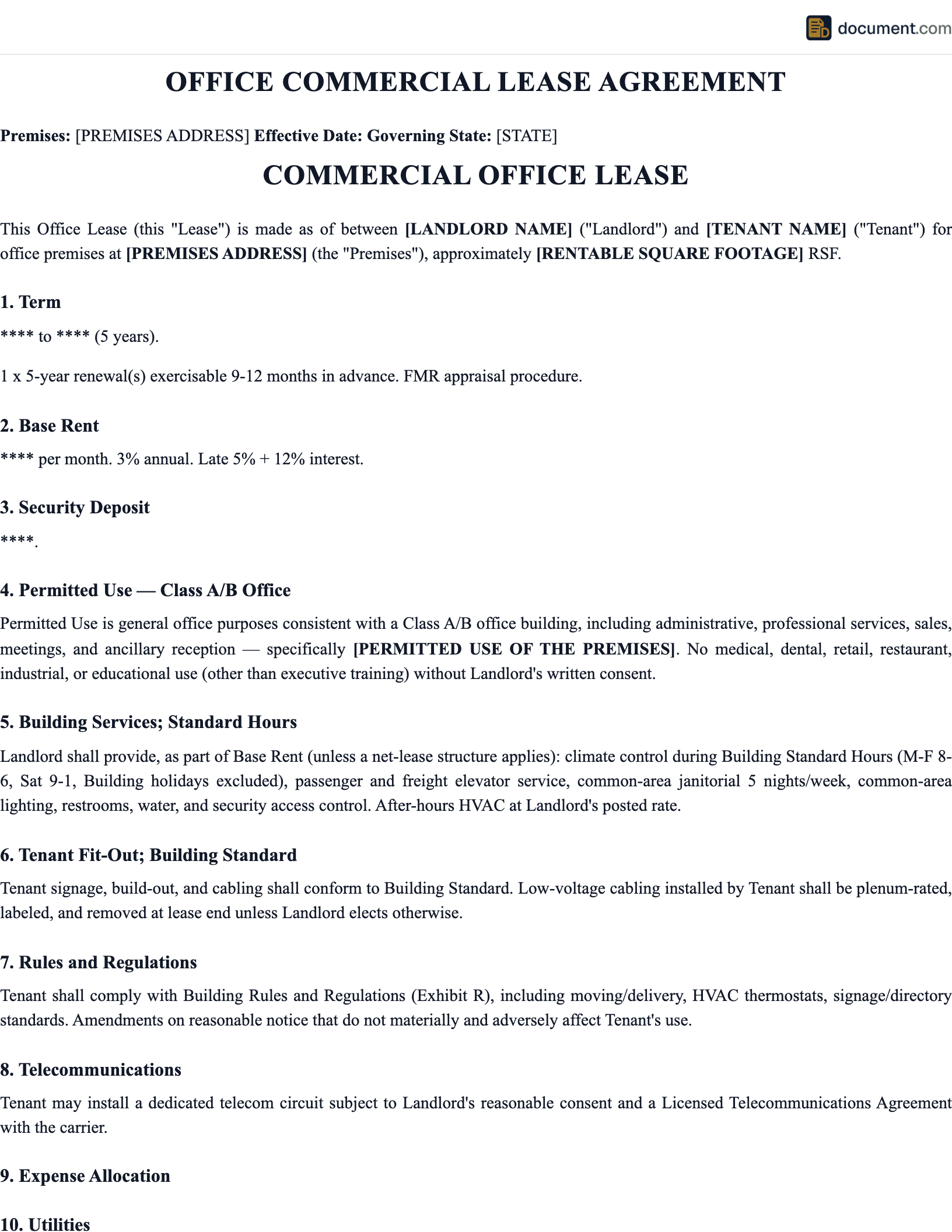
Sample New Hampshire Office Space Lease Agreement
Below is a preview of our New Hampshire-specific template. Your customized document will include all fields and provisions required for filing in any New Hampshire county.
OFFICE SPACE LEASE AGREEMENT
STATE OF NEW HAMPSHIRE
Legal Document Template
LANDLORD
Name: [Full Legal Name / Entity]
Address: [Management Office Address]
Contact: [Property Manager Name]
TENANT
Name: [Business Entity Name]
Address: [Current Business Address]
Tax ID: [EIN]
Guarantor: [If Applicable]
PREMISES
Building: [Building Name/Address]
Suite: [Number]
Floor: [Floor Number]
RSF: [Rentable Square Feet]
USF: [Usable Square Feet]
FINANCIAL TERMS
Base Rent: $[Amount]/RSF/year
TI Allowance: $[Amount]/RSF
Expense Stop: $[Amount]/RSF
Parking: [# Spaces]
Deposit: $[Amount]
New Hampshire Office Space Lease Agreement FAQ
Answers to common questions about filing a office space lease agreement in New Hampshire, including requirements, fees, and procedures.
Official New Hampshire Resources
Use these official state resources to verify requirements, find your local filing office, and access government forms for New Hampshire.
Related New Hampshire Documents
Depending on your situation, you may need additional documents alongside your New Hampshire office space lease agreement.
Create your New Hampshire Commercial Office Lease Agreement in under 5 minutes.
Answer a few questions and download a New Hampshire-compliant document, ready for the state agency.