
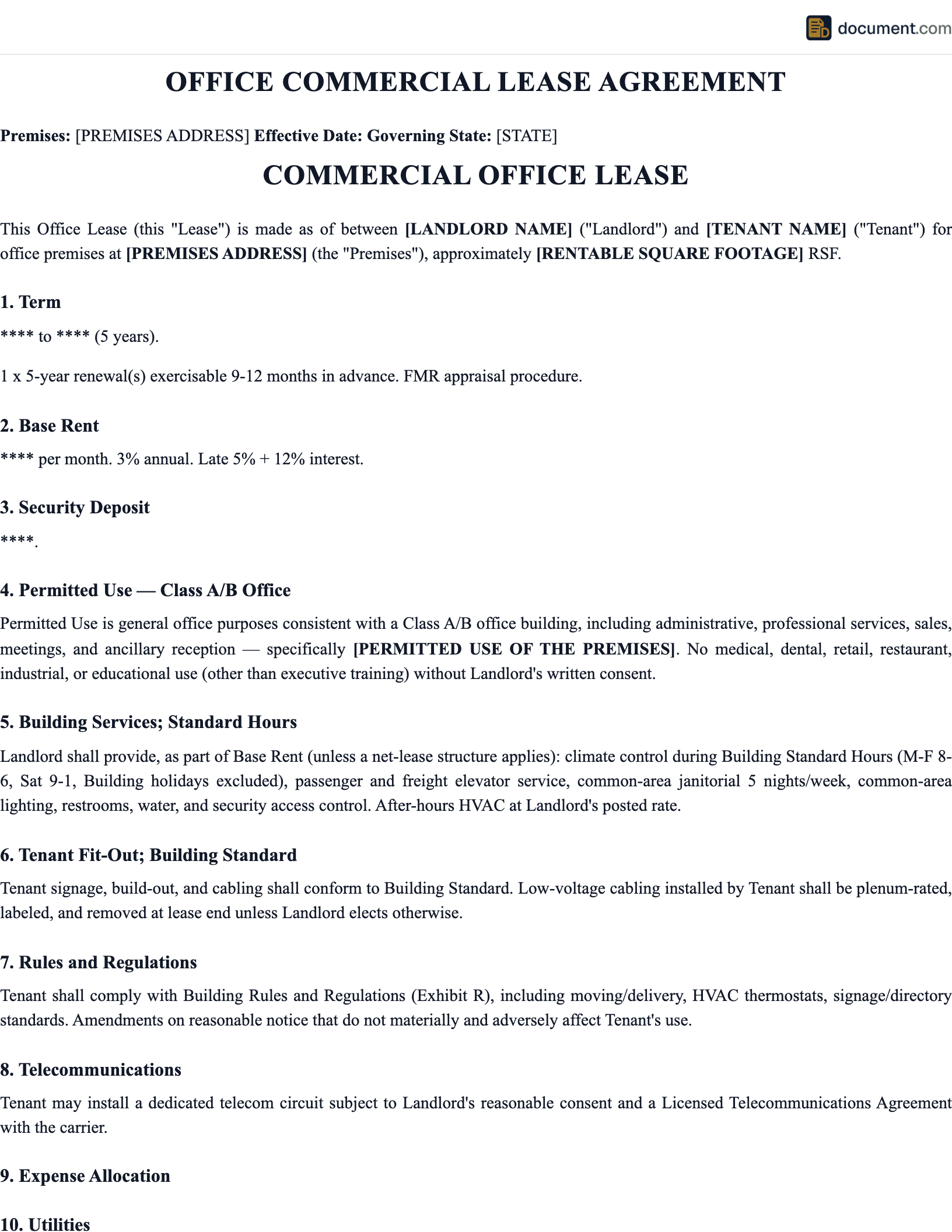



Nevada Office Space Lease Agreement Overview
Nevada's commercial office market is one of the more dynamic in the American West, driven by a business-friendly tax environment unlike almost any other state. The absence of both corporate income tax and personal income tax has made Nevada a destination for businesses looking to reduce their state tax burden, and the Las Vegas metro's Class A office inventory has tightened accordingly. Companies from California, in particular, have established Nevada satellite offices, regional headquarters, or full relocations to capture both the tax advantage and the lower overall cost of doing business. Reno-Sparks has followed a parallel trajectory, with the Northern Nevada Technology Center and a growing data center cluster transforming what was once a gaming-dependent economy.
Nevada commercial lease law is minimally interventionist. There is no commercial rent control, no mandatory commercial lease disclosure statute, and no cap on security deposits for commercial tenants. Nevada Revised Statutes govern commercial landlord-tenant relationships primarily through contract enforcement, meaning the terms parties negotiate in the lease control almost all disputes. Nevada courts apply commercial lease provisions as written and do not impose consumer-protective interpretations on business agreements. Practically, this means every protection a tenant wants must be negotiated into the lease: CAM caps, holdover rates, HVAC warranties, parking rights, assignment rights, and renewal options will not be implied by Nevada law.
$25
Filing fee
Required
Notarization
0
Witnesses required
County
Filing office
Nevada Requirements
Nevada has specific requirements for this type of legal document. Meeting these requirements ensures your document is accepted by the county recorder and is legally enforceable.
Nevada Specific Note
Nevada imposes no security deposit cap on commercial office leases and no mandatory disclosure requirements. Nevada has no state income tax or corporate income tax, which significantly affects lease economics and tenant demand. HVAC costs in Las Vegas are substantial due to desert climate air conditioning demands, and the lease should specify clearly whether utilities are included and who maintains the HVAC system. Clark County and Washoe County both have active commercial real estate markets with different characteristics.
Key Provisions for Nevada Office Leases
- Written Agreement: Required for leases exceeding one year under Nevada's statute of frauds; all material terms must be expressly stated
- HVAC and Utilities: Las Vegas desert climate makes HVAC costs a major occupancy expense; specify who pays, who maintains, and what standards the system must meet
- CAM Definitions and Cap: Specify included expenses, audit rights, and annual cap on controllable CAM increases; Nevada has no statutory protection on this
- Parking: Address ratio, reserved versus unreserved spaces, and monthly cost; parking is a key negotiation point in Las Vegas's denser office submarkets
- Holdover Rate: State the holdover rent rate expressly; Nevada courts enforce lease terms as written without judicial softening
- Use Clause: Gaming-related businesses should confirm the use clause permits their specific business activities, particularly if they involve gaming licensee operations
How to Execute a Nevada Office Lease
Executing a Nevada commercial office lease is a negotiation-driven process. Here is a practical sequence for Las Vegas or Reno office tenants.
Survey the Market and Identify Target Submarket
Las Vegas office submarkets differ significantly. Summerlin and Southwest Las Vegas offer suburban campus-style office parks with ample parking. Downtown Las Vegas has older stock and different parking dynamics. The Strip and surrounding area has specialized hospitality-adjacent demand. Reno-Sparks serves a different industry mix. Identify your target submarket before engaging brokers.
Negotiate a Letter of Intent
In Nevada's competitive Class A market, LOIs are the standard first step. Address base rent, term, TI allowance, parking terms, renewal options, and security deposit at the LOI stage. Getting these agreed in principle reduces negotiation friction when the full lease arrives.
Review and Negotiate the Full Lease
Pay particular attention to HVAC provisions and utility allocation, CAM definitions and caps, holdover provisions, assignment and sublease rights, and ADA compliance allocation. Nevada courts enforce commercial lease terms as written, so negotiate what you want in the document rather than assuming favorable terms will be implied.
Execute the Lease with Proper Authority
Both parties must sign through authorized representatives. Nevada does not require recording of commercial leases for enforceability between the parties, but recording a memorandum of lease with the Clark County or Washoe County Recorder protects against subsequent purchasers.
Complete Build-Out and Begin Occupancy
Finalize the work letter if TI is involved, obtain building permits from Clark County or City of Las Vegas, and track the rent commencement date relative to substantial completion. Document pre-occupancy condition of the space.
Tax Implications for Nevada Office Tenants
Nevada's tax advantages are a primary driver of office demand. There is no state corporate income tax and no personal income tax, which means businesses operating in Nevada do not pay state income tax on Nevada-sourced profits. Commercial rent is not subject to Nevada sales tax. This makes Nevada's total tax burden for office tenants among the lowest in the country. Property taxes in Clark County and Washoe County are moderate and are commonly passed through to tenants in NNN lease structures, but the absence of income tax more than offsets this for most businesses.
| Tax or Cost Item | Nevada Treatment |
|---|---|
| State Income Tax | None; Nevada has no corporate or personal income tax |
| Sales Tax on Rent | Not applicable; Nevada does not tax commercial rent |
| Property Tax Passthrough | Common in NNN leases; Clark County and Washoe County rates are moderate; negotiate a cap |
| Commerce Tax | Nevada's commerce tax applies to businesses with gross revenue over $4 million; confirm applicability with a Nevada CPA |
| TI Allowance Tax Treatment | May be taxable income at the federal level depending on structure; Nevada has no state income tax effect |
Sample Nevada Office Space Lease Agreement
Below is a preview of our Nevada-specific template. Your customized document will include all fields and provisions required for filing in any Nevada county.
OFFICE SPACE LEASE AGREEMENT
STATE OF NEVADA
Legal Document Template
LANDLORD
Name: [Full Legal Name / Entity]
Address: [Management Office Address]
Contact: [Property Manager Name]
TENANT
Name: [Business Entity Name]
Address: [Current Business Address]
Tax ID: [EIN]
Guarantor: [If Applicable]
PREMISES
Building: [Building Name/Address]
Suite: [Number]
Floor: [Floor Number]
RSF: [Rentable Square Feet]
USF: [Usable Square Feet]
FINANCIAL TERMS
Base Rent: $[Amount]/RSF/year
TI Allowance: $[Amount]/RSF
Expense Stop: $[Amount]/RSF
Parking: [# Spaces]
Deposit: $[Amount]
Nevada Office Space Lease Agreement FAQ
Answers to common questions about filing a office space lease agreement in Nevada, including requirements, fees, and procedures.
Official Nevada Resources
Use these official state resources to verify requirements, find your local filing office, and access government forms for Nevada.
Related Nevada Documents
Depending on your situation, you may need additional documents alongside your Nevada office space lease agreement.
Create your Nevada Commercial Office Lease Agreement in under 5 minutes.
Answer a few questions and download a Nevada-compliant document, ready for the state agency.