
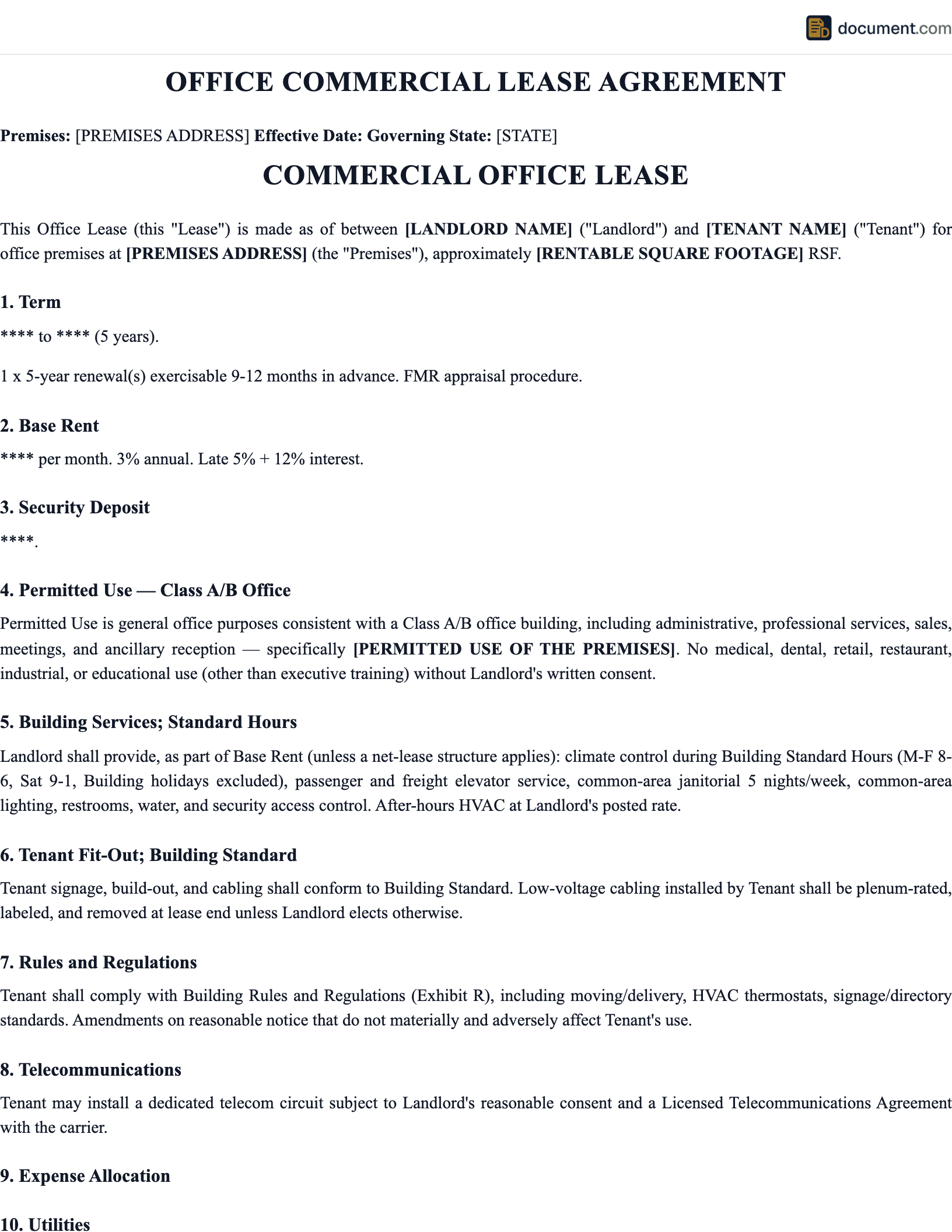



Montana Office Space Lease Agreement Overview
Montana's commercial office market is experiencing a genuine growth inflection. Bozeman has emerged as one of the fastest-growing small cities in the country, driven by remote workers, tech companies establishing Montana outposts, and an expanding professional services sector. Missoula carries a similar dynamic with university-adjacent businesses and a strong healthcare employment base. These markets now command office rents that would have been unthinkable a decade ago, and landlords in prime downtown locations are negotiating from a position of real leverage.
From a legal standpoint, Montana is a minimally regulated state for commercial real estate. There is no commercial rent control, no mandatory lease disclosure regime, and no statutory cap on security deposits. Commercial tenants in Montana operate almost entirely under the terms they negotiate, which makes the lease document critically important. Montana courts generally enforce commercial lease terms as written, without the paternalistic intervention some other states apply to business tenants. The state's statute of frauds requires leases exceeding one year to be in writing, but beyond that, the parties are largely free to structure the relationship as they see fit. HVAC allocation, utility metering, parking ratios, and build-out responsibilities all need to be addressed in the lease itself because Montana law provides no default rule favorable to tenants on these points.
$12
Filing fee
Required
Notarization
0
Witnesses required
County
Filing office
Montana Requirements
Montana commercial office leases are governed by general contract law rather than a comprehensive landlord-tenant statute. There is no state commercial lease act that imposes mandatory terms on the parties. What Montana does require is that leases exceeding one year be in writing, and that they be properly signed by authorized representatives of each party. Beyond that, enforceability depends almost entirely on whether the document is well-drafted.
Montana Important Note
Montana imposes no security deposit cap, no mandatory commercial lease disclosure requirements, and no rent control on commercial property. This is good news for landlords but means tenants must negotiate every protection they want. Build-out allowances, HVAC warranties, CAM audit rights, and holdover rent rates will not be implied by law if they are not written into the lease. In Montana's growing Bozeman and Missoula markets, getting these details right upfront is increasingly important.
Key Lease Provisions for Montana Office Tenants
- Written Agreement: Required by Montana's statute of frauds for leases exceeding one year; all material terms must be expressly stated
- Security Deposit Terms: No statutory cap; specify amount, interest (if any), permissible deductions, and return timeline in the lease itself
- HVAC and Utility Allocation: Montana winters demand clarity on who pays heating costs and who maintains the HVAC system; specify whether utilities are gross, modified gross, or net
- CAM Provisions: Define what expenses are included, cap annual CAM increases, and include audit rights; Montana law provides no default protections on this
- Holdover Rate: Expressly state the holdover rent rate (typically 125-150% of base rent) to avoid month-to-month uncertainty under Montana common law
- ADA Compliance Allocation: Montana has no state ADA analog; the lease must specify who is responsible for ADA compliance within the premises versus common areas
How to Execute a Montana Office Lease
Executing a Montana commercial office lease is a negotiation-driven process. Montana imposes no mandatory forms or state-agency filings for commercial leases, so the process is between the parties. Here is how it typically works.
Identify and Inspect the Space
Tour office options in your target Montana market. In Bozeman and Missoula, available Class A inventory is limited, so acting quickly once you identify the right space matters. Confirm HVAC condition, parking, internet infrastructure, and build-out status before negotiations begin.
Negotiate a Letter of Intent
A signed letter of intent establishes the key financial and business terms before the full lease is drafted. In Montana, LOIs are typically non-binding but create a roadmap that reduces back-and-forth on the lease itself. Address base rent, term, renewal options, build-out allowance, and security deposit at the LOI stage.
Draft and Review the Full Lease
Use a Montana-specific office lease template and customize it to match the negotiated LOI terms. Pay special attention to CAM definitions, utility responsibility, HVAC maintenance schedules, holdover provisions, and any build-out work letters. Montana law will not fill in missing terms favorably for tenants.
Sign and Deliver the Executed Lease
Both parties' authorized representatives must sign. For corporate tenants, confirm that the signatory has authority under the entity's governing documents. Montana does not require county filing or recording for a commercial lease to be valid between the parties, though recording a memorandum of lease protects against subsequent purchasers.
Coordinate Build-Out and Occupancy
If the lease includes a tenant improvement allowance, finalize the work letter, obtain building permits through the applicable Montana city or county, and confirm the rent commencement date relative to substantial completion of the build-out. Keep copies of the fully executed lease and all work letters for the entire tenancy.
Tax Implications for Montana Office Tenants
Montana's tax environment is generally favorable for businesses. The state has no sales tax, which means commercial rent is not subject to sales tax at the state level. Montana does have a state income tax, so rent payments are deductible business expenses for tenants structured as pass-through entities or corporations. Property tax in Montana is assessed at the county level, and in triple-net or modified-gross leases, a portion of the landlord's property tax obligation is typically passed through to tenants as part of CAM or operating expenses.
| Tax or Cost Item | Montana Treatment |
|---|---|
| Sales Tax on Rent | None; Montana has no general sales tax |
| Property Tax Passthrough | Common in NNN and modified-gross leases; negotiable cap is advisable |
| CAM Expense Recovery | Landlord recovers operating costs; reconciliation typically annual |
| Rent Deductibility | Deductible for Montana state income tax and federal purposes |
| TI Allowance Tax Treatment | May be taxable income to tenant; consult a Montana CPA before finalizing |
Sample Montana Office Space Lease Agreement
Below is a preview of our Montana-specific template. Your customized document will include all fields and provisions required for filing in any Montana county.
OFFICE SPACE LEASE AGREEMENT
STATE OF MONTANA
Legal Document Template
LANDLORD
Name: [Full Legal Name / Entity]
Address: [Management Office Address]
Contact: [Property Manager Name]
TENANT
Name: [Business Entity Name]
Address: [Current Business Address]
Tax ID: [EIN]
Guarantor: [If Applicable]
PREMISES
Building: [Building Name/Address]
Suite: [Number]
Floor: [Floor Number]
RSF: [Rentable Square Feet]
USF: [Usable Square Feet]
FINANCIAL TERMS
Base Rent: $[Amount]/RSF/year
TI Allowance: $[Amount]/RSF
Expense Stop: $[Amount]/RSF
Parking: [# Spaces]
Deposit: $[Amount]
Montana Office Space Lease Agreement FAQ
Answers to common questions about filing a office space lease agreement in Montana, including requirements, fees, and procedures.
Official Montana Resources
Use these official state resources to verify requirements, find your local filing office, and access government forms for Montana.
Related Montana Documents
Depending on your situation, you may need additional documents alongside your Montana office space lease agreement.
Create your Montana Commercial Office Lease Agreement in under 5 minutes.
Answer a few questions and download a Montana-compliant document, ready for the state agency.