



Missouri Office Space Lease Agreement Overview
Missouri office leases are governed by contract law — the state has no commercial landlord-tenant statute, so the negotiated agreement controls everything. Missouri has two dominant office markets with meaningfully different characteristics: Kansas City and St. Louis. Kansas City has a strong suburban office corridor in Johnson County, Kansas (across the state line), plus dense downtown towers and the growing Crossroads district. St. Louis office demand concentrates in Clayton, the Central Corridor along Forsyth and Hanley, and a revitalizing downtown. Rents in both markets are well below coastal benchmarks, which gives tenants negotiating leverage even in strong demand cycles.
One jurisdictional issue unique to Missouri: St. Louis City and St. Louis County are entirely separate governmental entities. A lease in St. Louis City subjects employees to the city's 1% earnings tax on wages earned within city limits, while leases in suburban municipalities like Clayton or Creve Coeur involve county-level governance with different tax structures. In Kansas City, the metro spans two states — Missouri and Kansas — creating additional complexity for businesses with employees on both sides. Understanding which jurisdiction your office is in before signing affects payroll tax planning, business licensing, and the applicable local building and zoning codes.
None
Sales tax on rent
None
Deposit cap
Contract
Law governs
KC / STL
Primary markets
Missouri Requirements
Missouri has no commercial tenant protection statute. The lease agreement and applicable local ordinances are the complete legal framework for a Missouri office tenancy.
St. Louis City vs. County — A Critical Distinction
St. Louis City and St. Louis County are independent governmental units. Office leases in St. Louis City trigger the city's 1% earnings tax on wages earned there, city business license requirements, and city building codes. Leases in Clayton, Creve Coeur, or other county municipalities are governed by different rules. Before signing a St. Louis area lease, confirm the applicable jurisdiction and factor local taxes into your total occupancy cost model.
Key Provisions to Negotiate
- Written agreement: Required for any lease exceeding one year under Missouri's statute of frauds; use a written agreement regardless of term for protection in any dispute
- CAM structure and cap: Identify which operating expenses are included, your proportionate share calculation method, and whether annual increases are capped or subject to an expense stop
- TI allowance and work letter: Specify the landlord's tenant improvement contribution, control over construction, completion timeline, and whether unused allowance converts to free rent
- Holdover rate: Define the holdover rate explicitly — Missouri leases commonly use 125-150% of base rent — to avoid ambiguity if the lease term expires
- Assignment and change-of-control: Negotiate whether a sale or acquisition of your business entity triggers a landlord consent requirement, and the standards under which consent can be withheld
- Personal guaranty: Missouri landlords frequently require personal guaranties from business owners; negotiate a burn-down tied to lease performance or a cap on the guaranty period
How to Execute a Missouri Office Lease
Missouri office leases are private contracts — there is no government filing required for a commercial lease to be binding between the parties. The process focuses on market research, negotiation, and careful execution.
Identify the Right Submarket
In Kansas City, determine whether downtown KC, the Crossroads, or the suburban Johnson County corridor best serves your workforce. In St. Louis, decide between Clayton, the Central Corridor, downtown, or suburban options like Creve Coeur or Chesterfield. The submarket choice affects commute patterns, rent levels, and applicable local taxes.
Submit a Letter of Intent
Propose your rent, term, TI allowance, free rent, and key business terms before the landlord drafts a full lease. Missouri landlords in the current market often negotiate meaningfully on TI allowances and free rent periods to attract creditworthy tenants.
Review CAM and Build-Out Terms
Request actual CAM reconciliation history for the building to understand real operating expenses. Negotiate the work letter — specifying TI allowance, landlord's construction obligations, and delivery timeline — before finalizing lease terms.
Execute by Authorized Signatories
Sign through the authorized representative of your business entity. Confirm the landlord signatory has authority to bind the property owner. Notarization is not required for a Missouri commercial lease to be enforceable, though landlords sometimes request it as a formality.
Deliver Security Deposit and Confirm Commencement
Deliver the security deposit per the lease terms. Confirm in writing the commencement date, rent commencement date, and any free rent period. Document the space condition at move-in with photographs to protect against damage claims at lease end.
Tax Implications and CAM Costs
Missouri does not tax commercial rent at the state level, which keeps occupancy costs lower than in states like Mississippi or Arizona. Local tax overlays in Kansas City and St. Louis require separate analysis.
| Cost Item | Missouri Treatment |
|---|---|
| State sales tax on rent | Missouri does not impose sales tax on commercial real property leases — a meaningful cost advantage over states that do |
| St. Louis City earnings tax | 1% earnings tax on wages earned within St. Louis City limits; does not apply in St. Louis County municipalities |
| CAM pass-through | Tenant's pro-rata share of operating expenses; negotiate a base-year expense stop or annual cap on increases |
| Rent deductibility | Base rent and CAM are deductible as ordinary business expenses for federal and Missouri state income tax purposes |
| TI allowance tax treatment | Leasehold improvements are amortized over the lease term or useful life; consult a tax professional for the correct classification |
Important Considerations
- Kansas City two-state metro: Many businesses in the KC metro have offices on both the Missouri and Kansas sides of the state line. Employees working in different states create payroll tax complexity — confirm with a tax professional before choosing a location.
- Clayton vs. St. Louis City: Clayton functions as the de facto business capital of the St. Louis region for many professional services firms. Class A rents in Clayton are higher than downtown St. Louis but lower than comparable space in most major coastal metros.
- Personal guaranty negotiation: Missouri landlords commonly require personal guaranties from business owners, particularly for newer businesses. Negotiate a burn-down provision that reduces guaranty exposure after a period of on-time payment.
- ADA compliance allocation: Missouri does not add state-level accessibility requirements beyond the federal ADA. Negotiate clearly in the lease which party is responsible for ADA-compliant modifications in tenant-controlled areas of the suite.
Sample Missouri Office Space Lease Agreement
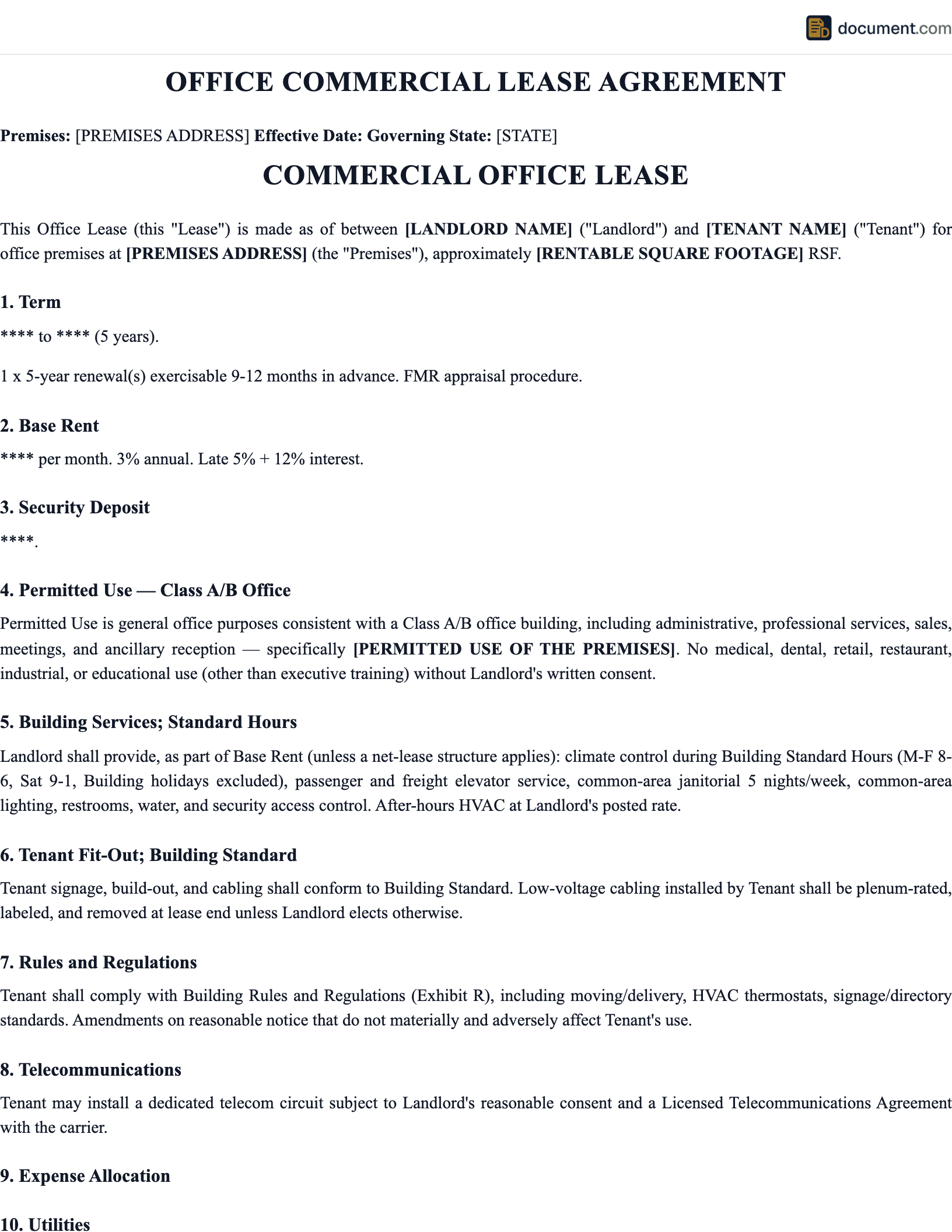
Below is a preview of our Missouri-specific template. Your customized document will include all fields and provisions required for filing in any Missouri county.
OFFICE SPACE LEASE AGREEMENT
STATE OF MISSOURI
Legal Document Template
LANDLORD
Name: [Full Legal Name / Entity]
Address: [Management Office Address]
Contact: [Property Manager Name]
TENANT
Name: [Business Entity Name]
Address: [Current Business Address]
Tax ID: [EIN]
Guarantor: [If Applicable]
PREMISES
Building: [Building Name/Address]
Suite: [Number]
Floor: [Floor Number]
RSF: [Rentable Square Feet]
USF: [Usable Square Feet]
FINANCIAL TERMS
Base Rent: $[Amount]/RSF/year
TI Allowance: $[Amount]/RSF
Expense Stop: $[Amount]/RSF
Parking: [# Spaces]
Deposit: $[Amount]
Missouri Office Space Lease Agreement FAQ
Answers to common questions about filing a office space lease agreement in Missouri, including requirements, fees, and procedures.
Official Missouri Resources
Use these official state resources to verify requirements, find your local filing office, and access government forms for Missouri.
Related Missouri Documents
Depending on your situation, you may need additional documents alongside your Missouri office space lease agreement.
Create your Missouri Commercial Office Lease Agreement in under 5 minutes.
Answer a few questions and download a Missouri-compliant document, ready for the state agency.