
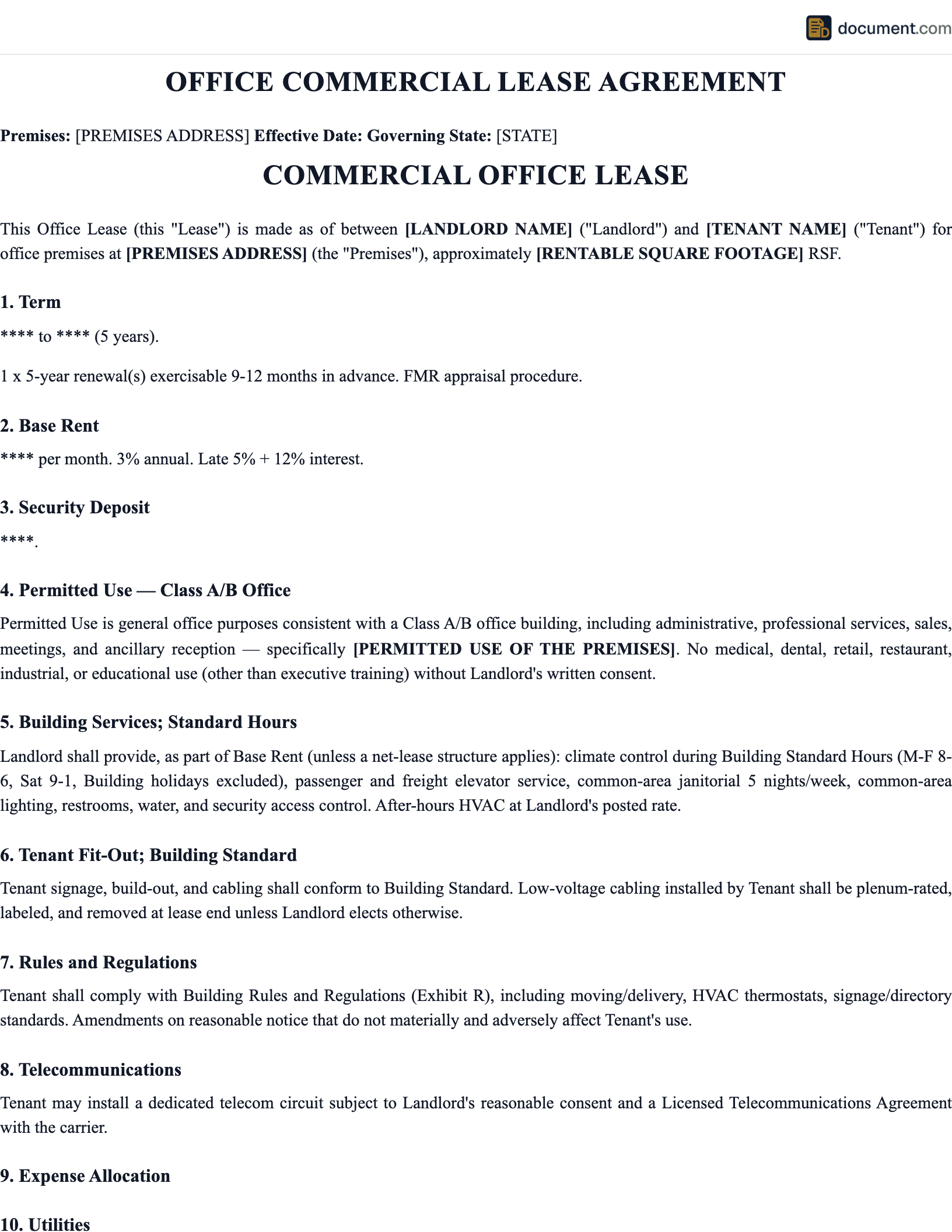



Minnesota Office Space Lease Agreement Overview
Minnesota's commercial office market is anchored by Minneapolis and St. Paul, two distinct markets with meaningfully different economics and tenant profiles. Minneapolis Class A office space in the central business district commands premium rents supported by a healthcare, finance, and technology economy. The city's famous skyway system connects most downtown office buildings and is a real factor in building desirability, particularly during the long Minnesota winters. St. Paul offers comparable quality space at lower rates, with a government and nonprofit sector employment base and a more relaxed leasing environment.
Minnesota commercial office leases are governed by contract law. The state has no commercial tenant statute that provides mandatory protections equivalent to its residential tenant laws. Security deposits are uncapped for commercial tenants, CAM structures vary by building type and market, and the written lease governs essentially everything about the landlord-tenant relationship. Minnesota's cold climate has a practical impact on lease terms: heating costs are a significant component of building operating expenses, after-hours HVAC provisions deserve close attention, and some tenants in older suburban buildings negotiate directly for dedicated HVAC systems during build-out to avoid shared infrastructure issues in extreme weather.
$46
Filing fee
Required
Notarization
0
Witnesses required
County
Filing office
Minnesota Requirements
Minnesota commercial office leases are governed by contract law, not by a commercial tenant statute. The statute of frauds requires written agreements for leases exceeding one year. Beyond that baseline, the key requirements are whatever the parties negotiate into the written lease.
Minnesota Specific Note
Minnesota's cold climate creates a genuine issue around HVAC provisions that office tenants in warmer states do not face. Building heating systems during Minnesota winters are often running near capacity, and after-hours heating availability and cost should be specifically negotiated rather than left to the landlord's standard operating procedures. The Minnesota Human Rights Act prohibits disability discrimination in commercial real estate and supplements federal ADA requirements for accessibility compliance.
Key Provisions for Minnesota Office Leases
- Skyway access terms: Confirm whether the building has direct skyway access, what hours the skyway is accessible, and whether the tenant's lease includes skyway access rights at no additional charge
- HVAC hours and after-hours rates: Specify the hours that HVAC is included in base rent, the specific rate for after-hours heating and cooling, and whether a dedicated HVAC system for the tenant's space is available
- CAM structure and controllable expense cap: Define the expense stop or base year, negotiate a cap on controllable expense increases, and confirm the right to audit CAM reconciliation statements annually
- Holdover provision: Specify the holdover rent rate and the notice period required to convert holdover to a month-to-month arrangement or terminate the occupancy
- Parking and winter access: In Minnesota, confirm the parking arrangement addresses winter conditions including heated ramp access, snow removal obligations, and whether outdoor surface lots are usable year-round
- Assignment and change of control: Define what constitutes a change of control requiring landlord consent and negotiate reasonable grounds for withholding consent
How to Execute a Minnesota Commercial Office Lease
Minnesota commercial office leases are private agreements not typically filed with any government office. Here is how the process typically unfolds.
Tour and Compare Buildings with Skyway Access
In Minneapolis's downtown market, skyway connectivity is a significant quality-of-life and operational factor. Build a comparison matrix of candidate buildings that includes skyway hours, after-hours access procedures, parking arrangements, and proximity to amenities before settling on a space to negotiate.
Negotiate a Letter of Intent
Lock in base rent, term, TI allowance, free rent, and HVAC provisions before the formal lease drafting begins. The LOI should address after-hours HVAC rates specifically, as this is a Minnesota-specific cost driver that is easy to overlook during initial negotiations.
Review CAM Structure and Expense Exclusions
Minnesota office buildings with CAM structures should clearly define what costs are included, what capital expenditures are excluded, and what the tenant's pro-rata share percentage is. Negotiate a cap on controllable expense increases and the right to audit CAM statements annually within 12 months of receipt.
Execute by Authorized Signatories
Both parties sign through individuals with authority to bind them. Notarization is not required for a Minnesota commercial lease to be enforceable between the parties unless it will be recorded with the County Recorder. Most office leases in Minnesota are not recorded.
Deliver Deposit and Confirm Build-Out Timeline
There is no Minnesota statute requiring commercial security deposits to be held separately. Confirm the deposit amount, when it is due, and the timeline for any tenant improvement work. Plan the build-out schedule to account for Minnesota weather if the work involves any exterior elements or HVAC modifications.
Tax Implications and CAM Costs in Minnesota
Minnesota office tenants need to understand both the CAM passthrough structure and the state tax treatment of commercial lease payments.
| Cost Item | Minnesota Treatment |
|---|---|
| CAM Expense Passthrough | Modified gross leases in Minneapolis pass increases above the base year expense stop to tenants on a pro-rata basis; heating costs make controllable expense caps particularly important in Minnesota |
| Minnesota Sales Tax on Rent | Minnesota does not impose a general sales tax on commercial real estate rent; confirm with a tax advisor whether any bundled services in the lease are subject to Minnesota sales tax |
| Property Tax Passthrough | Triple-net leases require tenants to pay a share of real estate taxes; modified gross leases address taxes through the expense stop or base year mechanism |
| Rent Deductibility | Office rent is deductible as an ordinary business expense for Minnesota income tax purposes; Minnesota follows federal treatment for lease expense deductions |
| After-Hours HVAC Costs | After-hours HVAC charges in Minnesota office buildings can be substantial during winter months; these costs are deductible as business expenses and should be tracked separately from base rent |
Important Considerations for Minnesota Office Tenants
Minnesota office tenants face some market conditions and practical issues that deserve special attention.
- Skyway system dynamics: The Minneapolis skyway is a genuine competitive differentiator for downtown office buildings, and its value varies by floor and building location. Some floors in some buildings have excellent skyway connectivity; others have access that requires multiple elevator changes. Walk the route yourself before committing.
- Minneapolis vs. St. Paul market differences: Minneapolis and St. Paul are distinct markets with different tenant demand profiles. St. Paul's downtown vacancy rate has historically been higher than Minneapolis, giving office tenants in St. Paul more negotiating leverage on rent, TI allowance, and free rent than they would have in comparable Minneapolis buildings.
- Healthcare sector concentration: The Twin Cities healthcare sector, anchored by large health systems, is the dominant employer in the market and tends to drive demand for both medical office and adjacent professional services space. Tenants in healthcare-adjacent industries often benefit from locating near major hospital campuses in the suburbs, where rents are competitive and parking is plentiful.
- Minnesota Human Rights Act: The Minnesota Human Rights Act is broader than federal ADA in some areas and applies to commercial real estate. Tenants who make physical alterations to their office space should confirm that both ADA and Minnesota Accessibility Code requirements are satisfied for any area affected by the build-out.
Sample Minnesota Office Space Lease Agreement
Below is a preview of our Minnesota-specific template. Your customized document will include all fields and provisions required for filing in any Minnesota county.
OFFICE SPACE LEASE AGREEMENT
STATE OF MINNESOTA
Legal Document Template
LANDLORD
Name: [Full Legal Name / Entity]
Address: [Management Office Address]
Contact: [Property Manager Name]
TENANT
Name: [Business Entity Name]
Address: [Current Business Address]
Tax ID: [EIN]
Guarantor: [If Applicable]
PREMISES
Building: [Building Name/Address]
Suite: [Number]
Floor: [Floor Number]
RSF: [Rentable Square Feet]
USF: [Usable Square Feet]
FINANCIAL TERMS
Base Rent: $[Amount]/RSF/year
TI Allowance: $[Amount]/RSF
Expense Stop: $[Amount]/RSF
Parking: [# Spaces]
Deposit: $[Amount]
Minnesota Office Space Lease Agreement FAQ
Answers to common questions about filing a office space lease agreement in Minnesota, including requirements, fees, and procedures.
Official Minnesota Resources
Use these official state resources to verify requirements, find your local filing office, and access government forms for Minnesota.
Related Minnesota Documents
Depending on your situation, you may need additional documents alongside your Minnesota office space lease agreement.
Create your Minnesota Commercial Office Lease Agreement in under 5 minutes.
Answer a few questions and download a Minnesota-compliant document, ready for the state agency.