



Massachusetts Office Space Lease Agreement Overview
Massachusetts commercial office leasing is shaped by two forces that tenants elsewhere rarely encounter with the same intensity: a dense urban core where biotech, life sciences, and technology firms compete aggressively for Class A space in Cambridge, the Seaport, and Kendall Square, and a strong attorney-review culture that treats lease negotiation as a transactional legal matter rather than a fill-in-the-blank exercise. Commercial leases in Massachusetts are governed by contract law, not by the residential landlord-tenant statute, and the parties have wide latitude to allocate risk however they negotiate.
There is no statutory cap on security deposits for commercial tenants in Massachusetts, and no mandatory disclosure checklist for office leases. What the state does offer is Chapter 93A, the consumer protection statute, which Massachusetts courts have extended to some commercial leasing contexts where a party engages in deceptive conduct beyond ordinary bargaining. The practical result is that Massachusetts commercial tenants have slightly more leverage when a landlord misrepresents material facts than tenants in states where 93A has no commercial application. Beyond that, the written lease controls almost everything: rent escalations, CAM expense obligations, HVAC hours, holdover rates, build-out allowances, and subletting rights. Negotiating a complete and precise lease at the outset protects both parties from costly disputes later.
$75
Filing fee
Required
Notarization
0
Witnesses required
Registry
Filing office
Massachusetts Requirements
Massachusetts commercial office leases are primarily creatures of contract. The statute of frauds requires any lease for a term longer than one year to be in writing. Beyond that baseline, the essential legal requirements are the ones the parties negotiate into the document itself.
Massachusetts Specific Note
Massachusetts's Architectural Access Board enforces accessibility standards that often exceed federal ADA requirements. Any tenant making physical alterations to its suite must comply with both sets of rules. The lease should clearly state which party bears AAB compliance costs in common areas versus tenant-controlled space. Attorney review of commercial office leases is a strong norm in Massachusetts, particularly for deals involving build-out allowances or lease terms exceeding five years.
Key Provisions for Massachusetts Office Leases
- Written agreement: Required by Massachusetts statute of frauds for any office lease with a term exceeding one year
- Expense stop and CAM audit rights: Define the base year or expense stop, specify which costs are included or excluded, and grant the tenant the right to audit landlord CAM reconciliations within a defined window
- Build-out and TI allowance terms: Specify the tenant improvement allowance per rentable square foot, timeline for disbursement, and what happens to any unused allowance
- Holdover clause: State explicitly what rent rate applies during holdover and whether the holdover creates a month-to-month tenancy or defaults to a tenancy at will under Massachusetts common law
- Access control and security: Define card access hours, after-hours guest procedures, and who bears cost for building security systems serving only the tenant's floor
- Parking allocation: Boston-area office buildings often have separate parking licenses or garages; confirm parking is addressed in the lease or a side agreement with its own term and termination rights
How to Execute a Massachusetts Commercial Office Lease
Most Massachusetts office leases are not recorded as a matter of course. The process is about proper negotiation, drafting, and execution rather than county filing. Here is how a typical Massachusetts office lease deal moves from letter of intent to signed lease.
Sign a Letter of Intent
Most Massachusetts office deals start with a non-binding letter of intent that establishes base rent, term, TI allowance, free rent period, and other economic terms before the full lease is drafted. Negotiate the LOI carefully because it sets expectations for the formal lease negotiation.
Review the Landlord's Form Lease
Boston-area commercial landlords almost always present their own form lease. Have a Massachusetts commercial real estate attorney review it. Focus on the expense stop definition, holdover rate, subletting consent rights, casualty and condemnation provisions, and any personal guaranty requirements.
Negotiate Build-Out Terms
If a tenant improvement allowance is involved, attach detailed construction specifications or a work letter that defines the scope, approval process, and disbursement schedule. Confirm AAB accessibility compliance obligations for any alterations to the space.
Execute with Authorized Signatories
Both parties must sign through an individual with authority to bind the entity. If the tenant is an LLC or corporation, confirm the signing officer has the necessary corporate or operating agreement authority. Notarization is not required for a commercial lease to be enforceable between the parties unless the lease will be recorded.
Deliver Security Deposit and First Month's Rent
The lease will specify when the security deposit and any prepaid rent are due. Confirm the deposit is held in a clearly identified account and get the landlord's written acknowledgment of receipt. There is no statutory requirement in Massachusetts for commercial security deposits to be held in a separate interest-bearing account, so the lease terms govern.
Tax Implications and CAM Costs in Massachusetts
Understanding the tax and expense passthrough structure of a Massachusetts office lease is as important as understanding the base rent. The two can differ substantially.
| Cost Item | Massachusetts Treatment |
|---|---|
| Property Tax Passthrough | Common in modified gross and NNN leases; tenant pays pro-rata share of real estate tax increases above the base year amount |
| CAM Expense Stop | Tenant pays its share of operating costs above the defined expense stop; negotiate a controllable expense cap of 3-5% annually |
| Massachusetts Sales Tax | Massachusetts does not impose a statewide sales tax on commercial rent, unlike some other states; confirm with a tax advisor for any local surcharges |
| Tenant Rent Deductibility | Rent payments for business office space are generally deductible as ordinary business expenses at both the federal and Massachusetts state level |
| TI Allowance Tax Treatment | Tenant improvement allowances may be treated as taxable income to the tenant under IRS rules; consult a tax advisor before signing a lease with a large TI component |
Important Considerations for Massachusetts Office Tenants
Beyond the standard commercial lease terms, Massachusetts office tenants should pay particular attention to issues specific to this market.
- Historic building considerations: A significant portion of Boston's office stock occupies pre-war and mid-century buildings subject to historic preservation rules. Tenants in these buildings may face restrictions on signage, exterior modifications, and certain interior alterations. Confirm what approvals are needed before assuming the build-out is straightforward.
- MBTA proximity and parking: Boston and Cambridge office buildings near T stops typically command rent premiums and provide limited or no on-site parking. If your workforce is car-dependent, negotiate a separate parking license or confirm garage access through the landlord before signing.
- Life sciences zoning overlay: Cambridge and portions of Boston have life sciences zoning overlays that affect permitted uses. A standard office lease may not authorize wet lab or certain biotech operations. Confirm the permitted use language is broad enough for your actual activities before you sign.
- Personal guaranty pressure: Boston landlords often require personal guaranties from founders or principals of startups. Push to limit the guaranty to a fixed dollar amount, a finite term (often the first two to three years of the lease), or a burn-down provision tied to meeting revenue milestones.
- Chapter 93A leverage: If a landlord materially misrepresents the condition of the space or common areas before you sign, Massachusetts courts have sometimes allowed tenants to pursue 93A claims. Document all landlord representations about the space in writing as part of the lease or side letter.
Massachusetts Fees & Costs
Below is a breakdown of the typical costs associated with filing this document in Massachusetts. Actual fees may vary by county.
| Fee / Cost | Amount |
|---|---|
| Filing Fee | $75 first page |
| Notarization | $5 - $25 per signature |
| Certified Copy | $1 - $10 per page |
| Attorney Review (optional) | $150 - $500 |
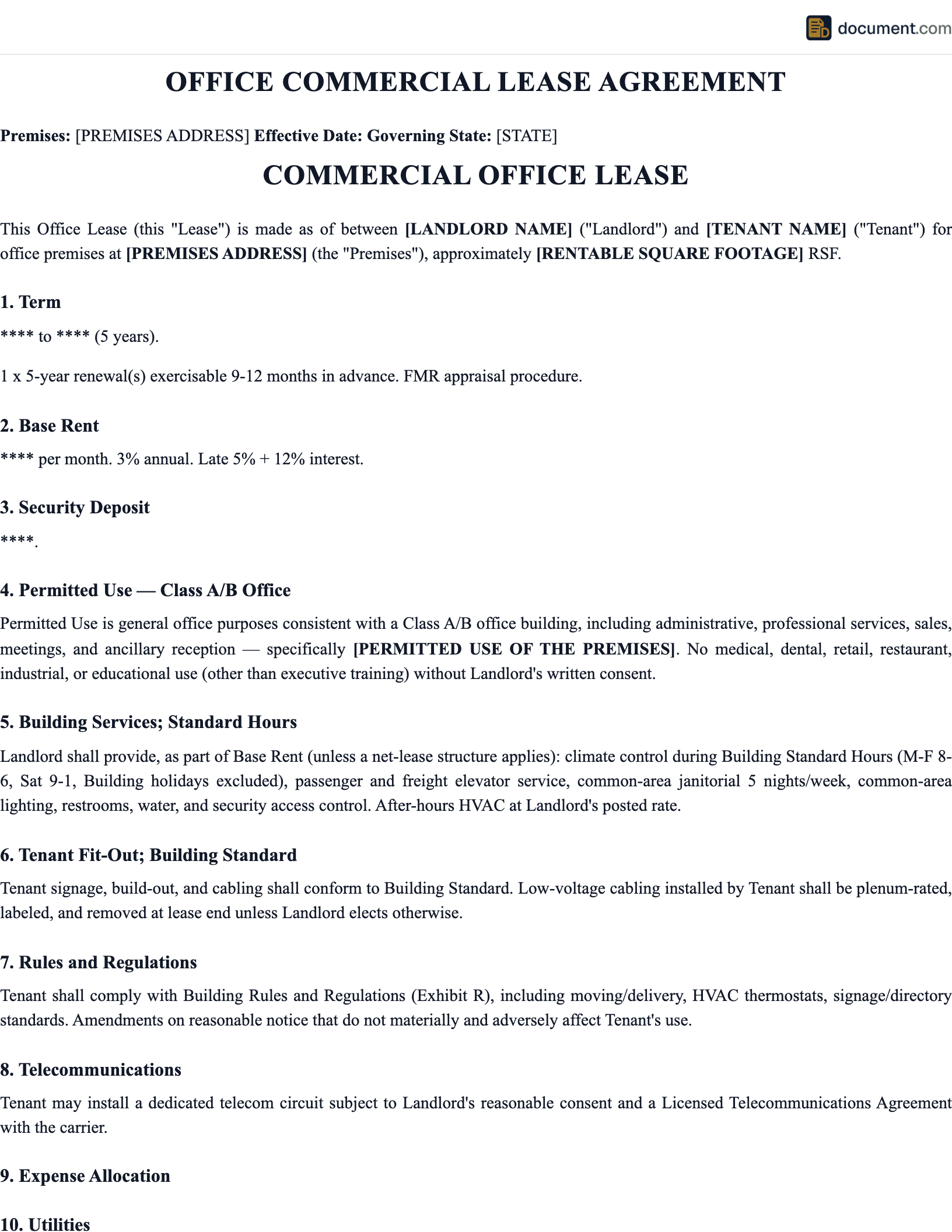
Sample Massachusetts Office Space Lease Agreement
Below is a preview of our Massachusetts-specific template. Your customized document will include all fields and provisions required for filing in any Massachusetts county.
OFFICE SPACE LEASE AGREEMENT
STATE OF MASSACHUSETTS
Legal Document Template
LANDLORD
Name: [Full Legal Name / Entity]
Address: [Management Office Address]
Contact: [Property Manager Name]
TENANT
Name: [Business Entity Name]
Address: [Current Business Address]
Tax ID: [EIN]
Guarantor: [If Applicable]
PREMISES
Building: [Building Name/Address]
Suite: [Number]
Floor: [Floor Number]
RSF: [Rentable Square Feet]
USF: [Usable Square Feet]
FINANCIAL TERMS
Base Rent: $[Amount]/RSF/year
TI Allowance: $[Amount]/RSF
Expense Stop: $[Amount]/RSF
Parking: [# Spaces]
Deposit: $[Amount]
Massachusetts Office Space Lease Agreement FAQ
Answers to common questions about filing a office space lease agreement in Massachusetts, including requirements, fees, and procedures.
Official Massachusetts Resources
Use these official state resources to verify requirements, find your local filing office, and access government forms for Massachusetts.
Related Massachusetts Documents
Depending on your situation, you may need additional documents alongside your Massachusetts office space lease agreement.
Create your Massachusetts Commercial Office Lease Agreement in under 5 minutes.
Answer a few questions and download a Massachusetts-compliant document, ready for the state agency.