
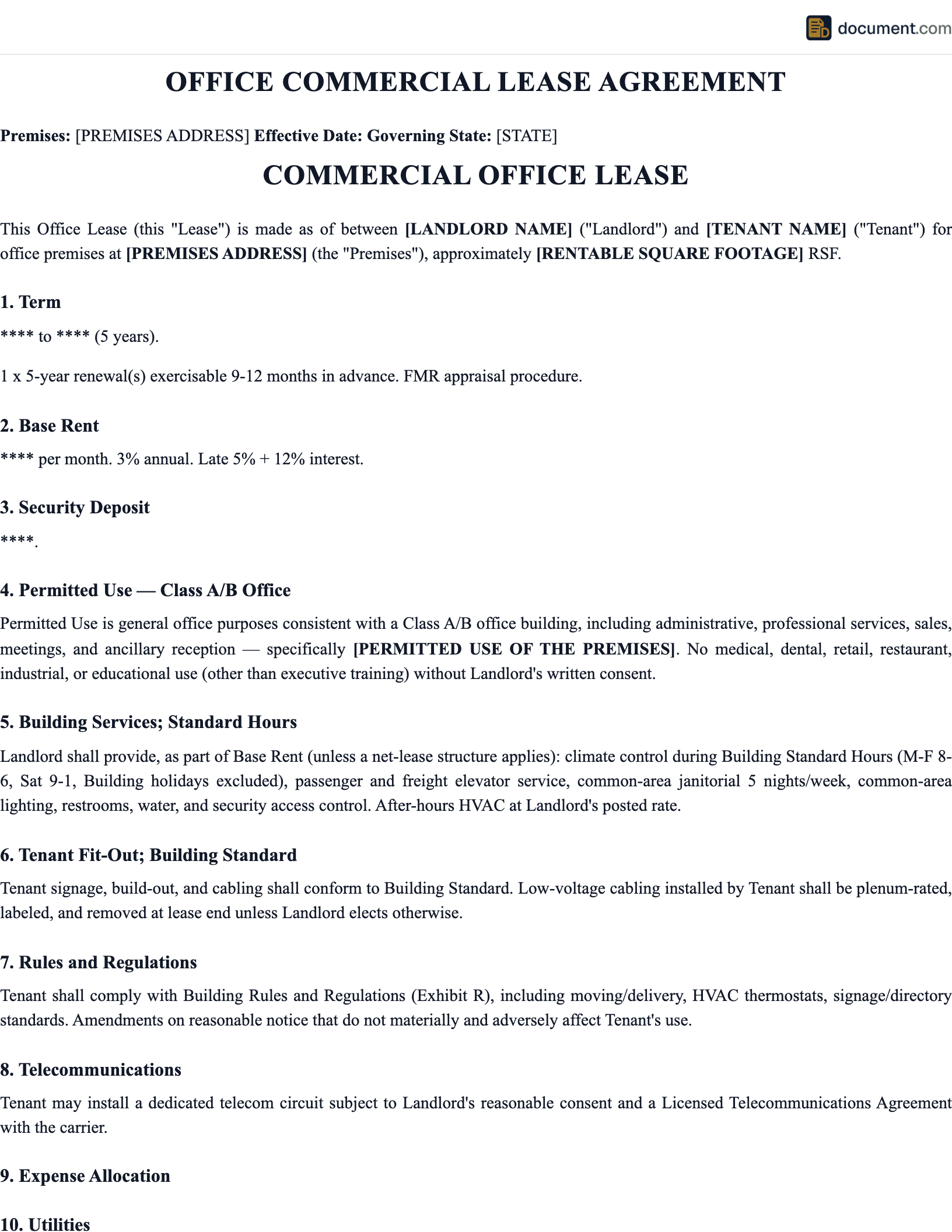



Maryland Office Space Lease Agreement Overview
Maryland's office market is bifurcated in a way few states match. Baltimore and its suburbs operate as a distinct commercial real estate market from the DC Metro Maryland suburbs, yet many tenants and landlords need to understand both. Baltimore's Inner Harbor, Mount Vernon, and Pratt Street corridors attract law firms, financial services companies, and healthcare organizations tied to Johns Hopkins and University of Maryland health systems. The DC Metro suburban Maryland market, concentrated in Montgomery County cities like Bethesda, Rockville, and Silver Spring, as well as Prince George's County communities near College Park and Greenbelt, operates under different rent economics driven by proximity to the federal government and major defense contractors.
Maryland commercial office leases are governed by the Real Property Article of the Maryland Code and by general contract law principles. Maryland provides fewer mandatory tenant protections for commercial tenants than it does for residential tenants. Notably, Maryland does not cap commercial rent increases, mandate notice periods for non-renewal, or require relocation assistance for displaced commercial tenants. The tenant's protection in a Maryland office lease comes entirely from skilled negotiation of the contract terms. CAM audit rights, expansion rights, renewal options at capped rent increases, sublease rights, and termination rights are all negotiated provisions, not legal defaults.
One Maryland-specific consideration is ground rent, a historical practice most common in Baltimore City where land ownership was historically separated from building ownership. Commercial buildings in older Baltimore neighborhoods occasionally sit on ground-leased land, which affects the landlord's cost structure and may appear in net lease operating expense calculations. Federal government and defense contractor tenants in Montgomery and Prince George's Counties also bring unique office lease requirements, including security provisions, access control systems, and SCIF-compliant build-out specifications that do not appear in standard Maryland commercial office leases.
$20
Filing fee
Required
Notarization
0
Witnesses required
Circuit
Filing office
Maryland Legal Requirements
Maryland commercial office leases are private contracts. There is no mandatory state form, no required filing with any public office, and no state agency approval required for commercial office leases. The following requirements govern execution and enforceability.
Maryland Office Lease Notice
Maryland does not provide statutory CAM caps, renewal rights, or relocation assistance for commercial office tenants. All tenant protections must be negotiated into the lease document. Montgomery County and Prince George's County do not impose additional commercial tenant protections beyond state law. Do not assume any Maryland protections apply to your commercial lease that are not expressly written in the signed agreement.
Lease Requirements
- Written Form for Multi-Year Terms: Maryland's statute of frauds requires commercial leases exceeding one year to be in writing and signed; month-to-month arrangements may be oral but should always be documented to prevent disputes
- Rent Structure and CAM Definition: Clearly define whether the lease is gross, modified gross, or net; if net, specify exactly which operating expenses are passed through and how the annual CAM reconciliation is calculated and capped
- CAM Audit Rights: Negotiate a written right to audit the landlord's operating expense records within 12 months of receiving the annual CAM reconciliation; Maryland landlords are not required to grant audit rights unless the lease requires it
- Tenant Improvement Allowance Terms: Document the TI allowance amount, disbursement conditions, whether unused TI can be converted to free rent, and the timeline for completion; Maryland courts enforce TI allowance provisions as written
- Renewal and Expansion Options: Renewal and expansion options must be written into the lease; Maryland has no statute granting commercial tenants the right to renew; negotiate renewal options with a stated rent structure, such as fair market value with a floor and ceiling, or a fixed percentage increase
- ADA Compliance Allocation: Specify in the lease which party bears responsibility for ADA improvements to the premises and to common areas; Maryland follows federal ADA standards and building code requirements for commercial office space
- Personal Guarantee Negotiation: Landlords in Maryland, particularly in Baltimore CBD, routinely require personal guarantees from small business tenants; negotiate guarantee burn-down provisions that reduce or eliminate the guarantee after a period of on-time performance
How to Execute an Office Lease in Maryland
Maryland commercial office leases do not require filing with any government office. The steps below cover the negotiation and execution process for a Maryland office lease in either Baltimore or the DC suburban Maryland market.
Evaluate the Market and Target Submarket
Baltimore CBD, Baltimore suburbs, Montgomery County, and Prince George's County operate as distinct submarkets with different rent levels, vacancy rates, and landlord negotiating leverage. Identify which submarket aligns with your business needs before committing to negotiations. DC suburb locations near Metro stations, particularly Bethesda, Silver Spring, Rockville, and College Park, command premium rents but offer significant transit access benefits that may reduce parking requirements.
Negotiate Lease Terms and TI Allowance
Maryland office landlords typically present standard form leases that heavily favor the landlord. Focus negotiation on the TI allowance amount, CAM cap and exclusions, renewal option rent structure, sublease consent standards, holdover penalty provisions, and personal guarantee scope and duration. Baltimore CBD Class A TI allowances typically run $40 to $70 per square foot; Montgomery County Class A buildings often offer $60 to $90 per square foot for creditworthy tenants.
Address Personal Guarantee Terms
Maryland landlords, particularly in Baltimore, routinely require personal guarantees from business entity tenants without substantial balance sheets. Negotiate a guarantee burn-down clause that reduces personal exposure after 12 to 24 months of on-time rent payment. Some Maryland landlords accept a good-guy clause that allows the guarantor to be released from liability if the tenant vacates and surrenders the premises rather than defaulting in place. Know your leverage: a stronger credit profile and longer lease term give the tenant more negotiating power on guarantee terms.
Execute the Lease
Maryland commercial office leases do not require notarization or recording to be enforceable between the parties. Both the landlord and tenant, or their authorized representatives, sign all counterparts. Pay the security deposit and first month's rent per the lease schedule. If the lease requires a letter of credit rather than a cash deposit, arrange the letter of credit through your bank before the signing deadline specified in the lease.
Manage the Build-Out and Commencement
If the lease involves a tenant improvement build-out, confirm the process for TI disbursement: whether the landlord manages construction or reimburses the tenant, what approvals are required for the construction drawings, and what the deadline is for substantial completion. Maryland landlords sometimes allow the rent commencement date to be delayed if the build-out is not substantially complete by the stated date; ensure this delay mechanism is written into the lease before signing.
Tax Implications for Maryland Office Tenants
Maryland office rent is deductible as a business expense under both federal and Maryland income tax rules. Maryland's corporate income tax rate is 8.25 percent on federal taxable income. Maryland does not impose a statewide commercial rent tax. However, certain counties, including Montgomery County, may impose local occupancy taxes or business personal property taxes that affect the total cost of maintaining an office location. Businesses should confirm local county tax obligations, particularly property tax on business personal property used in the office space.
Maryland offers several enterprise zone and economic development incentive programs, particularly for businesses locating in designated revitalization areas of Baltimore City and Prince George's County. Eligible tenants may qualify for Maryland's Enterprise Zone Tax Credit, which provides corporate income tax credits and real property tax credits for qualifying businesses in certified enterprise zones. Tenants considering Baltimore City locations should investigate enterprise zone eligibility before finalizing a lease location.
Important Considerations for Maryland Office Tenants
Parking provisions matter significantly in the Maryland office market. Baltimore CBD has limited parking structures and some buildings include parking in the lease; others charge separately. DC suburb locations near Metro stations often undercount parking because tenants rely on transit, but suburban office parks in Rockville, Germantown, and Landover require adequate parking ratios typically 3 to 4 per 1,000 square feet. Confirm exactly how many reserved and unreserved parking spaces are included, what the monthly cost is for any additional spaces, and whether the parking is surface lot, structure, or street.
Federal government contractor tenants in Montgomery and Prince George's Counties should carefully review security and access control provisions. Some classified work requires SCIF (Sensitive Compartmented Information Facility) construction standards that involve reinforced walls, specific door and lock specifications, and IT infrastructure that cannot be modified without government approval. Ensure that the lease permits SCIF construction if required, that the landlord's consent is pre-approved in the lease for classified build-out work, and that security clearance requirements for building access are compatible with the landlord's standard building access protocols.
Renewal timing is critical in tight Maryland submarkets. Bethesda, downtown Bethesda in particular, and Inner Harbor Baltimore have historically low vacancy rates in Class A buildings. Tenants who wait until 6 months before expiration to begin renewal negotiations often find that the landlord has limited motivation to offer favorable terms given the scarcity of comparable replacement options. Begin renewal discussions 18 to 24 months before expiration to maximize negotiating leverage while the landlord still values your continued occupancy.
Maryland Fees & Costs
Below is a breakdown of the typical costs associated with filing this document in Maryland. Actual fees may vary by county.
| Fee / Cost | Amount |
|---|---|
| Filing Fee | $20 first page |
| Notarization | $5 - $25 per signature |
| Certified Copy | $1 - $10 per page |
| Attorney Review (optional) | $150 - $500 |
Sample Maryland Office Space Lease Agreement
Below is a preview of our Maryland-specific template. Your customized document will include all fields and provisions required for filing in any Maryland county.
OFFICE SPACE LEASE AGREEMENT
STATE OF MARYLAND
Legal Document Template
LANDLORD
Name: [Full Legal Name / Entity]
Address: [Management Office Address]
Contact: [Property Manager Name]
TENANT
Name: [Business Entity Name]
Address: [Current Business Address]
Tax ID: [EIN]
Guarantor: [If Applicable]
PREMISES
Building: [Building Name/Address]
Suite: [Number]
Floor: [Floor Number]
RSF: [Rentable Square Feet]
USF: [Usable Square Feet]
FINANCIAL TERMS
Base Rent: $[Amount]/RSF/year
TI Allowance: $[Amount]/RSF
Expense Stop: $[Amount]/RSF
Parking: [# Spaces]
Deposit: $[Amount]
Maryland Office Space Lease Agreement FAQ
Answers to common questions about filing a office space lease agreement in Maryland, including requirements, fees, and procedures.
Official Maryland Resources
Use these official state resources to verify requirements, find your local filing office, and access government forms for Maryland.
Related Maryland Documents
Depending on your situation, you may need additional documents alongside your Maryland office space lease agreement.
Create your Maryland Commercial Office Lease Agreement in under 5 minutes.
Answer a few questions and download a Maryland-compliant document, ready for the state agency.