



Louisiana Office Space Lease Agreement Overview
Louisiana is the only state in the country whose commercial lease law derives from the civil law tradition rather than English common law. Commercial leases in Louisiana are governed by Louisiana Civil Code Articles 2668 through 2729, which create obligations and rights that differ meaningfully from what businesses familiar with common law leasing expect. If you are negotiating a commercial office lease in New Orleans or Baton Rouge with prior experience in other states, those differences are not trivial.
The New Orleans Central Business District is the state's largest commercial office market and has seen significant redevelopment post-Katrina, with many older Class B office buildings in the Warehouse District and CBD now competing against newer Class A space. Office rents in New Orleans are moderate by national standards but carry higher insurance costs due to flood and hurricane risk. Tenants in New Orleans need to address those costs explicitly in the lease structure. Baton Rouge is the more stable market, driven by state government operations, LSU institutional demand, and petrochemical industry administrative offices along the I-10 corridor.
The civil code framework creates some default rules that most out-of-state businesses would not anticipate. Under Civil Code Article 2713, a Louisiana lessee may sublet or assign the lease unless the lease prohibits it, which is the opposite of the common law default. Under Article 2696, the lessor warrants that the premises are free from defects that prevent the lessee's intended use, a warranty that can be modified by contract but which Louisiana courts take seriously. Both of these provisions require specific contractual attention in any Louisiana commercial office lease.
$55
Filing fee
Required
Notarization
2
Witnesses required
Clerk
Filing office
Louisiana Legal Requirements for Office Leases
Louisiana commercial office leases are governed by Civil Code Articles 2668 through 2729. The lease must be in writing under Article 2681 for any term exceeding one year and for the lease to be effective against third parties. For registration in the parish conveyance records, the lease must be executed before a Louisiana notary public and two witnesses.
Louisiana Civil Law Note
Louisiana's civil law default rules differ significantly from common law states. Under Civil Code Article 2713, a Louisiana lessee may sublet or assign the lease unless the lease expressly prohibits it. Landlords must include explicit prohibition or consent language or lose control over subletting. The lessor's warranty against defects under Article 2696 applies unless expressly waived. Flood and hurricane force majeure provisions, and the interplay between flood damage and rent abatement obligations, must be addressed explicitly given Louisiana's climate risk.
Key Requirements and Civil Law Provisions
- Written Form: Required under Civil Code Article 2681 for leases exceeding one year and for enforceability against third parties
- Notarization and Witnesses for Registration: Two witnesses and a Louisiana notary required to register the lease in parish conveyance records and protect tenant rights against subsequent purchasers
- Sublease/Assignment Prohibition: Must be expressly stated; the civil code default permits subletting without landlord consent (Article 2713)
- Warranty Waiver or Modification: The lessor's warranty against defects (Article 2696) should be addressed in the lease; specify whether and how it is modified for commercial use
- Flood and Hurricane Provisions: Specify insurance obligations, rent abatement triggers for storm-related inaccessibility, and force majeure provisions covering named storm events
- CAM Provisions in Historic Buildings: New Orleans historic buildings carry higher maintenance costs; negotiate CAM caps, capital expenditure exclusions, and audit rights
How to Execute a Louisiana Office Lease
Executing a commercial office lease in Louisiana does not require filing anything with the government for the lease to be binding between the parties. Registration in the parish conveyance records is optional but strongly advisable for leases exceeding one year. Follow these steps.
Negotiate Key Civil Law Provisions
Work through subletting prohibition, warranty modifications, flood insurance allocation, holdover reconduction rules, and CAM provisions with Louisiana-specific civil code awareness. Out-of-state form leases will miss these issues.
Address Insurance Before Signing
Confirm flood insurance coverage on the building and whether the landlord's policy covers tenant improvements. Determine whether the tenant must carry a separate flood rider for personal property, equipment, and client inventory in New Orleans or South Louisiana markets.
Execute Before a Notary with Two Witnesses
If the lease will be registered in the parish conveyance records, both parties must sign before a Louisiana-commissioned notary and two witnesses. This is not required for the lease to bind the parties but is required for registration and protection against future building purchasers.
Register in Parish Conveyance Records if Warranted
For leases exceeding one year, file the notarized, witnessed lease with the Clerk of Court for the parish where the property is located. This protects the tenant's right to possession against a subsequent purchaser or mortgagee who claims lack of notice.
Deliver Security Deposit and Document Space Condition
Pay the security deposit and first month's rent and photograph the entire space condition including any pre-existing flood damage, mold, or staining before occupancy. This documentation is essential if a deposit dispute arises at the end of a Louisiana lease.
Tax Implications for Louisiana Office Tenants
Louisiana does not impose a statewide commercial rent tax on office leases. Base rent and CAM charges are deductible as ordinary business expenses under federal and Louisiana income tax rules. Louisiana's ad valorem property tax is assessed at the parish level and can be significant for prime office locations in Orleans Parish. Net lease tenants who pay property taxes directly or as a CAM passthrough may deduct those amounts as business expenses. Louisiana offers enterprise zone tax incentives for commercial tenants in designated areas of New Orleans and other qualifying parishes that can provide employment tax credits, sales tax exemptions on eligible purchases, and investment tax credits. Tenants considering these locations should evaluate eligibility before signing.
Important Considerations for Louisiana Office Leases
New Orleans office buildings in historic districts are subject to Vieux Carre Commission or Historic District Landmarks Commission review for any exterior modifications, signage, or structural changes. Tenants who need building-mounted signage or exterior branding should verify what is permitted before signing and confirm the landlord can grant permission. Louisiana's flood elevation requirements affect older CBD and Warehouse District buildings differently than newer construction; understand the FEMA flood zone classification of your building and how it affects insurance costs. In Baton Rouge, the petrochemical industry drives a segment of office demand for engineering, environmental compliance, and regulatory affairs firms; these tenants may need provisions addressing confidential document security and access control that standard office leases do not include. For any Louisiana office lease in a building that was occupied before Katrina, request documentation of post-storm remediation to ensure no residual mold or structural issues remain.
Louisiana Fees & Costs
Below is a breakdown of the typical costs associated with filing this document in Louisiana. Actual fees may vary by county.
| Fee / Cost | Amount |
|---|---|
| Filing Fee | $55 first page |
| Notarization | $5 - $25 per signature |
| Certified Copy | $1 - $10 per page |
| Attorney Review (optional) | $150 - $500 |
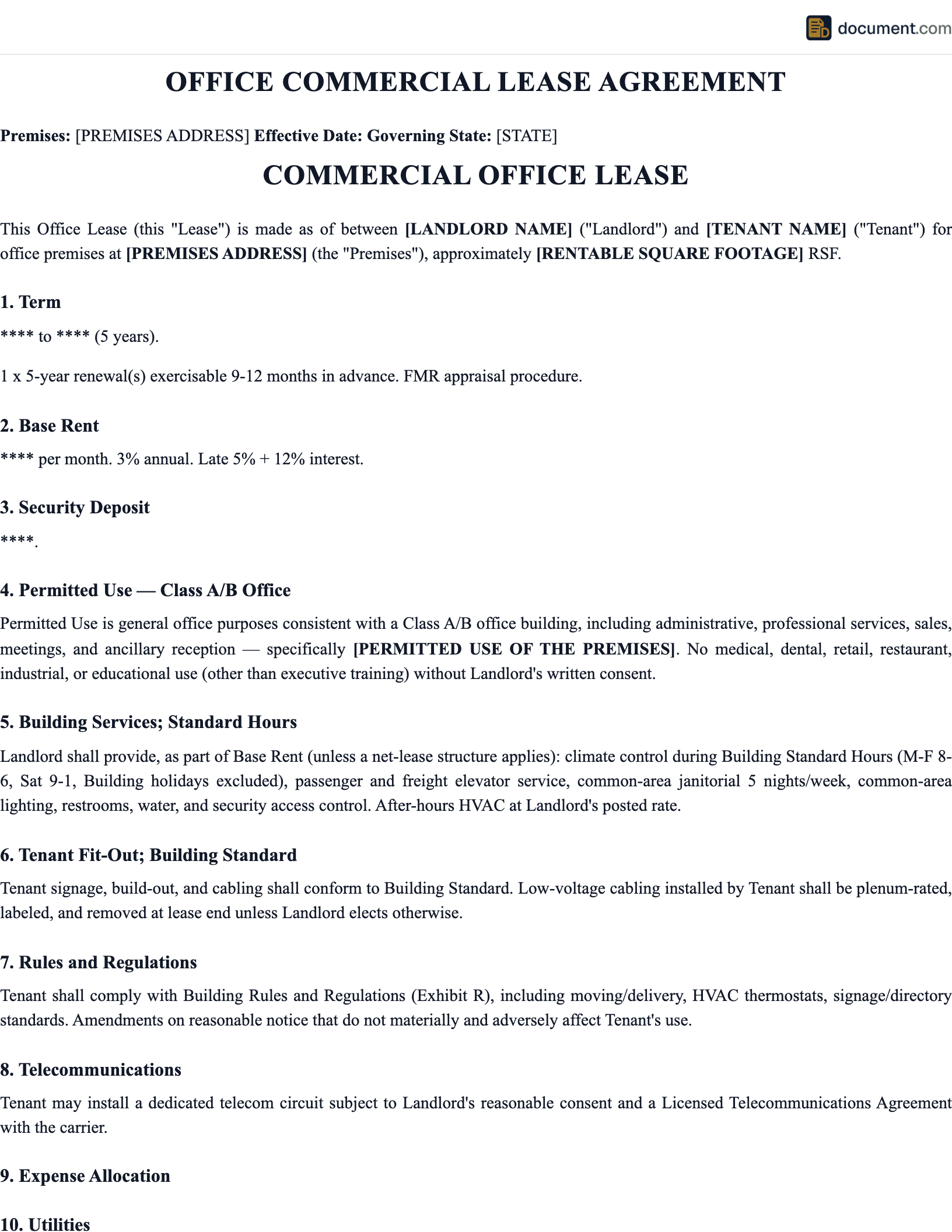
Sample Louisiana Office Space Lease Agreement
Below is a preview of our Louisiana-specific template. Your customized document will include all fields and provisions required for filing in any Louisiana county.
OFFICE SPACE LEASE AGREEMENT
STATE OF LOUISIANA
Legal Document Template
LANDLORD
Name: [Full Legal Name / Entity]
Address: [Management Office Address]
Contact: [Property Manager Name]
TENANT
Name: [Business Entity Name]
Address: [Current Business Address]
Tax ID: [EIN]
Guarantor: [If Applicable]
PREMISES
Building: [Building Name/Address]
Suite: [Number]
Floor: [Floor Number]
RSF: [Rentable Square Feet]
USF: [Usable Square Feet]
FINANCIAL TERMS
Base Rent: $[Amount]/RSF/year
TI Allowance: $[Amount]/RSF
Expense Stop: $[Amount]/RSF
Parking: [# Spaces]
Deposit: $[Amount]
Louisiana Office Space Lease Agreement FAQ
Answers to common questions about filing a office space lease agreement in Louisiana, including requirements, fees, and procedures.
Official Louisiana Resources
Use these official state resources to verify requirements, find your local filing office, and access government forms for Louisiana.
Related Louisiana Documents
Depending on your situation, you may need additional documents alongside your Louisiana office space lease agreement.
Create your Louisiana Commercial Office Lease Agreement in under 5 minutes.
Answer a few questions and download a Louisiana-compliant document, ready for the state agency.