



Kentucky Office Space Lease Agreement Overview
Kentucky commercial office leasing centers on two distinct markets with very different economics. Louisville is the state's largest commercial market with a well-established Class A downtown corridor anchored by financial services, healthcare, and bourbon industry tenants. The Louisville Central Business District and the East End suburban corridor along Shelbyville Road attract regional and national tenants who expect full-service gross leases with expense stops, TI packages, and structured renewal options. Lexington, driven by the University of Kentucky medical complex and horse industry administrative operations, has a smaller but active market with somewhat lower rates and more flexible landlord terms.
Kentucky has no commercial tenant protection statute. Office leases are governed entirely by contract principles, which means the lease document is the complete source of tenant rights. Unlike residential leases, Kentucky commercial office leases carry no implied warranty of habitability, no required notice period for rent increases, and no limitation on landlord self-help remedies unless those protections are negotiated into the lease. The bourbon industry's growth has created secondary demand for office space from tourism operators, distillery management companies, and hospitality firms, adding a category of tenant with non-standard space needs including warehouse-adjacent offices and visitor-facing reception areas.
Kentucky's horse industry, centered around Lexington and Keeneland, generates demand for office space from farms, breeding operations, veterinary services, and auction management companies. These tenants often have non-standard equipment and vehicle requirements and may need lease provisions covering agricultural-commercial hybrid uses that standard office leases do not contemplate.
$32
Filing fee
Required
Notarization
0
Witnesses required
County
Filing office
Kentucky Legal Requirements for Office Leases
Kentucky commercial office leases are not regulated by any specific commercial landlord-tenant statute. They are enforced as ordinary contracts. The Kentucky Uniform Residential Landlord and Tenant Act covers only residential properties and creates no rights for commercial office tenants. This means every material protection a tenant needs must be negotiated into the lease document.
Kentucky Commercial Lease Note
Kentucky has no commercial rent control and no statutory cap on security deposits for office space. Leases exceeding one year must be in writing under Kentucky statute of frauds principles (KRS 371.010). Notarization is not required for the lease to be binding between the parties, but is required if the lease is to be recorded with the County Clerk. Recording is optional but protects the tenant's possessory interest against a subsequent purchaser of the building.
Key Negotiation Points for Kentucky Office Leases
- Written Requirement: Required for any term over one year under KRS 371.010; always advisable in writing regardless of lease length
- Security Deposit: No statutory cap; negotiate written return criteria, deduction process, and a 30-day return timeline; Jefferson County landlords may insist on 60 days
- CAM and Expense Stops: Negotiate a base year expense stop, annual cap on controllable CAM increases, exclusion of capital improvements from CAM, and audit rights within 90 days of annual reconciliation
- Holdover Provisions: Default is month-to-month at same rent under Kentucky common law; negotiate a penalty multiplier of 125 to 150 percent and landlord termination rights after written notice
- ADA Allocation: Confirm which party handles ADA accessibility upgrades for the leased suite versus common areas, particularly in older Louisville or Lexington buildings
- Parking: Specify reserved versus unreserved spaces, after-hours access, and monthly parking fees as a separate exhibit tied to CPI or stated annual escalators
How to Execute a Kentucky Office Lease
Signing a commercial office lease in Kentucky does not require filing with a government office. The lease is binding once both authorized parties sign. Follow these steps for a clean execution.
Negotiate and Finalize the Lease Draft
Begin with the landlord's standard form and mark up key provisions including CAM definitions, holdover rent, TI allowance, assignment rights, and permitted use. Louisville CBD landlords typically use BOMA-standard lease forms while smaller markets may use simpler documents.
Confirm the Work Letter and TI Scope
Before signing, agree on the work letter that describes tenant improvements, sets the TI allowance amount, names the construction manager, and sets the schedule. Ambiguity in the work letter is one of the most common sources of Kentucky commercial lease disputes.
Verify Entity Authority
Confirm that each signatory has authority to bind their respective entity under Kentucky law. For LLCs, confirm authority under the operating agreement; for corporations, confirm board authorization. Kentucky courts can void leases signed by unauthorized agents.
Execute All Exhibits Simultaneously
Sign the base lease, parking exhibit, work letter, guaranty, and any subordination/non-disturbance agreement at the same time. Each exhibit should reference the main lease and be dated consistently.
Deliver Deposit and First Month's Rent
Tender the security deposit and any prepaid rent required by lease commencement conditions. Document the space condition with photographs and retain all payment records in case of deposit dispute at lease end.
Tax Implications for Kentucky Office Tenants
Kentucky does not impose a statewide commercial rent tax on office leases. Base rent and CAM reimbursements are deductible as ordinary business expenses under both federal and Kentucky income tax rules. Kentucky property taxes passed through in a net lease are deductible at the federal level as a business cost. Jefferson County commercial property tax rates in Louisville are among the highest in the state and can be a meaningful component of net lease total occupancy cost. TI allowances received from a Kentucky landlord may require coordination with a CPA to determine whether they are taxable income or reduce the tenant's depreciable basis in leasehold improvements.
Important Considerations for Kentucky Office Leases
Bourbon industry tenants leasing office space near distillery operations in Louisville or along the Bourbon Trail should confirm that the building's permitted use and zoning accommodate visitor-facing hospitality activities if clients or tour groups will visit the office. Kentucky horse industry tenants in Fayette County who need agricultural-adjacent office space should verify that the lease permits on-site vehicle and equipment parking that standard office leases typically prohibit. Personal guarantees are extremely common in Kentucky for tenants without significant balance sheets; push to cap the guarantee at 12 months of rent or structure it as a declining guarantee that reduces after the tenant demonstrates 24 months of on-time payments.
Kentucky Fees & Costs
Below is a breakdown of the typical costs associated with filing this document in Kentucky. Actual fees may vary by county.
| Fee / Cost | Amount |
|---|---|
| Filing Fee | $32 per document |
| Notarization | $5 - $25 per signature |
| Certified Copy | $1 - $10 per page |
| Attorney Review (optional) | $150 - $500 |
Sample Kentucky Office Space Lease Agreement
Below is a preview of our Kentucky-specific template. Your customized document will include all fields and provisions required for filing in any Kentucky county.
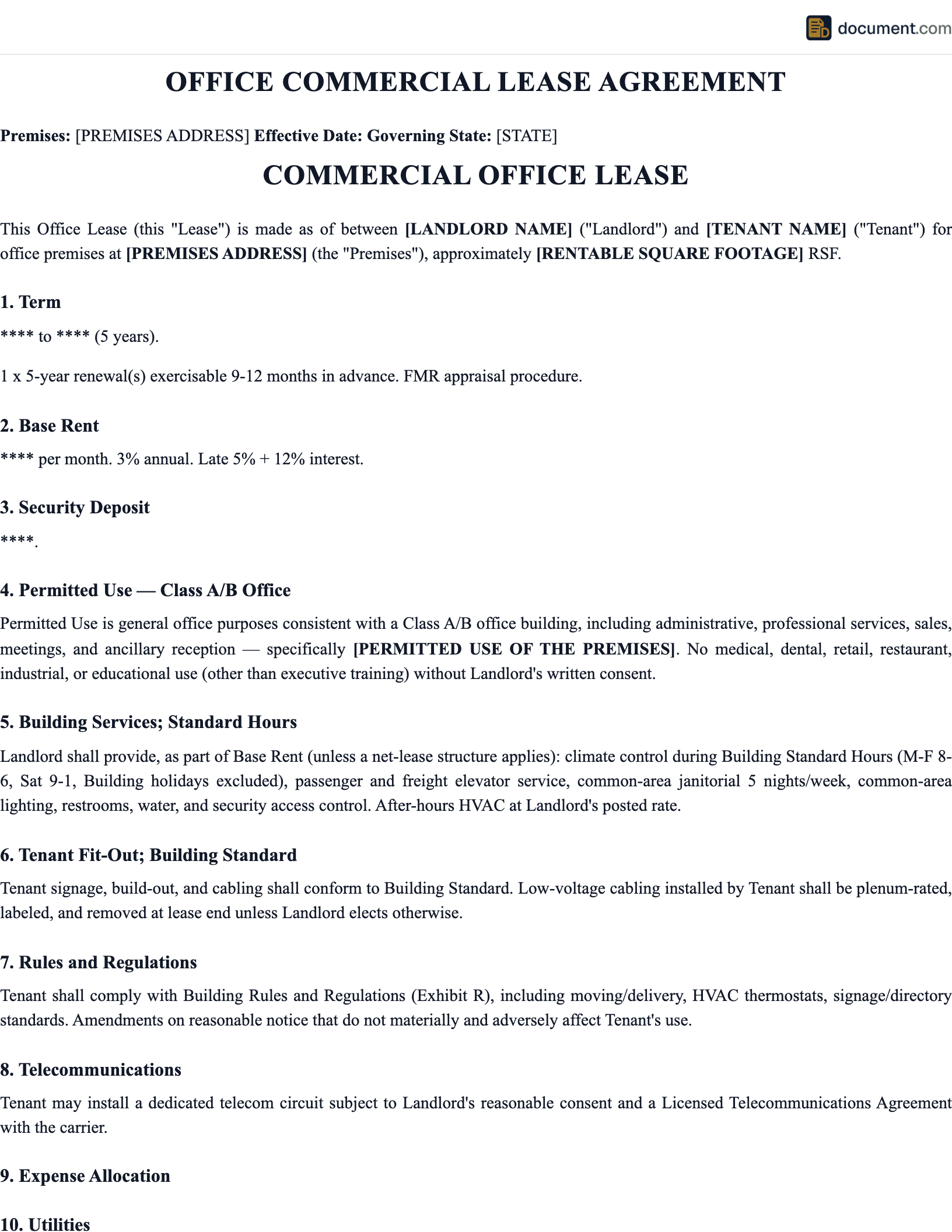
OFFICE SPACE LEASE AGREEMENT
STATE OF KENTUCKY
Legal Document Template
LANDLORD
Name: [Full Legal Name / Entity]
Address: [Management Office Address]
Contact: [Property Manager Name]
TENANT
Name: [Business Entity Name]
Address: [Current Business Address]
Tax ID: [EIN]
Guarantor: [If Applicable]
PREMISES
Building: [Building Name/Address]
Suite: [Number]
Floor: [Floor Number]
RSF: [Rentable Square Feet]
USF: [Usable Square Feet]
FINANCIAL TERMS
Base Rent: $[Amount]/RSF/year
TI Allowance: $[Amount]/RSF
Expense Stop: $[Amount]/RSF
Parking: [# Spaces]
Deposit: $[Amount]
Kentucky Office Space Lease Agreement FAQ
Answers to common questions about filing a office space lease agreement in Kentucky, including requirements, fees, and procedures.
Official Kentucky Resources
Use these official state resources to verify requirements, find your local filing office, and access government forms for Kentucky.
Related Kentucky Documents
Depending on your situation, you may need additional documents alongside your Kentucky office space lease agreement.
Create your Kentucky Commercial Office Lease Agreement in under 5 minutes.
Answer a few questions and download a Kentucky-compliant document, ready for the state agency.