



Indiana Office Space Lease Agreement Overview
Indiana commercial real estate is governed by general contract law, not any residential landlord-tenant statute. The Indiana Code does not carve out special protections for office tenants, which means the lease document itself is the primary source of rights and obligations for both parties. Indianapolis anchors the market, with a mix of class A downtown towers, suburban office parks in Carmel and Fishers, and smaller mixed-use buildings scattered through Broad Ripple, Fountain Square, and the Mass Ave corridor. Fort Wayne, South Bend, and Evanston also have active markets serving mid-size and regional businesses.
Indiana has no commercial rent tax, which keeps occupancy costs relatively straightforward compared to states like Illinois or Hawaii. Tenants should still budget carefully for operating expense pass-throughs in NNN and modified gross leases. Property tax rates vary by county, and Marion County (Indianapolis) assessments have risen in recent years, so requesting the current tax bill before signing is prudent. Parking is almost always a key negotiation point because Indiana's car-dependent commuting culture means adequate surface or structured parking can make or break a location decision.
No rent tax
No commercial rent tax
None
Deposit cap (commercial)
Indy primary
Indianapolis leads market
Contract law
No commercial tenancy statute
Indiana Requirements
Indiana does not impose a commercial landlord-tenant statute, so the lease agreement must be comprehensive. Every obligation, right, and remedy needs to be spelled out in the document itself because courts will generally enforce the written terms as negotiated.
Operating Expense Pass-Throughs in Indiana
Indiana NNN and modified gross leases routinely pass property taxes, insurance, and maintenance costs through to tenants. Marion County (Indianapolis) property tax rates have increased, and in some office buildings the operating expense load adds $8 to $15 per rentable square foot on top of base rent. Always request the prior year operating expense reconciliation before signing so you understand your true all-in cost.
Key Lease Requirements
- Written agreement: Oral commercial lease terms are enforceable in Indiana for terms under one year, but anything longer requires a signed written document to be enforceable under the Statute of Frauds
- Lease structure clarity: Confirm whether the quoted rent is gross, modified gross, or NNN; Indiana leases frequently use modified gross structures where tenants pay increases above a base year expense stop
- CAM audit rights: Negotiate the right to audit landlord CAM calculations annually; Indiana landlords are not required by statute to provide audits, so this must be a lease provision
- Renewal options and rent bumps: Specify renewal rent terms in the lease; Indiana courts will enforce as-written terms, so vague renewal language creates risk
- Tenant improvement allowance: Document TI allowance amounts, permitted uses, and completion timelines in the lease or a separate work letter; Indiana has no implied TI obligations for landlords
- Parking allocation: Define the number, type (reserved or unreserved), and cost of parking spaces; suburban Indiana spaces are often free but should be specified to avoid disputes
How to Execute a Commercial Office Lease in Indiana
Indiana commercial leases are negotiated and executed directly between the parties. There is no state filing requirement for most office leases, but taking the right steps through the process protects your interests.
Tour and Compare Submarkets
Survey downtown Indianapolis, Meridian-Kessler, Keystone at the Crossing, and suburban Carmel and Fishers based on your team size, commute patterns, and budget. Suburban spaces often deliver lower total cost but require careful parking and access analysis. In Fort Wayne, compare downtown near Calhoun Street to the southwest and north commercial corridors.
Request Operating Expense History
Before submitting a letter of intent, ask for two years of operating expense reconciliation statements. This reveals the true cost of occupancy beyond base rent and exposes any unusual pass-throughs or escalations to negotiate against.
Negotiate the Letter of Intent
Use the LOI to lock in base rent, lease term, TI allowance, renewal options, parking, and the expense structure. The Indianapolis market has seen elevated vacancy since 2020, giving tenants real leverage on TI concessions and free rent periods. Suburban landlords in Carmel and Fishers have been more competitive on rent but firmer on term length.
Review the Lease Draft Carefully
Indiana courts enforce commercial lease terms as written. Pay close attention to holdover rent provisions (often 150% of base rent), sublease and assignment restrictions, restoration obligations at lease end, and the CAM reconciliation and audit process. Have an Indiana commercial real estate attorney review the draft for any unusual or risky language.
Execute and Obtain Local Licenses
Have authorized signatories for both parties execute the lease. Register your business with the Indiana Secretary of State if needed, obtain any required local business licenses from the city or county, and coordinate your build-out or move-in schedule with the landlord per the lease terms.
Indiana Office Lease Costs
Indiana is a cost-competitive office market. The figures below reflect typical ranges for Indianapolis and Fort Wayne. Suburban markets like Carmel and Fishers often sit in the mid-range on rent while offering free parking that significantly lowers total occupancy cost.
| Cost Item | Typical Range |
|---|---|
| Base rent, downtown Indianapolis class A | $24 to $36/RSF/year |
| Base rent, suburban Carmel or Fishers | $18 to $27/RSF/year |
| Base rent, Fort Wayne office | $14 to $22/RSF/year |
| Operating expenses (CAM, tax, insurance) | $8 to $15/RSF/year |
| Commercial rent tax | None |
| Downtown Indianapolis parking | $100 to $250/space/month |
| Security deposit | 1 to 3 months base rent (no statutory cap) |
| Attorney review | $500 to $2,500 |
Sample Indiana Office Space Lease Agreement
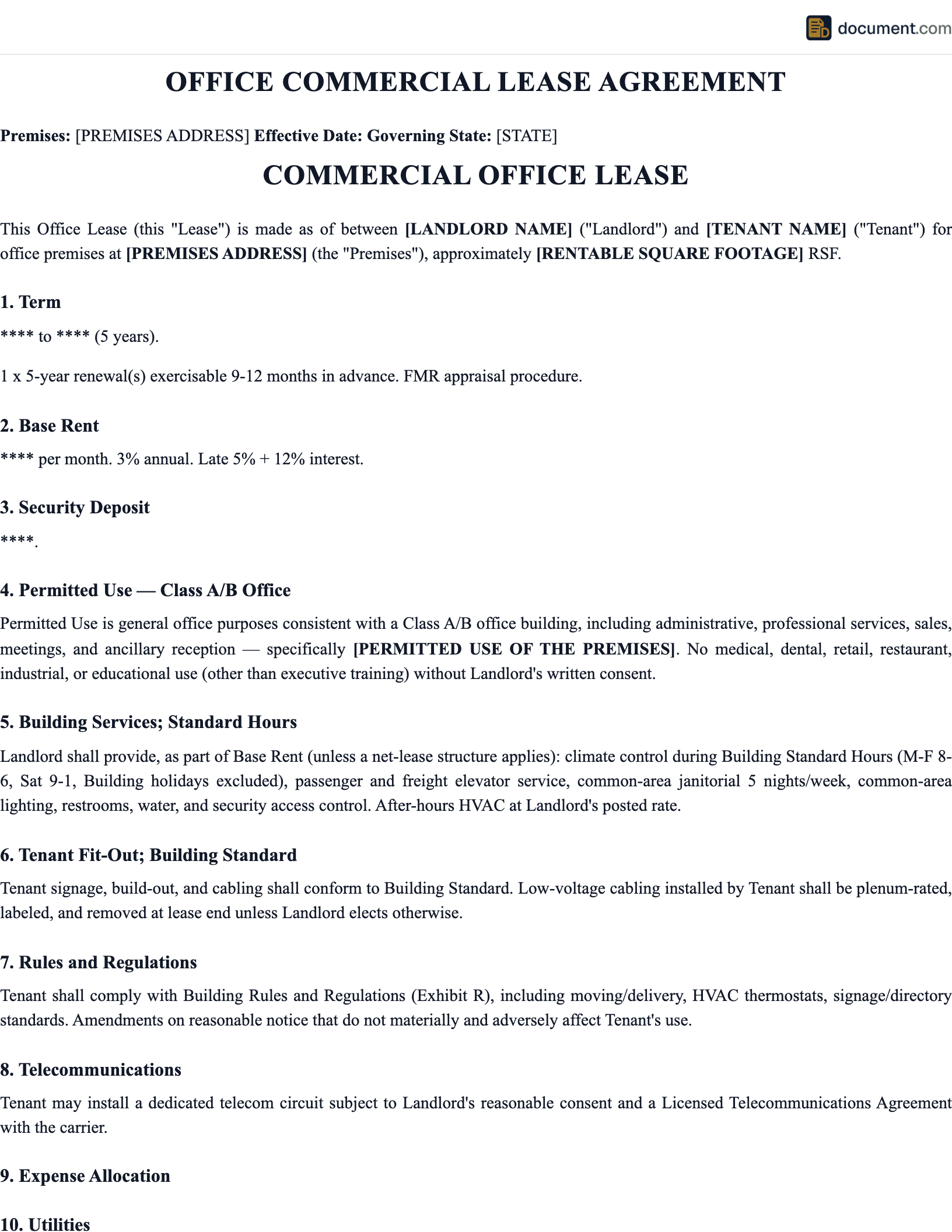
Below is a preview of our Indiana-specific template. Your customized document will include all fields and provisions required for filing in any Indiana county.
OFFICE SPACE LEASE AGREEMENT
STATE OF INDIANA
Legal Document Template
LANDLORD
Name: [Full Legal Name / Entity]
Address: [Management Office Address]
Contact: [Property Manager Name]
TENANT
Name: [Business Entity Name]
Address: [Current Business Address]
Tax ID: [EIN]
Guarantor: [If Applicable]
PREMISES
Building: [Building Name/Address]
Suite: [Number]
Floor: [Floor Number]
RSF: [Rentable Square Feet]
USF: [Usable Square Feet]
FINANCIAL TERMS
Base Rent: $[Amount]/RSF/year
TI Allowance: $[Amount]/RSF
Expense Stop: $[Amount]/RSF
Parking: [# Spaces]
Deposit: $[Amount]
Indiana Office Space Lease Agreement FAQ
Answers to common questions about filing an office space lease agreement in Indiana, including requirements, fees, and procedures.
Official Indiana Resources
Use these official state resources to verify requirements, find your local filing office, and access government forms for Indiana.
Related Indiana Documents
Depending on your situation, you may need additional documents alongside your Indiana office space lease agreement.
Create your Indiana Commercial Office Lease Agreement in under 5 minutes.
Answer a few questions and download a Indiana-compliant document, ready for the state agency.