



Illinois Office Space Lease Agreement Overview
Illinois office leasing is dominated by Chicago, which is the third-largest commercial real estate market in the country. The CBD, River North, Fulton Market, and the broader Cook County suburban corridor account for the vast majority of the state's office inventory. Since the pandemic-era shift to remote and hybrid work, Chicago has seen elevated office vacancy, particularly in older Class B and C stock, which has created negotiating leverage for tenants in many submarkets.
Illinois commercial leases are governed by contract law, not a specific commercial tenancy statute. The most distinctive feature of the Illinois office market is the property tax environment. Cook County has one of the highest commercial property tax burdens in the country, with commercial properties assessed at a higher ratio than residential under the county's classification system. These taxes are routinely passed through to tenants in NNN and modified gross leases and represent a significant occupancy cost that tenants must understand and budget before comparing space options.
High
Property tax pass-through
BOMA
Measurement standard
None
Deposit cap
Contract
Law governs
Illinois Legal Requirements for Office Leases
Illinois has no specific commercial landlord-tenant statute comparable to the residential landlord-tenant law (765 ILCS 710 and 720). Commercial office leases in Illinois are governed almost entirely by contract principles. The key requirements are practical and negotiated, not statutory.
Cook County Property Tax Pass-Through
Cook County's commercial property tax burden is substantial and almost universally passed through to tenants in expense reconciliations. Before signing any Chicago-area office lease, ask for the most recent real estate tax bill for the building. Calculate your pro-rata share at your occupancy percentage to understand what you will owe in addition to base rent. For a 5,000 RSF tenant in a 100,000 RSF building, a $2 million annual property tax bill means $100,000 in annual property tax pass-through.
Key Provisions to Negotiate
- Written Agreement: Illinois statute of frauds requires leases for more than one year to be in writing
- Operating Expense Base Year: Establish a base year for operating expenses and confirm whether taxes and insurance are included or excluded from the expense stop
- CAM Audit Rights: Negotiate the right to audit CAM reconciliations annually with a reasonable review period and process for disputing overcharges
- Sublease and Assignment: In a high-vacancy market, negotiate sublease rights with a reasonable landlord consent standard and defined response timeline
- Holdover Provision: Understand the holdover rent rate (often 150-200% of final month's rent) and plan renewal decisions accordingly
- BOMA Measurement: Confirm whether rent is based on usable or rentable square footage; in Chicago buildings with 15-25% load factors, this is a significant cost variable
How to Execute a Commercial Office Lease in Illinois
Executing a Chicago or Illinois office lease is a negotiation-intensive process. There is no required government filing for the lease to be valid between the parties, though long-term leases can be recorded with the Cook County Recorder of Deeds to protect the tenant's leasehold interest.
Select the Submarket and Identify Available Space
Define your submarket priorities before touring. Chicago CBD has walkability and transit access but the highest total occupancy costs. Suburban submarkets like Schaumburg, Oak Brook, and Rosemont offer lower rents and abundant parking. The Fulton Market corridor has attracted tech and creative tenants with newer, amenity-rich buildings at premium rents.
Request Operating Expense Statements
Before signing an LOI, request the last three years of operating expense reconciliations and the current real estate tax bill. In Cook County this data is critical for understanding total occupancy cost. A building with low base rent but high operating expenses can cost more than a building with a higher quoted rate and a well-managed expense base.
Negotiate the Letter of Intent
Lock in key economic terms, measurement basis, TI allowance, free rent period, renewal options, and sublease rights in the LOI before the formal lease is drafted. In the current high-vacancy Chicago market, tenants have more leverage than they have had in years. Use it at the LOI stage when the landlord is most motivated.
Review and Negotiate the Lease Draft
Illinois commercial leases are complex documents. Pay particular attention to the CAM definition and controllable/uncontrollable expense categories, property tax pass-through mechanics, the holdover provision, restoration obligations, and operating expense audit rights. These provisions have major financial implications over the lease term.
Execute and Obtain Required Local Licenses
Chicago requires a city business license for most commercial operations. Some business categories require additional city permits or inspections. Obtain all required licenses before your commencement date and confirm any city-specific requirements apply to your business type and location.
Tax and Cost Implications for Illinois Office Leases
Illinois office tenants face some of the highest total occupancy costs in the Midwest once property tax pass-throughs, operating expenses, and parking are factored in alongside base rent. Understanding the full cost picture before signing is essential.
| Cost Item | Typical Range |
|---|---|
| Base Rent (Chicago CBD Class A) | $30 - $55/RSF/year |
| Base Rent (Chicago Suburbs) | $15 - $25/RSF/year |
| Operating Expenses incl. Property Tax (Cook County) | $15 - $25/RSF/year |
| CBD Parking | $300 - $500/month per space |
| Security Deposit (no cap, negotiable) | 2 to 6 months rent in CBD; less in suburbs |
| Attorney Review | $1,000 - $5,000 depending on lease complexity |
Sample Illinois Office Space Lease Agreement
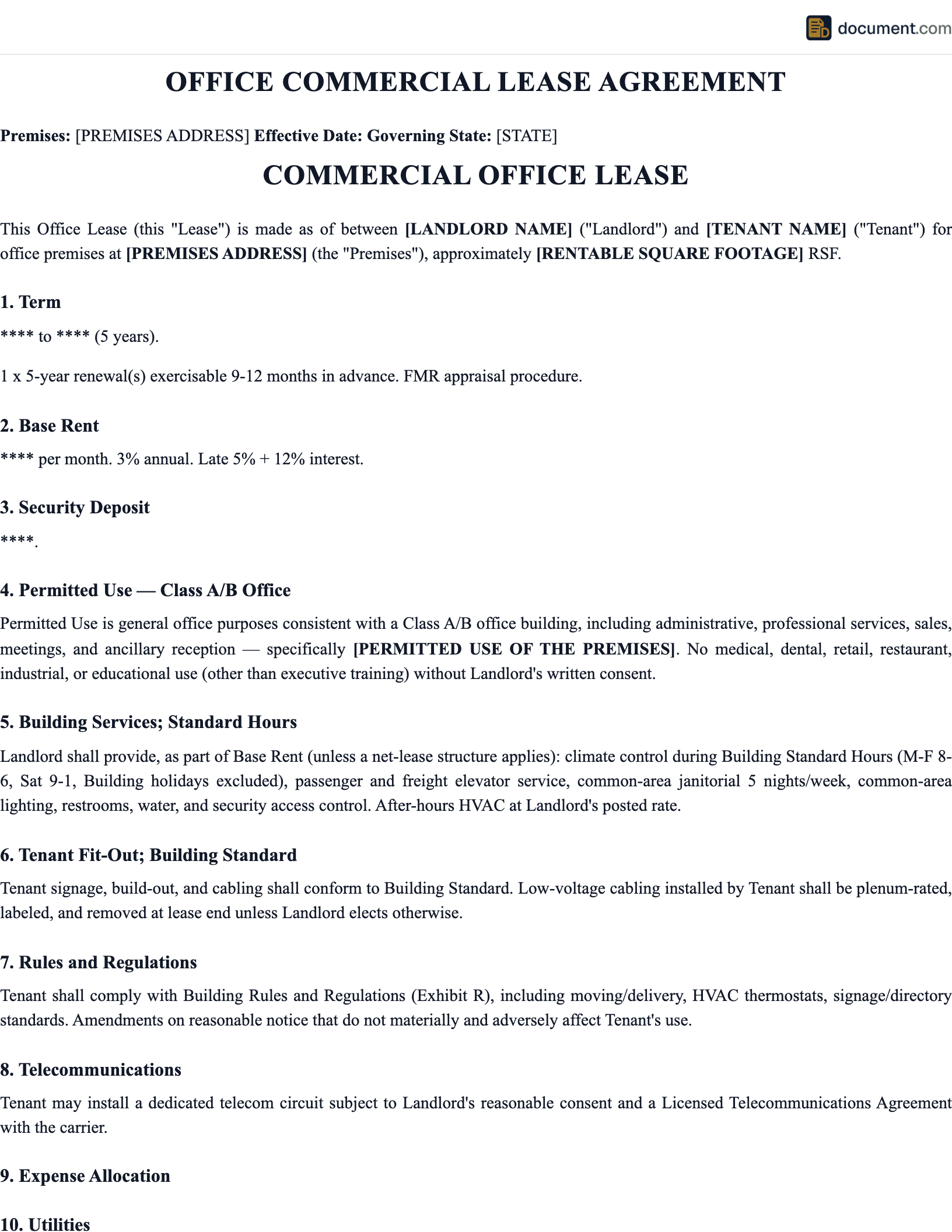
Below is a preview of our Illinois-specific template. Your customized document will include all fields and provisions required for filing in any Illinois county.
OFFICE SPACE LEASE AGREEMENT
STATE OF ILLINOIS
Legal Document Template
LANDLORD
Name: [Full Legal Name / Entity]
Address: [Management Office Address]
Contact: [Property Manager Name]
TENANT
Name: [Business Entity Name]
Address: [Current Business Address]
Tax ID: [EIN]
Guarantor: [If Applicable]
PREMISES
Building: [Building Name/Address]
Suite: [Number]
Floor: [Floor Number]
RSF: [Rentable Square Feet]
USF: [Usable Square Feet]
FINANCIAL TERMS
Base Rent: $[Amount]/RSF/year
TI Allowance: $[Amount]/RSF
Expense Stop: $[Amount]/RSF
Parking: [# Spaces]
Deposit: $[Amount]
Illinois Office Space Lease Agreement FAQ
Answers to common questions about filing an office space lease agreement in Illinois, including requirements, fees, and procedures.
Official Illinois Resources
Use these official state resources to verify requirements, find your local filing office, and access government forms for Illinois.
Related Illinois Documents
Depending on your situation, you may need additional documents alongside your Illinois office space lease agreement.
Create your Illinois Commercial Office Lease Agreement in under 5 minutes.
Answer a few questions and download a Illinois-compliant document, ready for the state agency.