



Florida Office Space Lease Agreement Overview
Florida is one of the most active commercial office markets in the country, driven largely by business migration from high-tax states. Brickell and Wynwood in Miami have attracted financial services firms, tech companies, and Latin American regional headquarters. Tampa's Channel District and Downtown have absorbed major corporate relocations. Orlando's market is shaped by healthcare, hospitality, and defense contracting. Florida has no commercial landlord-tenant statute, so office leases are pure contract documents with terms that Florida courts enforce as written.
Two provisions that distinguish Florida office leases from those in other states are windstorm and hurricane insurance, and CAM charge structures. Florida commercial buildings in coastal and South Florida markets frequently carry separate windstorm insurance policies, and landlords often attempt to pass those premiums through as CAM charges. Negotiating a CAM cap and audit rights is essential. Security deposits have no statutory limit, and Florida courts set no maximum holdover rate, making careful upfront negotiation on both points important.
Contract
Law governs
No Cap
Security deposit
Windstorm
Key insurance issue
Miami/Tampa
Major FL markets
Florida Requirements
Florida commercial office leases have no dedicated statute. The following provisions protect office tenants under standard contract law principles.
Florida Office Lease Note
Florida has no commercial landlord-tenant statute. Chapter 83 of the Florida Statutes governs residential tenancies only. A Florida commercial office lease is a private contract and Florida courts enforce it as written. Negotiate windstorm insurance allocation, CAM caps, audit rights, holdover rates, and deposit return timelines explicitly before signing.
Key Provisions to Include
- Windstorm and hurricane insurance allocation: Specify which party carries windstorm coverage, what limits apply, and whether the premium can be passed through as a CAM charge
- CAM cap and audit rights: Negotiate a cap on annual CAM increases and an annual audit right; Florida Class A buildings in Brickell and Downtown Tampa can carry substantial CAM loads
- TI allowance and build-out terms: State the tenant improvement allowance amount, scope, and disbursement timeline; Florida markets frequently offer TI allowances to attract longer-term tenants
- Holdover rate: Florida leases should express the holdover rate (commonly 150-200% of base rent) and consequential damages exposure explicitly in the agreement
- Parking allocation: Miami and Tampa office buildings frequently price parking separately; confirm the number of allocated spaces, the monthly rate, and whether the landlord can increase parking charges
- Authorized entity signatories: Both parties must execute through properly authorized representatives; Florida LLC and corporate tenants should confirm signatory authority in writing
How to Execute a Florida Office Lease
Florida commercial office leases do not require filing with any government office. Execution is between the parties. These steps cover the full process from LOI through move-in.
Submit a Letter of Intent
Before lease drafting begins, exchange a non-binding Letter of Intent covering base rent, term, TI allowance, parking allocation, and free-rent period. In Miami, Tampa, and Orlando Class A buildings, LOI terms set the baseline for the full lease negotiation.
Negotiate Insurance and CAM Provisions
Florida office leases require careful attention to windstorm and hurricane insurance allocation and CAM charge structures. Confirm whether windstorm premiums are included in CAM, negotiate a cap on annual CAM increases, and secure a right to audit CAM reconciliation statements annually.
Verify Zoning and Permitted Use
Confirm with the applicable Florida municipality that the intended office use complies with current zoning. Miami-Dade, Hillsborough, and Orange Counties all have active zoning and land use regulations that should be verified before finalizing the lease.
Execute with Authorized Signatories
Florida commercial office leases do not require notarization for validity between the parties. Both parties execute through properly authorized representatives. Florida LLC and corporate tenants should confirm signatory authority before execution.
Coordinate Build-Out and Move-In
Document move-in condition at lease commencement. Coordinate TI build-out with the landlord's construction timeline, confirm parking access and HVAC hours, and ensure Florida business registration or foreign qualification is current at the new address.
Florida Office Lease Tax Implications
Florida's tax structure offers significant advantages for businesses, but commercial office tenants need to understand the specific tax treatment of lease costs.
| Tax / Cost Item | Florida Treatment |
|---|---|
| State income tax on rent income | Florida has no personal state income tax. For corporate landlords, Florida's corporate income tax applies to rental income, but this is a landlord obligation, not a tenant charge. |
| Sales tax on commercial rent | Florida imposes sales tax on commercial rent under Florida Statute 212.031. Confirm whether your lease terms reflect the applicable rate and which party is responsible for collection and remittance. |
| CAM and expense passthrough | CAM charges, including windstorm insurance allocations and property tax passthroughs, are additional rent in Florida NNN leases. The annual reconciliation can significantly affect total occupancy cost. |
| TI allowance tax treatment | Tenant improvement allowances received from landlords may have federal income tax implications. Whether TI funds are treated as income or as a reduction in leasehold cost depends on the structure; consult a tax advisor. |
| Attorney review | Florida commercial real estate attorneys typically charge $1,500 to $5,000 for lease review and negotiation on a standard office transaction, depending on complexity and market. |
Sample Florida Office Space Lease Agreement
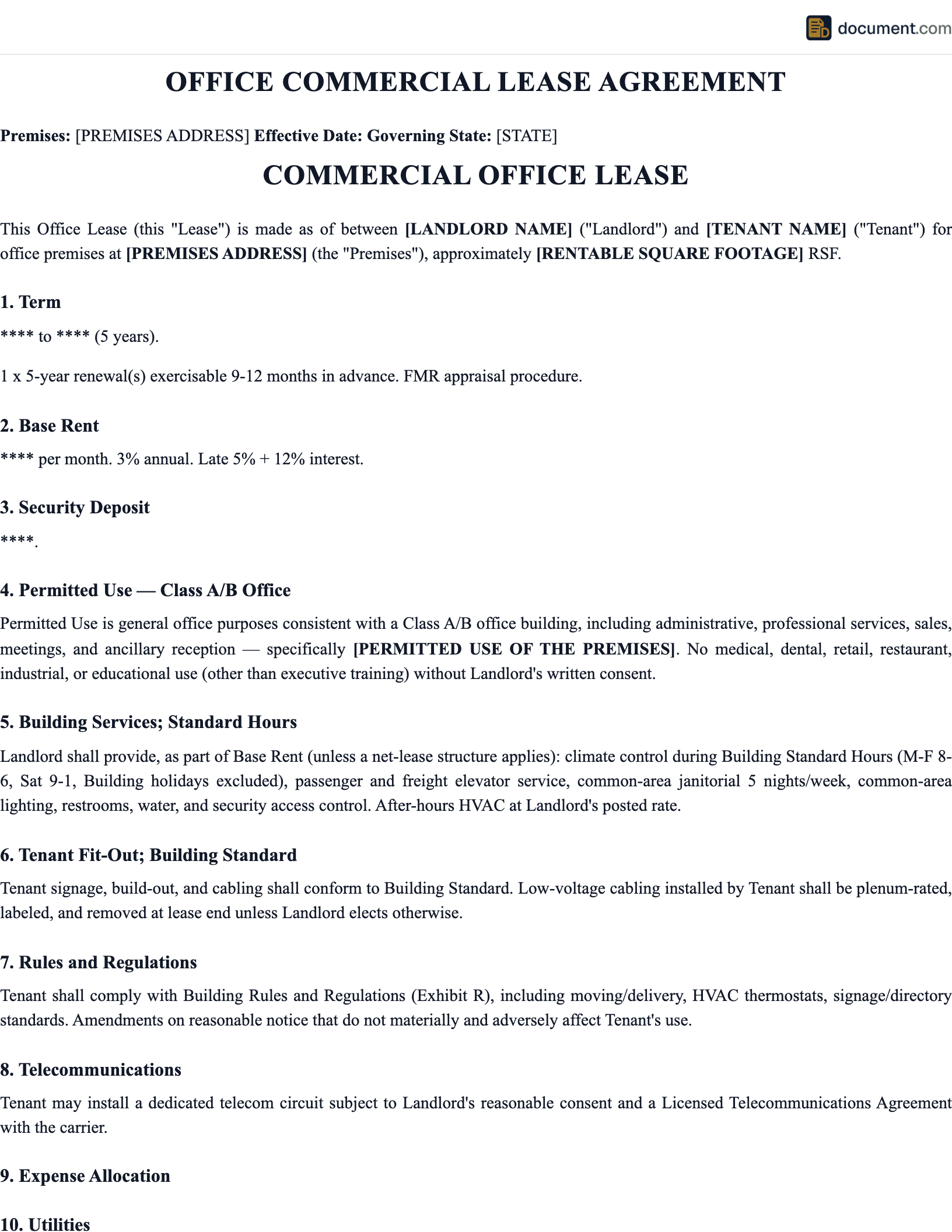
Below is a preview of our Florida-specific template. Your customized document will include all fields and provisions required for filing in any Florida county.
OFFICE SPACE LEASE AGREEMENT
STATE OF FLORIDA
Legal Document Template
LANDLORD
Name: [Full Legal Name / Entity]
Address: [Management Office Address]
Contact: [Property Manager Name]
TENANT
Name: [Business Entity Name]
Address: [Current Business Address]
Tax ID: [EIN]
Guarantor: [If Applicable]
PREMISES
Building: [Building Name/Address]
Suite: [Number]
Floor: [Floor Number]
RSF: [Rentable Square Feet]
USF: [Usable Square Feet]
FINANCIAL TERMS
Base Rent: $[Amount]/RSF/year
TI Allowance: $[Amount]/RSF
Expense Stop: $[Amount]/RSF
Parking: [# Spaces]
Deposit: $[Amount]
Florida Office Space Lease Agreement FAQ
Answers to common questions about filing a office space lease agreement in Florida, including requirements, fees, and procedures.
Official Florida Resources
Use these official state resources to verify requirements, find your local filing office, and access government forms for Florida.
Related Florida Documents
Depending on your situation, you may need additional documents alongside your Florida office space lease agreement.
Create your Florida Commercial Office Lease Agreement in under 5 minutes.
Answer a few questions and download a Florida-compliant document, ready for the state agency.