



Connecticut Office Space Lease Agreement Overview
Connecticut's office market is anchored by two very different cities. Stamford is the state's financial center, home to hedge funds, financial services firms, and media companies, with office rents and standards that are among the highest in New England. Hartford is the insurance industry capital, with a more modest rent base and a market that has absorbed significant office vacancy over the past decade as tenants have downsized or relocated. Greenwich adds a third dimension as one of the wealthiest office markets in the country. The dynamics, market norms, and landlord leverage vary significantly across these submarkets.
Connecticut is one of the few states where the General Statutes (CGS) do provide some framework that courts apply to commercial lease disputes, including implied duties of good faith. However, commercial office leases are still primarily governed by the written contract. Connecticut tenants should pay particular attention to insurance requirements, which tend to run higher than national norms, shorter initial terms driven by the state's high operating costs, and expense reconciliation structures in older Hartford and Stamford buildings that can produce significant annual true-up charges.
CGS
Some protections
No Cap
Security deposit
Higher
Insurance requirements
3-5 yr
Typical term
Connecticut Commercial Office Lease Requirements
Connecticut commercial office leases are governed primarily by contract law, with the Connecticut General Statutes providing some background protections. The requirements below reflect what a sound Connecticut office lease should address.
Connecticut Commercial Lease Note
Connecticut courts have applied CGS good faith principles in commercial lease disputes, giving tenants slightly more statutory footing than in pure contract-law states. Even so, the written lease controls the relationship. Insurance requirements in Connecticut commercial leases tend to run higher than national averages, and expense reconciliation structures in Stamford and Hartford buildings can produce significant annual true-up charges. Read every obligation carefully.
Key Lease Provisions for Connecticut Office Tenants
- Insurance Requirements: Confirm that your commercial general liability limits match what the lease requires; Connecticut landlords commonly require $2M per occurrence / $4M aggregate minimum for office tenants
- Expense Stop and CAM Reconciliation: Define the base year or expense stop amount and negotiate an annual cap on controllable operating expense increases (3-5% is standard in CT markets)
- Parking Allocation: Stamford and Hartford parking is a significant cost; confirm the number of spaces, their location, and the rate, which may escalate separately from base rent
- HVAC After-Hours Charges: Connecticut office buildings frequently charge for HVAC use outside standard hours; confirm the hourly rate and what constitutes standard business hours in the building
- Connecticut Accessibility Compliance: Allocate responsibility for ADA and CGS 29-269 et seq. accessibility compliance between landlord (common areas) and tenant (leased premises after build-out)
- Authorized Entity Signatories: A Connecticut LLC must sign through a properly authorized manager or member; a corporation through an officer; verify that signatories have actual authority
How to Execute a Commercial Office Lease in Connecticut
Connecticut office lease execution follows a negotiated process. These are the steps that apply to Hartford, Stamford, and other Connecticut office markets.
Negotiate a Letter of Intent
Start with a non-binding LOI that establishes base rent, term, TI allowance, parking, expense structure, and any renewal options. Connecticut office landlords generally expect to negotiate the LOI before engaging attorneys on the full lease draft.
Review Insurance Requirements Early
Connecticut commercial office leases typically require higher insurance limits than you may carry currently. Send the insurance exhibit to your broker before the lease is finalized so you can confirm compliance and factor any premium increase into your occupancy cost analysis.
Negotiate Expense Reconciliation and Audit Rights
In Hartford and Stamford office buildings, annual operating expense reconciliations can add meaningful costs above base rent. Negotiate a CAM cap on controllable expenses, an audit right with a 90-day window, and exclusions for capital expenditures and management fee markups.
Execute with Authorized Representatives
Both parties sign through properly authorized representatives. Connecticut does not require notarization for a commercial lease to be valid between parties, though notarization may be required if the lease is to be recorded with the Town Clerk. Collect any required personal guaranty at signing.
Coordinate Move-In and Tenant Build-Out
Confirm rent commencement date, TI allowance disbursement schedule, building permit requirements for any Connecticut construction work, and access control setup. Notify your insurer and update your Connecticut Department of Revenue Services registration if using the new address for tax purposes.
Connecticut Office Lease Tax Implications
Connecticut's commercial leasing landscape has meaningful tax and cost considerations beyond base rent. Understanding them before signing avoids surprises.
| Tax / Cost Item | Connecticut Context |
|---|---|
| Connecticut Sales Tax on Rent | Connecticut does not impose a sales tax on commercial rent. However, certain services bundled into the lease, such as cleaning, security, or IT services, may be subject to Connecticut's services sales tax. Clarify whether any bundled services are being billed separately. |
| Property Tax Passthrough | Connecticut has high property tax rates relative to neighboring states. In modified gross and NNN leases, property tax increases above the base year are passed to tenants. Request the current mill rate and ask how the space is assessed relative to the building as a whole. |
| CAM Reconciliation | Annual CAM true-ups in Hartford and Stamford office buildings can add 10-20% above quoted base rent. Cap controllable CAM at 3-5% per year and negotiate audit rights. |
| Tenant Improvement Allowance | TI allowances received from a Connecticut landlord may be taxable income to the tenant. Work with a Connecticut CPA to structure larger allowances in the most tax-efficient manner before the lease is signed. |
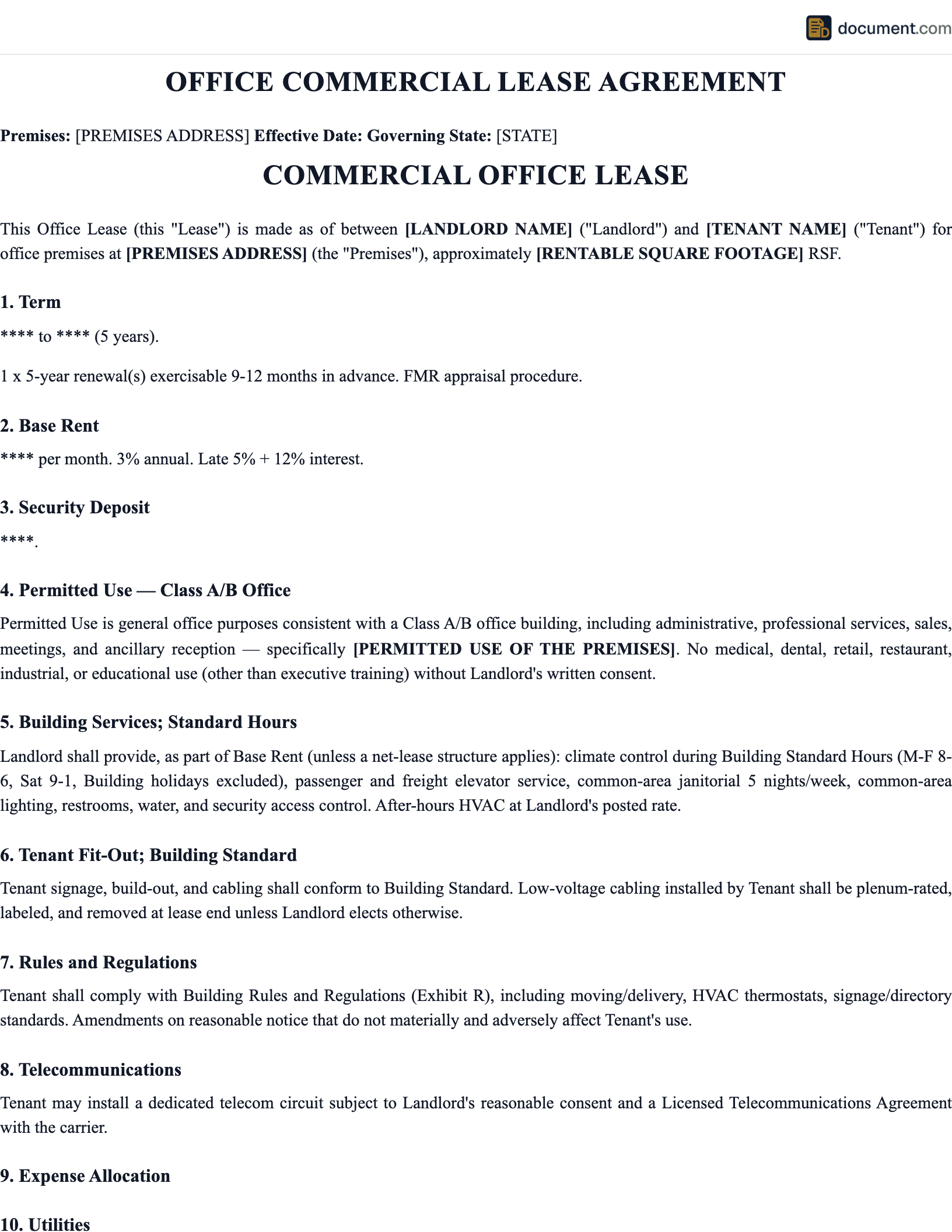
Sample Connecticut Office Space Lease Agreement
Below is a preview of our Connecticut-specific template. Your customized document will include all fields and provisions required for filing in any Connecticut county.
OFFICE SPACE LEASE AGREEMENT
STATE OF CONNECTICUT
Legal Document Template
LANDLORD
Name: [Full Legal Name / Entity]
Address: [Management Office Address]
Contact: [Property Manager Name]
TENANT
Name: [Business Entity Name]
Address: [Current Business Address]
Tax ID: [EIN]
Guarantor: [If Applicable]
PREMISES
Building: [Building Name/Address]
Suite: [Number]
Floor: [Floor Number]
RSF: [Rentable Square Feet]
USF: [Usable Square Feet]
FINANCIAL TERMS
Base Rent: $[Amount]/RSF/year
TI Allowance: $[Amount]/RSF
Expense Stop: $[Amount]/RSF
Parking: [# Spaces]
Deposit: $[Amount]
Connecticut Office Space Lease Agreement FAQ
Answers to common questions about filing a office space lease agreement in Connecticut, including requirements, fees, and procedures.
Official Connecticut Resources
Use these official state resources to verify requirements, find your local filing office, and access government forms for Connecticut.
Related Connecticut Documents
Depending on your situation, you may need additional documents alongside your Connecticut office space lease agreement.
Create your Connecticut Commercial Office Lease Agreement in under 5 minutes.
Answer a few questions and download a Connecticut-compliant document, ready for the state agency.