



Colorado Office Space Lease Agreement Overview
Colorado does not have a dedicated commercial landlord-tenant statute, which means office leases in the state are almost entirely governed by contract law. That reality cuts both ways: landlords can negotiate aggressive terms and courts will enforce them, but tenants who negotiate carefully can also lock in meaningful protections. The Denver metro, Boulder, and Fort Collins markets all have distinct dynamics. Denver CBD and Cherry Creek command Class A rents with full-service gross structures, while suburban submarkets outside the city often use triple-net arrangements with lower face rents and more tenant-favorable buildout allowances.
Colorado's booming tech and startup culture has pushed coworking and flexible office demand, but traditional multi-year office leases remain the backbone of the corporate real estate market here. Key negotiating points for Colorado office tenants include the expense stop or base year in gross leases, build-out allowances and delivery conditions, parking ratios given Denver's transit investment, HVAC after-hours charges, and the interaction between the Denver Green Building Ordinance and tenant fit-out obligations. There is no statutory requirement to notarize or record a commercial lease in Colorado for it to be enforceable between the parties, though leases exceeding one year must be in writing under the statute of frauds.
Contract
Law governs
No Cap
Security deposit
CAM
Passthrough common
Written
Required over 1 year
Colorado Requirements
Colorado commercial office leases are governed by contract law rather than a dedicated landlord-tenant statute. The requirements below reflect what makes a Colorado office lease legally enforceable and commercially sound.
Colorado Commercial Lease Note
Colorado gives commercial tenants far fewer baseline protections than residential tenants. There is no commercial security deposit cap, no implied warranty of suitability, and no statutory cure period for landlord defaults unless those terms are negotiated into the lease. Everything material must be written into the agreement itself.
Key Lease Requirements and Provisions
- Written Agreement: Leases exceeding one year must be in writing under Colorado's statute of frauds; oral commercial leases are enforceable only for terms under one year
- Permitted Use Clause: Define the permitted use precisely; Colorado courts enforce use restrictions strictly, and an overly narrow clause can limit your business flexibility
- CAM and Expense Reconciliation: Specify what operating expenses are included, how the base year or expense stop is calculated, and your right to audit within a defined period
- Denver Green Building Compliance: Buildings subject to Denver's ordinance may require tenants to cooperate on energy benchmarking; clarify obligations in the lease
- ADA Allocation: The lease should specify that the landlord handles common area ADA compliance and the tenant handles compliance within its leased premises after build-out
- Authorized Signatories: Entities must sign through properly authorized representatives; a Colorado LLC requires a manager or authorized member, a corporation requires an officer
How to Execute a Commercial Office Lease in Colorado
Executing a commercial office lease in Colorado is a negotiated process, not a simple filing. The steps below reflect how office leases actually get done in the Denver and Front Range markets.
Issue or Receive a Letter of Intent
Colorado office transactions typically begin with a non-binding LOI that outlines base rent, term, TI allowance, parking, and rent commencement. Get these economic terms in writing before engaging attorneys on the full lease.
Negotiate Key Lease Provisions
Focus on CAM caps, expense stop or base year, build-out timeline and TI disbursement mechanics, holdover rate, assignment and subletting consent standards, and any Colorado-specific green lease requirements for the building.
Conduct Due Diligence on the Space
Verify the building's zoning for your intended office use with the local municipality. In Denver, confirm whether the building falls under the Energy Benchmarking ordinance and request the last three years of operating expense reconciliations.
Execute the Lease with Authorized Signatories
Both parties must sign through properly authorized representatives. Collect any required personal guaranty from principals. Colorado does not require notarization for the lease to be valid between parties, though notarization is needed if the lease will be recorded.
Distribute Copies and Coordinate Move-In
Both parties keep fully executed originals. Confirm the rent commencement date, build-out schedule, access control setup, and parking assignment in writing. Notify your insurance carrier and update your business address with the Colorado Secretary of State if applicable.
Colorado Office Lease Tax Implications
Commercial leasing in Colorado carries several tax and cost considerations that differ from residential leases. Understanding these before you sign saves surprises at year-end reconciliation.
| Tax / Cost Item | Colorado Context |
|---|---|
| Colorado Sales Tax on Rent | Colorado does not impose a statewide sales tax on commercial rent, but some local jurisdictions do. Denver does not currently tax commercial rent; verify with the specific municipality. |
| Property Tax Passthrough | In NNN and modified gross leases, property tax increases above the base year are passed to tenants. Colorado property taxes are assessed at market value and reassessed biennially; ask for the current mill levy. |
| CAM Operating Expense Reconciliation | Annual CAM reconciliations can result in significant true-up charges. Cap controllable CAM increases (typically 3-5% per year) and exclude capital expenditures from CAM pools. |
| Tenant Improvement Allowance Tax Treatment | TI allowances received from a landlord are generally taxable income to the tenant unless structured as a landlord-owned improvement. Consult a Colorado CPA on the optimal structure for larger build-outs. |
| Attorney Review | $300 - $500/hr for Colorado commercial real estate counsel; budget for 5-15 hours on a mid-market office lease negotiation |
Sample Colorado Office Space Lease Agreement
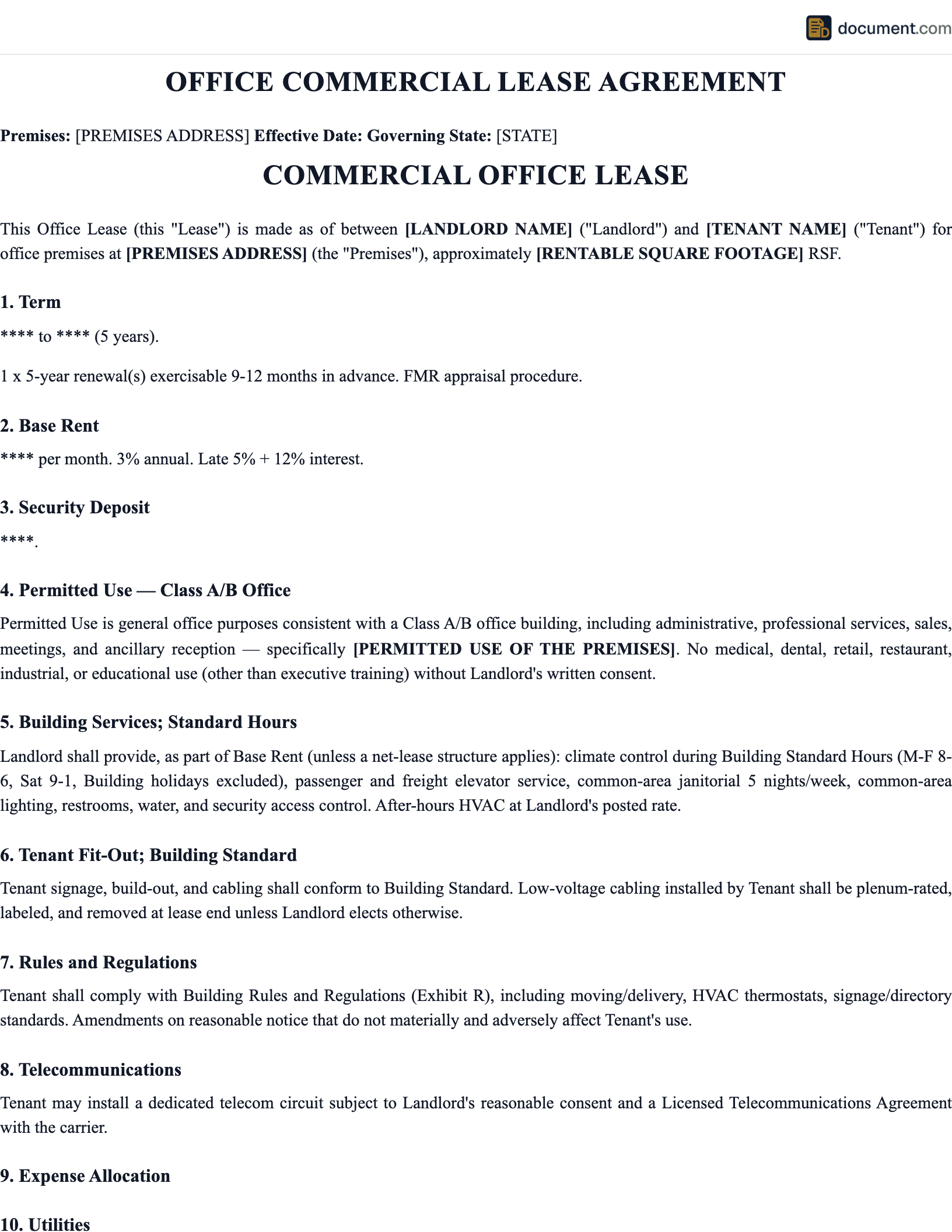
Below is a preview of our Colorado-specific template. Your customized document will include all fields and provisions required for filing in any Colorado county.
OFFICE SPACE LEASE AGREEMENT
STATE OF COLORADO
Legal Document Template
LANDLORD
Name: [Full Legal Name / Entity]
Address: [Management Office Address]
Contact: [Property Manager Name]
TENANT
Name: [Business Entity Name]
Address: [Current Business Address]
Tax ID: [EIN]
Guarantor: [If Applicable]
PREMISES
Building: [Building Name/Address]
Suite: [Number]
Floor: [Floor Number]
RSF: [Rentable Square Feet]
USF: [Usable Square Feet]
FINANCIAL TERMS
Base Rent: $[Amount]/RSF/year
TI Allowance: $[Amount]/RSF
Expense Stop: $[Amount]/RSF
Parking: [# Spaces]
Deposit: $[Amount]
Colorado Office Space Lease Agreement FAQ
Answers to common questions about filing a office space lease agreement in Colorado, including requirements, fees, and procedures.
Official Colorado Resources
Use these official state resources to verify requirements, find your local filing office, and access government forms for Colorado.
Related Colorado Documents
Depending on your situation, you may need additional documents alongside your Colorado office space lease agreement.
Create your Colorado Commercial Office Lease Agreement in under 5 minutes.
Answer a few questions and download a Colorado-compliant document, ready for the state agency.