



California Office Space Lease Agreement Overview
California has the most expensive and most complex commercial office leasing market in the country. San Francisco commands the highest rents in its prime Financial District and SoMa submarkets, though significant post-pandemic vacancy has shifted negotiating leverage toward tenants in ways not seen since the dot-com bust. Los Angeles is not one market but many: Century City and West LA serve entertainment and media tenants at premium rents; El Segundo and Playa Vista serve aerospace and tech; Downtown LA remains oversupplied. San Diego's North County, UTC, and Sorrento Valley clusters cater heavily to life sciences and defense contractors. Understanding which California submarket you are negotiating in matters as much as knowing state law.
California commercial lease law provides no statutory protections for office tenants. The California Civil Code governs commercial leases as ordinary contracts, and courts enforce them as written. California has two significant office-lease-specific requirements that tenants must understand: first, Civil Code Section 1938 requires landlords to disclose whether the premises have been inspected by a Certified Access Specialist (CASp) for disability access compliance; second, Proposition 13 property tax passthrough provisions can create unexpected cost spikes when a building sells and property taxes reset. California also imposes Proposition 65 chemical exposure warning requirements that affect many commercial buildings, particularly older construction in the Bay Area and Los Angeles.
$40-100+
RSF/year Class A
CASp
Disclosure required
None
Deposit cap
Prop 13
Tax passthrough risk
California Requirements
California has two mandatory disclosure requirements specific to commercial office leases that are not present in most other states. Beyond those, the lease framework is contractual, giving you leverage to negotiate but no regulatory floor if you do not negotiate effectively.
California Commercial Lease Note
California Civil Code Section 1938 requires all California commercial leases to include a disclosure about whether the premises have been inspected by a Certified Access Specialist (CASp). This is a mandatory provision unique to California. Also review operating expense provisions for Proposition 13 property tax passthrough language, which can create significant cost spikes if the building sells during your lease term.
California-Specific Provisions to Address
- CASp Disclosure: California Civil Code Section 1938 requires the landlord to disclose whether the premises have been inspected by a Certified Access Specialist and the findings of any report
- Proposition 13 Tax Passthrough: Review whether operating expenses include property tax reassessment costs triggered by a building sale, and negotiate limits on tax passthrough increases
- Proposition 65 Warnings: Confirm the building has appropriate Proposition 65 signage for chemical exposure if required, and whether any tenant buildout will trigger additional obligations
- Operating Expense Cap: Negotiate a cap on annual increases in controllable operating expenses, typically 3 to 5 percent, to limit exposure in California's high-cost market environment
- TI Allowance Structure: Negotiate TI allowance as a dollar amount per RSF with clear construction timing, disbursement conditions, and rights if the buildout runs over cost or schedule
How to File in California
Executing a California commercial office lease involves navigating a more complex process than most other states due to the state's unique disclosure requirements and the sophistication of the landlord community in California's major markets.
Identify Your Submarket and Tour Properties
Identify the California submarket that fits your business: Downtown SF or SoMa for tech; Century City or Santa Monica for entertainment and media in LA; UTC, Del Mar Heights, or Sorrento Valley in San Diego for life sciences and tech. Tour multiple properties and request current vacancy and asking rent data from a tenant broker, who represents your interests at no cost (the landlord pays the commission).
Negotiate the Letter of Intent
Submit a letter of intent covering base rent, free rent period, TI allowance per RSF, lease term, renewal options, and any operating expense cap. California markets currently favor tenants in many submarkets (particularly San Francisco), so push hard on concessions at the LOI stage before the lease is drafted.
Review California-Specific Lease Provisions
Review the lease for the required Civil Code Section 1938 CASp disclosure, Proposition 65 warning obligations, property tax passthrough provisions triggered by building sales (Prop 13 reassessment), operating expense definitions and caps, and any HVAC/after-hours charge provisions. California commercial leases are typically long and complex; legal review by a California commercial real estate attorney is strongly recommended.
Execute the Lease
Both parties sign the finalized lease. California does not require notarization for commercial leases to be enforceable between the parties, though leases recorded against title would require acknowledgment. Deliver the security deposit at signing and confirm all exhibits (TI work letter, parking addendum, HVAC maintenance obligations) are attached and initialed.
Coordinate Buildout and Insurance
Once the lease is executed, coordinate with the landlord on the TI construction schedule. California building permits for tenant improvements often take longer than in other states, particularly in San Francisco and Los Angeles. Confirm your commercial general liability insurance is in place naming the landlord as additional insured before taking occupancy, as required by nearly all California commercial leases.
California Fees & Costs
California office rents are the highest in the country in prime submarkets. The ranges below reflect current market conditions; San Francisco has seen meaningful rent corrections since 2020 that have improved affordability compared to pre-pandemic peaks.
| Fee / Cost | Amount |
|---|---|
| Base Rent (SF Financial District Class A) | $60 - $100+/RSF/year |
| Base Rent (LA West Side Class A) | $48 - $80/RSF/year |
| Base Rent (San Diego UTC/Sorrento) | $40 - $65/RSF/year |
| Security Deposit | 2 - 6 months base rent (no statutory cap) |
| Operating Expenses (CAM) | $12 - $25/RSF/year in major markets |
| Attorney Review | $2,000 - $8,000+ for complex CA leases |
Sample California Office Space Lease Agreement
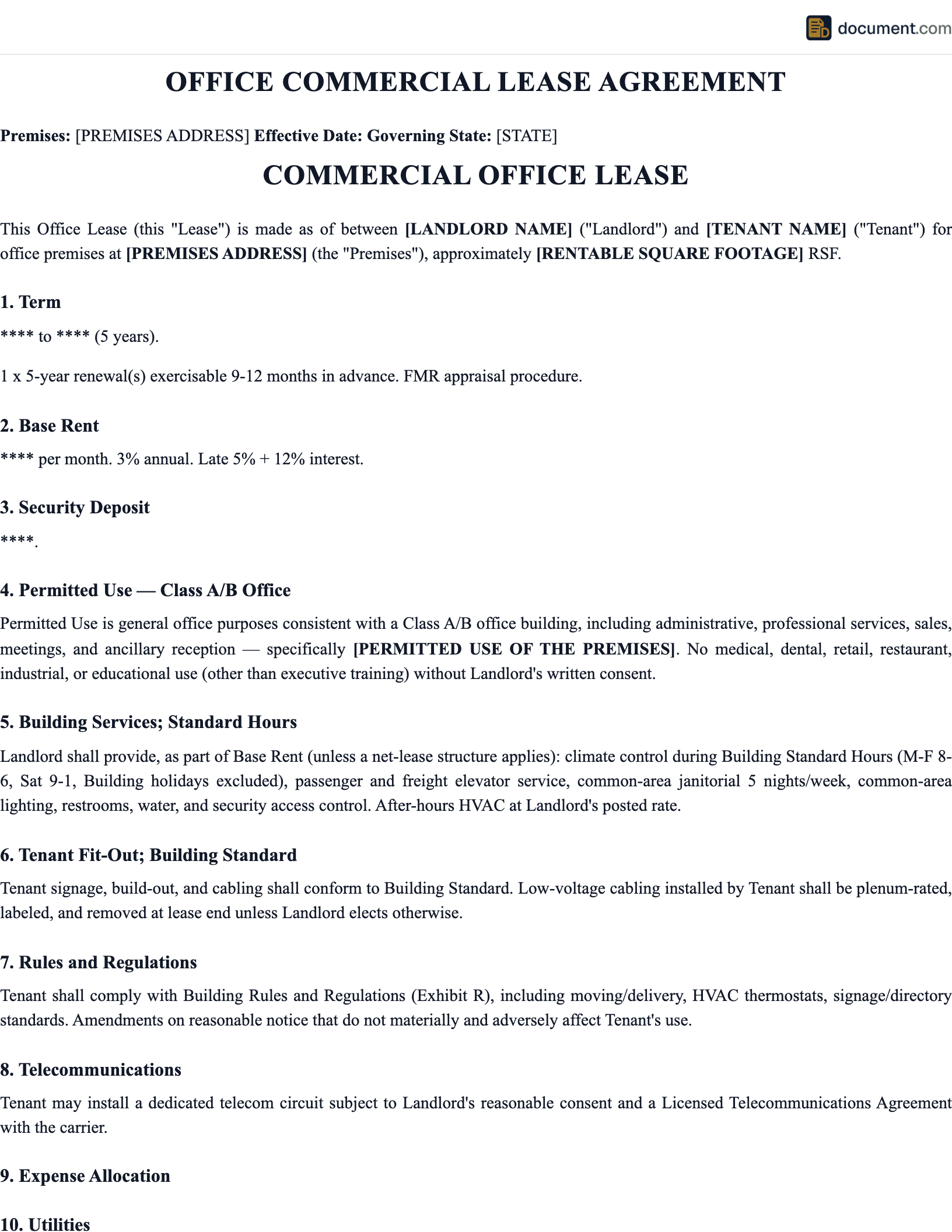
Below is a preview of our California-specific template. Your customized document will include all fields and provisions required for filing in any California county.
OFFICE SPACE LEASE AGREEMENT
STATE OF CALIFORNIA
Legal Document Template
LANDLORD
Name: [Full Legal Name / Entity]
Address: [Management Office Address]
Contact: [Property Manager Name]
TENANT
Name: [Business Entity Name]
Address: [Current Business Address]
Tax ID: [EIN]
Guarantor: [If Applicable]
PREMISES
Building: [Building Name/Address]
Suite: [Number]
Floor: [Floor Number]
RSF: [Rentable Square Feet]
USF: [Usable Square Feet]
FINANCIAL TERMS
Base Rent: $[Amount]/RSF/year
TI Allowance: $[Amount]/RSF
Expense Stop: $[Amount]/RSF
Parking: [# Spaces]
Deposit: $[Amount]
California Office Space Lease Agreement FAQ
Answers to common questions about filing a office space lease agreement in California, including requirements, fees, and procedures.
Official California Resources
Use these official state resources to verify requirements, find your local filing office, and access government forms for California.
Related California Documents
Depending on your situation, you may need additional documents alongside your California office space lease agreement.
Create your California Commercial Office Lease Agreement in under 5 minutes.
Answer a few questions and download a California-compliant document, ready for the state agency.