



What Is a Lady Bird Deed?
A Lady Bird deed — formally known as an enhanced life estate deed— is a specialized type of property deed that allows an owner to retain complete control over their real property during their lifetime while designating one or more beneficiaries who will automatically receive the property upon the owner's death. The property transfers by operation of law at death, bypassing the probate process entirely. The owner continues to live in, use, rent, or otherwise enjoy the property exactly as if no deed had been created.
What sets the Lady Bird deed apart from other estate planning instruments is the scope of powers the owner retains. Under a Lady Bird deed, the owner — referred to as the life tenant— keeps the full right to sell the property, take out a mortgage or home equity loan against it, lease it to tenants, gift it to someone else, or revoke the deed entirely and name different beneficiaries. The named beneficiaries — called remainder beneficiaries or remaindermen— have no current ownership interest, no right to occupy the property, and no ability to prevent the owner from doing anything with it. Their interest is entirely contingent on the owner still holding the property at the time of death.
Lady Bird deeds are most commonly used in Florida, where they have become a cornerstone of Medicaid planning and probate avoidance strategies. They are also recognized in Texas, Michigan, Vermont, and West Virginia. The deed takes its name from Lady Bird Johnson, the former First Lady — though whether she ever actually used one is a matter of debate among real estate attorneys. The critical legal distinction is the "enhanced" language that reserves the owner's right to deal with the property during their lifetime without limitation, which creates fundamentally different legal and tax consequences compared to a traditional life estate deed.
Because Lady Bird deeds are only recognized in a handful of states and require precise drafting language to function as intended, they are not a universal solution. In states that do not recognize enhanced life estate deeds, a similarly worded document may be treated as an ordinary life estate or outright conveyance — with dramatically different consequences for the owner's control, tax treatment, and Medicaid eligibility. Before creating a Lady Bird deed, it is essential to confirm that your state recognizes the instrument and that the deed is drafted with the specific enhanced powers language required under your state's law.
Full Owner Control
Retain the right to sell, mortgage, lease, or revoke without beneficiary consent
Probate Avoidance
Property transfers automatically at death by operation of law
Tax Advantages
Beneficiaries receive a stepped-up tax basis, no gift tax on creation
Lady Bird Deed by State
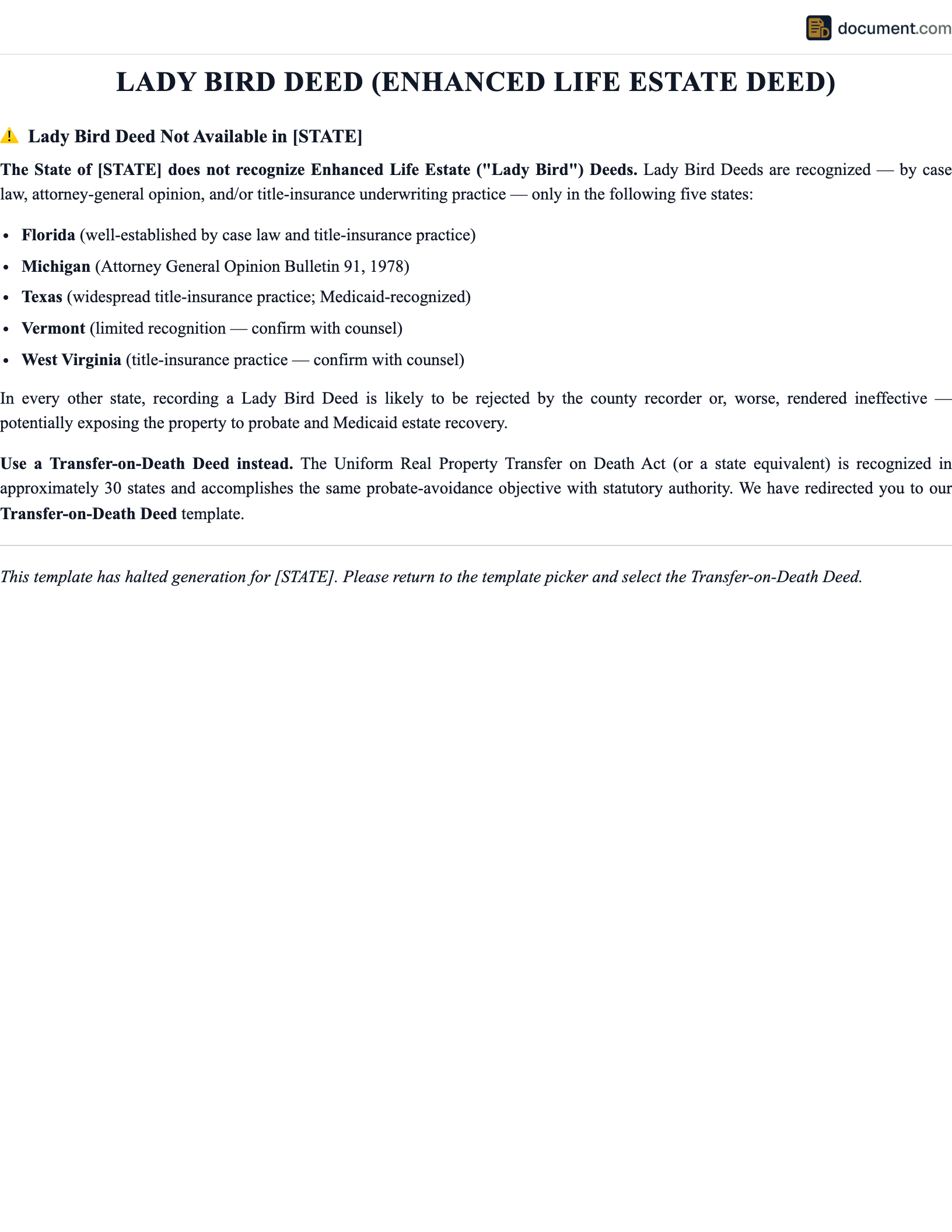
Lady Bird deeds are recognized in only five states: Florida, Michigan, Texas, Vermont, and West Virginia. Those are the only states where Document.com generates one. Every state page below explains the rules for that state and, where a Lady Bird deed is not an option, the alternatives that are.
Origin of the Name "Lady Bird Deed"
The term "Lady Bird deed" is attributed to a Florida attorney who reportedly used Lady Bird Johnson — wife of President Lyndon B. Johnson — as a hypothetical example in a legal seminar to illustrate how an enhanced life estate deed works. The name caught on in the Florida legal community and eventually became the widely used informal name for this type of deed, even though there is no confirmed evidence that Lady Bird Johnson herself ever used one.
Despite its informal origin, the name has become so prevalent that it is used in court opinions, law review articles, state bar publications, and continuing legal education materials throughout the states that recognize the instrument. The formal legal term remains "enhanced life estate deed," and that is the language used in the deed document itself. The "enhanced" modifier is what distinguishes it from a traditional life estate deed and is the key to its favorable legal treatment — without the enhanced powers language, the deed operates as a standard life estate with significantly different consequences for the grantor and beneficiaries.
How a Lady Bird Deed Works
A Lady Bird deed creates two distinct interests in the property: a life estate with enhanced powers retained by the current owner, and a remainder interestgranted to the named beneficiaries. The mechanics operate differently from most other property transfer instruments because the owner's retained powers effectively make the remainder interest contingent rather than vested.
During the Owner's Lifetime
The owner (life tenant) retains complete dominion over the property. This includes the right to live in the property, collect rental income, make improvements, take out mortgages or home equity lines of credit, sell the property outright, change the beneficiaries, or revoke the deed entirely. The owner continues to pay property taxes, maintain insurance, and handle all responsibilities of ownership exactly as if the Lady Bird deed did not exist. The beneficiaries have no right to use the property, no right to receive income from it, and no ability to encumber it or prevent the owner from acting.
- Owner keeps full possession, use, and enjoyment of the property
- Owner can sell, mortgage, lease, gift, or revoke without any consent
- Owner remains responsible for taxes, insurance, and maintenance
- Beneficiaries have no current ownership rights whatsoever
At the Owner's Death
When the owner dies, the life estate automatically terminates and the remainder beneficiaries receive full ownership of the property by operation of law. There is no probate proceeding, no court involvement, and no need for a personal representative to transfer the deed. The beneficiaries record a certified copy of the death certificate along with an affidavit of survivorship at the county recorder's office to establish their ownership in the public record. The transfer is immediate and automatic.
- Ownership transfers automatically — no probate required
- Beneficiaries record death certificate and affidavit to confirm title
- Property receives a stepped-up tax basis as of the date of death
Lady Bird Deed Form Preview
Below is a visual preview of the sections and fields included in a Lady Bird deed form. This mockup illustrates the structure of our attorney-reviewed template. Your completed document will be fully formatted, professionally styled, and customized for your state's recording requirements and enhanced life estate language.
Enhanced Life Estate Deed
(Lady Bird Deed)
Section 1: Grantor / Life Tenant (Property Owner)
Section 2: Remainder Beneficiaries
Primary Beneficiary
Contingent Beneficiary
Section 3: Property Description
Section 4: Retained Enhanced Powers
Section 5: Execution
Grantor Signature
Notary Public
Witness 1 Signature
Witness 2 Signature
Lady Bird Deed vs Regular Life Estate Deed
This is the most important distinction to understand. A Lady Bird deed and a traditional life estate deed may look similar on paper, but they produce fundamentally different legal outcomes. The difference centers entirely on the owner's retained powers — and getting this wrong can have serious consequences for property control, Medicaid eligibility, and taxes.
The Key Distinction: Owner Control
Lady Bird Deed (Enhanced Life Estate)
- - Owner retains full control of the property
- - Can sell, mortgage, or lease without consent
- - Can revoke the deed or change beneficiaries at any time
- - Remainder interest is contingent, not vested
- - Not treated as a completed gift for tax purposes
- - Generally not a disqualifying Medicaid transfer
- - Beneficiaries receive a stepped-up tax basis
Traditional Life Estate Deed
- - Owner cannot sell without remainderman's consent
- - Cannot mortgage the property alone
- - Cannot revoke — the transfer is permanent
- - Remainder interest is vested immediately
- - May be treated as a completed gift, triggering gift tax
- - May trigger Medicaid five-year look-back penalty
- - Beneficiaries may take the owner's original cost basis
Critical warning:If a deed intended to be a Lady Bird deed does not include the specific enhanced powers language, a court may treat it as a traditional life estate deed. This means the owner would need the beneficiary's written consent to sell, mortgage, or refinance the property — and the deed could trigger a Medicaid penalty period. Precise drafting is essential.
Lady Bird Deed vs Revocable Living Trust
Both Lady Bird deeds and revocable living trusts can be used to transfer property outside of probate. However, they differ significantly in complexity, cost, scope, and the types of assets they can handle. The right choice depends on the size and complexity of your estate.
Side-by-Side Comparison
Lady Bird Deed
- - Covers one property per deed
- - Simple to create and inexpensive ($200–$500)
- - Recorded in public records — not private
- - Only available in a handful of states
- - No ongoing management or administration required
- - Does not protect against incapacity planning
- - Cannot hold bank accounts, investments, or personal property
Revocable Living Trust
- - Can hold all types of assets (real estate, accounts, investments)
- - More complex and expensive to establish ($1,500–$5,000+)
- - Private — not part of public record
- - Available in all 50 states
- - Requires ongoing asset management and funding
- - Includes incapacity provisions via successor trustee
- - Provides comprehensive estate plan for complex situations
When to use both: If you own a primary residence in a Lady Bird deed state and have other significant assets, you may benefit from using a Lady Bird deed for the real property and a revocable trust for everything else. The Lady Bird deed is simpler and avoids the need to transfer the property into the trust, while the trust handles your financial accounts, investments, and personal property. Many Florida and Texas estate plans use this combination.
Lady Bird Deed vs Transfer-on-Death Deed
Transfer-on-death (TOD) deeds — also called beneficiary deeds in some states — serve a similar purpose to Lady Bird deeds: transferring property at death without probate. Both allow the owner to retain control during their lifetime and revoke the designation at any time. However, they are different legal instruments with different state availability and different consequences.
Key Differences
Lady Bird Deed
- - Recognized in only 5 states
- - Creates an enhanced life estate structure
- - Well-established Medicaid planning benefits in Florida
- - Longer legal history with case law support
- - Owner retains life estate — technically a present interest
- - May provide stronger creditor protection in some states
Transfer-on-Death (TOD) Deed
- - Available in more than 30 states plus DC
- - Does not create a life estate — purely a beneficiary designation
- - Medicaid treatment varies and is less established
- - Newer statutory instrument (uniform act approved in 2009)
- - Owner retains full fee simple ownership during lifetime
- - Simpler document — does not require enhanced powers language
Key takeaway: If you live in a state that recognizes Lady Bird deeds and Medicaid planning is a concern, the Lady Bird deed has a stronger track record. If your state offers TOD deeds but not Lady Bird deeds, the TOD deed is the closest alternative for simple probate avoidance. In states that recognize neither, a revocable living trust is the primary option.
Which States Recognize Lady Bird Deeds
Lady Bird deeds are only recognized in a small number of states. This is one of the most important facts about this instrument — if your state does not recognize enhanced life estate deeds, using Lady Bird deed language in a conveyance could produce unintended and potentially harmful legal consequences. The following is the current landscape of state recognition.
Florida
The state where Lady Bird deeds are most widely used and best supported by case law. Florida courts have consistently upheld enhanced life estate deeds, and they are a standard tool in Florida Medicaid planning. Florida's Medicaid estate recovery program only reaches probate assets, making the Lady Bird deed an effective way to shield the homestead from recovery. Florida law also preserves the homestead property tax exemption for the life tenant.
Texas
Texas recognizes enhanced life estate deeds, though they are less commonly used than in Florida. Texas also offers transfer-on-death deeds as an alternative. Texas property law supports the concept of a life estate with reserved powers, and Texas estate planning attorneys use Lady Bird deeds for both probate avoidance and potential Medicaid planning benefits, though Medicaid treatment in Texas may differ from Florida.
Michigan
Michigan has recognized Lady Bird deeds for decades, and Michigan title insurers routinely accept them. Michigan has no transfer-on-death deed, so estate planning attorneys there frequently use them as a probate avoidance tool, particularly for homestead properties. Michigan's Medicaid estate recovery rules and their interaction with Lady Bird deeds should be confirmed with a local elder law attorney.
West Virginia
West Virginia recognizes enhanced life estate deeds, largely through title-insurance practice. The instrument is used for probate avoidance, though it is less common than in Florida or Michigan. Property owners in West Virginia considering a Lady Bird deed should confirm current acceptance with a local real estate attorney and verify how the state's Medicaid program treats the instrument.
Vermont
Vermont recognizes enhanced life estate deeds by statute. The Enhanced Life Estate Deed Act (27 V.S.A. §§ 651 to 660) covers how they are executed, recorded, and revoked, and includes an optional statutory form. They are less common than in Florida, so confirm the deed with a Vermont attorney or your title insurer, and have an elder law attorney review any Medicaid implications.
States That Do NOT Recognize Lady Bird Deeds
The vast majority of states — including California, New York, Illinois, Pennsylvania, Ohio, and most others — do not recognize enhanced life estate deeds. In these states, a deed with Lady Bird-style language may be interpreted as a traditional life estate deed or an outright conveyance, which would produce very different legal, tax, and Medicaid outcomes. In North Carolina they are legally untested, with no statute or appellate decision behind them. Document.com does not generate Lady Bird deeds for property in any of these states. If you live in one, consider a transfer-on-death deed (if available in your state) or a revocable living trust as alternatives for probate avoidance.
Lady Bird Deeds and Medicaid Planning
One of the primary reasons Lady Bird deeds have become so popular — particularly in Florida — is their favorable treatment under Medicaid eligibility and estate recovery rules. Medicaid is the joint federal-state program that pays for long-term care for individuals who meet income and asset thresholds. For many older homeowners, the family home is their most valuable asset, and protecting it from Medicaid claims while maintaining eligibility is a central concern.
Under federal law, states are required to seek recovery of Medicaid benefits paid on behalf of a deceased recipient from the recipient's estate — a process called Medicaid estate recovery. However, the federal statute defines "estate" to mean the probate estate, and states have the option to expand that definition to include non-probate assets. This distinction is critical because a Lady Bird deed transfers property outside of probate, potentially shielding it from estate recovery in states that limit recovery to probate assets.
Florida: The Strongest Protection
Florida limits Medicaid estate recovery to the probate estate. Because a Lady Bird deed transfers property outside of probate, the homestead is generally protected from Medicaid liens and estate recovery claims. Additionally, because the owner retains full control of the property including the right to sell or revoke, creating a Lady Bird deed is generally not treated as a "transfer for less than fair market value" under the Medicaid five-year look-back period. This combination — no look-back penalty and no estate recovery — makes the Lady Bird deed a cornerstone of Florida Medicaid planning.
Other States: Variable and Evolving
In states other than Florida, the Medicaid treatment of Lady Bird deeds is less settled. Some states have expanded their definition of "estate" for Medicaid recovery purposes to include non-probate transfers, which could subject Lady Bird deed property to recovery claims. The Medicaid five-year look-back treatment may also vary. Federal Medicaid rules could change at any time, potentially affecting the treatment of Lady Bird deeds nationwide. Any Medicaid planning strategy involving a Lady Bird deed should be reviewed by an elder law attorney who is current on both federal rules and your state's specific Medicaid policies.
Homestead Exemption Preservation
In Florida, a Lady Bird deed preserves the homestead property tax exemption for the life tenant because the owner retains full possession and use of the property as their primary residence. The homestead exemption (up to $50,000 in assessed value) continues to apply during the owner's lifetime. This is a significant advantage over transferring the property outright or into a trust, either of which could potentially trigger a loss of the homestead exemption or a reassessment. However, upon the owner's death, the property will likely be reassessed at current market value for the new owner.
Tax Implications of a Lady Bird Deed
The tax treatment of Lady Bird deeds is one of their most significant advantages. Because the owner retains full control and the power to revoke, the tax consequences are fundamentally different from those of an outright gift or a traditional life estate deed.
Stepped-Up Basis at Death
Because the property is included in the owner's estate for federal estate tax purposes, beneficiaries receive a stepped-up cost basis equal to the fair market value on the date of death. If the owner purchased the home for $150,000 and it is worth $500,000 at death, the beneficiary's basis is $500,000 — eliminating $350,000 in potential capital gains if the property is subsequently sold. This is a major advantage over an outright gift during the owner's lifetime, where the recipient would take the owner's original $150,000 basis.
No Gift Tax
Creating a Lady Bird deed is not a completed gift for federal gift tax purposes because the owner retains the power to revoke. No gift tax return (Form 709) is required when the deed is recorded. The transfer only becomes complete at death, at which point it is included in the owner's taxable estate — but the federal estate tax exemption of approximately $13.6 million per individual (as of 2024) means the vast majority of estates owe no federal estate tax.
No Reassessment During Lifetime
Because the owner retains full ownership and control during their lifetime, the creation of a Lady Bird deed does not trigger a property tax reassessment. The property continues to be taxed at its current assessed value with any applicable homestead exemptions intact. This avoids the potential increase in property taxes that could result from an outright transfer or conveyance into a trust.
Potential Reassessment at Death
When ownership transfers to the beneficiary at the owner's death, the property may be reassessed at its current fair market value for property tax purposes. In states with "Save Our Homes" caps on annual assessment increases (such as Florida), this can result in a significant increase in property taxes for the beneficiary. Beneficiaries should budget for this potential increase and explore whether any additional homestead exemptions are available to them.
Key Provisions of a Lady Bird Deed
A properly drafted Lady Bird deed must include specific provisions to function as intended. Missing or improperly worded provisions can result in the deed being treated as a traditional life estate with dramatically different legal consequences. The following components are essential.
| Provision | Description |
|---|---|
| Granting Clause with Enhanced Life Estate Language | The deed must explicitly state that the grantor retains a life estate with enhanced powers, including the right to sell, mortgage, lease, and revoke. This language is what distinguishes a Lady Bird deed from a traditional life estate. |
| Full Legal Description | The complete legal description of the property as it appears in the county records — including lot, block, subdivision, plat book, page, and county. A street address alone is not sufficient for recording. |
| Remainder Beneficiary Designation | Full legal names and manner of taking (tenants in common, joint tenants with right of survivorship) for the beneficiaries who will receive the property at the owner's death. |
| Contingent Beneficiary Clause | Names alternate beneficiaries who receive the property if a primary beneficiary predeceases the owner. Without this, the remainder interest may lapse, requiring probate. |
| Retained Powers Clause | An explicit statement of the owner's retained powers: the right to sell, convey, mortgage, lease, collect rents, and revoke the deed in whole or in part, all without the consent of the remainder beneficiaries. |
| Consideration Statement | A recital of nominal consideration (typically "$10.00 and other good and valuable consideration") as required for deed validity in most states. |
| Grantor Signature and Notarization | The owner's signature, properly notarized. Most states require notarization for recording. Some states also require witnesses. |
| Prepared-By and Return-To Statements | County recorders require identifying information for who prepared the deed and where the recorded document should be returned after filing. |
How to Create a Lady Bird Deed: 3 Steps
Creating a valid Lady Bird deed requires careful attention to your state's deed requirements, precise enhanced life estate language, and proper recording. Follow these three steps to create and execute your Lady Bird deed.
Draft the Deed with Enhanced Life Estate Language
The most critical step is ensuring the deed contains the specific language that creates an enhanced life estate rather than a traditional one. The granting clause must explicitly reserve the owner's right to sell, mortgage, lease, and revoke without the beneficiaries' consent. Gather the following information before drafting:
- Full legal name and address of the property owner (grantor/life tenant)
- Full legal names and addresses of all remainder beneficiaries
- Full legal names of contingent beneficiaries
- Complete legal description of the property (from your existing deed or county records)
- Property parcel identification number or tax folio number
Warning:Using generic or imprecise life estate language — without the enhanced powers reservation — will likely result in a traditional life estate deed, which removes your ability to sell or mortgage without the beneficiary's consent and may trigger Medicaid look-back penalties. This is not a document to draft casually.
Execute and Notarize the Deed
The property owner must sign the deed in the presence of a notary public. In Florida and several other states, two witnesses are also required. The beneficiaries do not need to sign the deed — their consent is not required and they do not even need to be informed that the deed exists, though it is generally good practice to let them know. The owner must be mentally competent at the time of signing.
Tip:Keep a copy of the signed and notarized deed in a safe location and provide a copy to each named beneficiary. While the recorded deed is available through the county recorder's office, having a copy readily available will make the post-death transfer process faster and simpler.
Record the Deed with the County Recorder
The signed and notarized deed must be recorded with the county recorder's office (or county clerk, register of deeds, depending on your state's terminology) in the county where the property is located. Recording provides constructive notice to the public that the deed exists and establishes the beneficiaries' future interest. Recording fees vary by county but are typically $10 to $30 for the first page and $5 to $10 for each additional page. Some counties also require documentary stamp taxes or transfer taxes, though Lady Bird deeds may be exempt in certain states because no consideration is exchanged.
The deed is not effective until it is recorded. An unrecorded Lady Bird deed may not accomplish its intended purpose and could create title issues for the beneficiaries after the owner's death. Confirm with the county recorder that the document meets all formatting requirements (margins, font size, paper size) before submitting.
Common Mistakes to Avoid
Lady Bird deeds require precise drafting and proper execution. The following mistakes can undermine the deed's intended purpose or create serious legal and financial problems for the owner and beneficiaries.
Omitting Enhanced Life Estate Language
Without the specific "enhanced powers" reservation — explicitly stating the right to sell, mortgage, lease, and revoke — the deed will be treated as a traditional life estate. This is the most common and most consequential mistake, as it removes the owner's control over the property and changes the tax and Medicaid treatment entirely.
Failing to Record the Deed
An unrecorded deed may not be legally effective and will not provide constructive notice to third parties. If the deed is not recorded before the owner's death, the beneficiaries may face title complications and may need to go through probate to establish ownership.
Not Naming Contingent Beneficiaries
If the sole remainder beneficiary predeceases the owner and no contingent beneficiary is named, the remainder interest lapses. The property then passes through the owner's probate estate — defeating the entire purpose of the Lady Bird deed. Always name at least one contingent beneficiary.
Using a Lady Bird Deed in a Non-Recognizing State
If your state does not recognize enhanced life estate deeds, the document may be interpreted as a traditional life estate or outright conveyance — producing completely different legal consequences than intended. Always verify state recognition before drafting.
Using an Incorrect Legal Description
The legal description in the deed must exactly match the description in the county records. Even minor errors — a wrong lot number, incorrect plat book reference, or missing subdivision name — can create title defects that require costly correction. Always obtain the legal description from the most recent recorded deed or a title search.
Ignoring Existing Mortgage or Title Issues
While recording a Lady Bird deed on mortgaged property is generally permissible, failing to consider the existing mortgage, liens, or title defects can create complications. Review title insurance, existing mortgage terms, and any liens before recording the deed.
Sample Lady Bird Deed
Below is a condensed preview of a Lady Bird deed template showing the enhanced life estate language and key provisions. Your completed document will be fully customized for your state, property description, and named beneficiaries.
ENHANCED LIFE ESTATE DEED
(Lady Bird Deed)
This Enhanced Life Estate Deed is made on [Date], by [Grantor Full Legal Name], whose address is [Grantor Address](hereinafter "Grantor").
1. GRANT OF ENHANCED LIFE ESTATE
Grantor hereby conveys to [Beneficiary Name(s)](hereinafter "Remainder Beneficiary"), a remainder interest in the real property described herein, subject to and contingent upon a retained enhanced life estate in the Grantor. The Grantor retains a life estate in said property with the full power and authority to sell, convey, mortgage, lease, and otherwise manage and dispose of the property described herein, in fee simple, with full power to divest the remainder interest created herein, without the joinder, consent, or agreement of the Remainder Beneficiary.
2. PROPERTY DESCRIPTION
Parcel ID: [Parcel Number]
Property Address: [Street Address, City, State, ZIP]
3. RETAINED POWERS
During Grantor's lifetime, Grantor reserves unto herself/himself the following rights and powers, exercisable without the joinder or consent of the Remainder Beneficiary:
- The right to sell, transfer, or convey the property in fee simple
- The right to mortgage, pledge, or encumber the property
- The right to lease the property and collect rents therefrom
- The right to revoke this deed in whole or in part
- The right to change the remainder beneficiary designation
- The right to manage, maintain, and improve the property
- All rights of possession, use, and enjoyment
4. CONTINGENT BENEFICIARY
In the event the Remainder Beneficiary predeceases the Grantor, the remainder interest shall pass to [Contingent Beneficiary Name(s)], or their successors in interest.
5. AUTOMATIC TRANSFER
Upon the death of the Grantor, the life estate shall terminate, and fee simple title to the above-described property shall vest automatically in the Remainder Beneficiary (or Contingent Beneficiary, if applicable) without the necessity of probate proceedings, administration, or further conveyance...
Frequently Asked Questions
Find answers to common questions about Lady Bird deeds, enhanced life estate planning, state recognition, Medicaid treatment, and tax implications.
Official Resources
For additional information on Lady Bird deeds, enhanced life estate planning, Medicaid eligibility, and real estate deed requirements, consult these official and reputable resources.
Florida Bar — Real Property Guide
Florida Bar Association consumer guide to real property and deed issues
Medicaid.gov — Eligibility
Federal Medicaid eligibility rules and asset treatment guidance
NAELA — Elder Law Attorneys
National Academy of Elder Law Attorneys — find an elder law attorney near you
ABA — Real Property & Trust Law
American Bar Association section on real property, trust, and estate law
ULC — Real Property Transfer on Death Act
Uniform Law Commission information on the RUTODA and state adoption status
IRS — Publication 551 (Basis of Assets)
IRS guidance on cost basis, stepped-up basis, and basis of inherited property
Nolo — Lady Bird Deed Guide
Free legal information on Lady Bird deeds, state availability, and alternatives
CFPB — Mortgage Resources
Consumer Financial Protection Bureau mortgage and homeownership guidance
Create your Lady Bird Deed in under 10 minutes.
Answer a few questions and download a compliant, attorney-drafted document ready for your state.