



What Is an Invitation Letter for US Visa?
An invitation letter for a US visa — sometimes called a letter of invitation, host letter, or sponsorship letter — is a written statement from a US citizen, lawful permanent resident, valid nonimmigrant visa holder, or US-based company inviting a foreign national to visit the United States temporarily. The letter is typically submitted alongside a B-1 business visitor visa application or a B-2 tourist visa application at a US embassy or consulate, and it serves as one of the primary pieces of evidence the consular officer uses to evaluate the legitimacy and feasibility of the proposed trip.
Although US immigration law does not formally require an invitation letter for a B-1 or B-2 visa, in practice the letter is one of the most powerful documents an applicant can present. It answers the questions every consular officer asks: Why is the visitor coming? Where will they stay? Who is hosting them? How long will they stay? Who is paying? What is the visitor's relationship to the host? Does the visitor have enough ties to their home country to ensure they will return at the end of the trip? A well-drafted letter answers all of these questions in a single document, organized in a way the officer can read in under a minute. A poorly drafted or missing letter forces the officer to ask the same questions in person and often leads to additional documentation requests or outright denial under Section 214(b).
The letter is most commonly used by US-based family members inviting parents, siblings, adult children, or close friends to visit. It is also used by US companies inviting foreign business partners for meetings, training, or conferences; by hosts of weddings, graduations, and milestone events; by parents inviting grandparents to help with the birth of a baby; and by friends inviting tourists for vacation. The same basic structure applies in every case, but the specific content varies based on the purpose of the visit, the host's ability to provide financial support, and the visitor's personal circumstances. Our templates adapt to each of these scenarios.
The invitation letter should be paired with documentation that proves the host's identity, status, address, and financial ability. Common attachments include a copy of the host's US passport, green card, or visa and I-94; a copy of the host's most recent federal tax return; recent bank statements; a recent pay stub or employment verification letter; and a copy of the host's lease or mortgage. For longer or more involved visits, the host may also need to file Form I-134 (Declaration of Financial Support), which is a sworn USCIS form that complements the narrative invitation letter. The visitor brings the entire packet to the visa interview, along with their own DS-160 confirmation, passport, photo, application fee receipt, and evidence of ties to their home country.
Whether you are inviting a parent to visit for the holidays, a sister for your wedding, a colleague for a business meeting, or a friend for a vacation, our attorney-reviewed templates produce a clear, professional letter that addresses every question a consular officer is going to ask. Each template includes the host identification block, the visitor identification block, a purpose-of-visit narrative, a planned itinerary, a financial sponsorship statement, a supporting-document checklist, and a clean signature block compatible with the I-134 framework.
Embassy-Ready
Built for B-1 and B-2 visa interviews at US embassies and consulates
Sponsorship Language
Includes the financial-support statements consular officers expect to see
Document Checklist
Lists every supporting document to attach to the host packet
Invitation Letter Preview
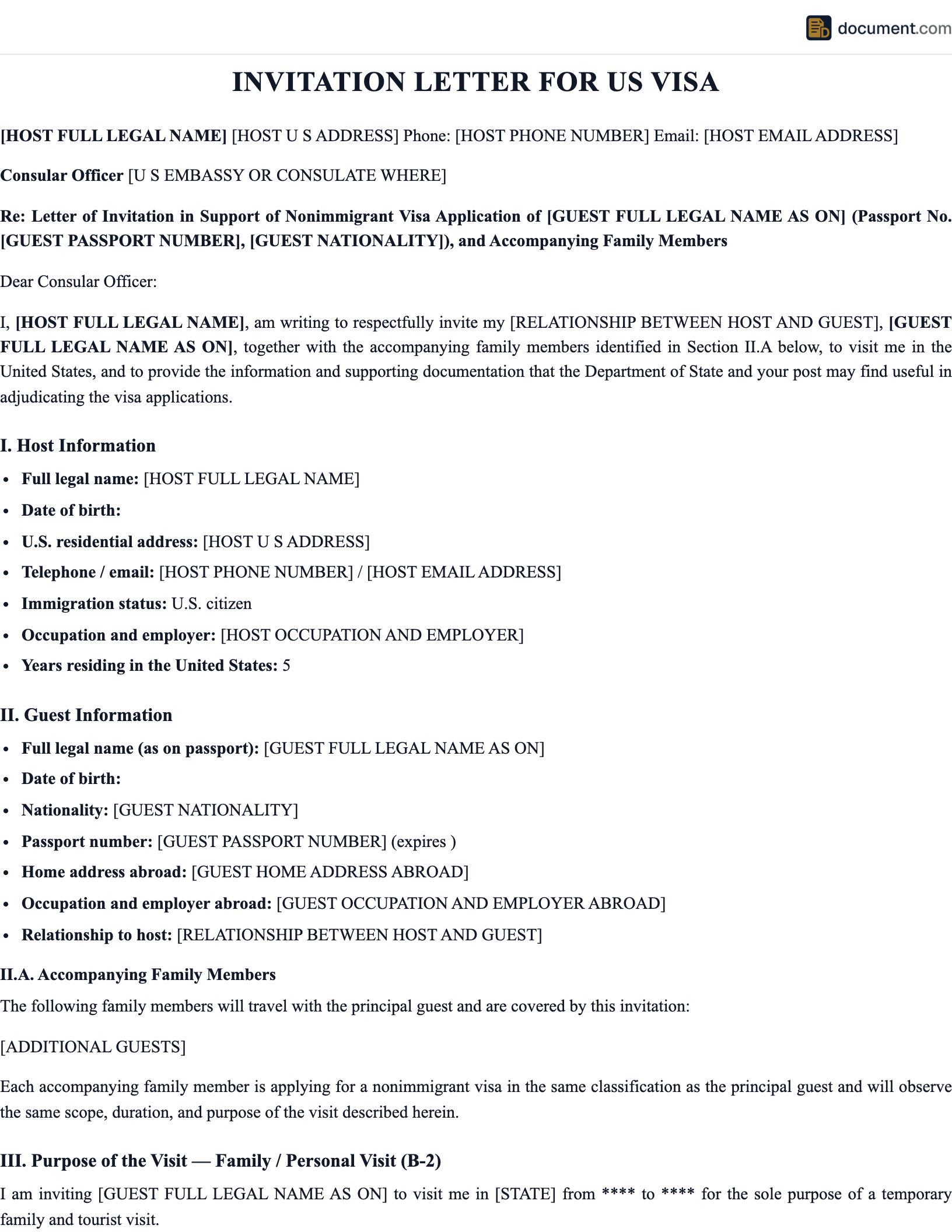
Below is a visual preview of the sections in a complete invitation letter. Your finished document will be fully formatted, professionally styled, and customized for the visitor, the purpose of the visit, and your immigration status.
Letter of Invitation
For US B-1 / B-2 Visitor Visa Application
Section 1: Host Information
Section 2: Visitor Information
Section 3: Visit Details
Section 4: Sponsorship
Section 5: Signature
Host Signature & Date
When You Need an Invitation Letter
Almost any temporary visit to the United States by a foreign national can be supported by an invitation letter. The most common purposes are below.
Family Visit (B-2 Tourist)
Invite a parent, sibling, child, or other relative for a family visit
Wedding or Special Event
Invite family and friends to attend a wedding, graduation, or milestone event
Birth of a Child
Invite a parent or close relative to support during the birth of a baby
Medical Care for a Visiting Relative
Support a family member visiting for medical treatment
Tourism and Sightseeing
Invite friends or relatives for a vacation in the United States
Business Meeting (B-1)
Invite a business contact for meetings, conferences, or training
Graduation or Academic Event
Invite family to attend a graduation ceremony or academic milestone
Conference or Training
Sponsor a colleague or partner for a professional event in the US
Invitation Letter vs I-134 vs I-864
US immigration law uses several different documents to demonstrate financial support for foreign visitors and immigrants. Understanding the differences ensures you submit the right document for the right situation.
Invitation Letter
A narrative document written by the host that explains the purpose of the visit, the host-visitor relationship, the planned itinerary, and the host's ability to provide support. Not a government form. Not formally required, but routinely used to support B-1 and B-2 visa applications. May be submitted alone for shorter visits or alongside Form I-134 for longer or more involved visits.
Form I-134 (Declaration of Financial Support)
A USCIS form on which the host certifies under oath that they are willing and able to financially support a foreign visitor and that they accept responsibility for ensuring the visitor does not become a public charge. Used for nonimmigrant visa applications (B-1, B-2, F-1, J-1, etc.). The host must attach evidence of income, savings, and ability to support. The I-134 obligation is not legally enforceable in the way the I-864 is, but it carries significant weight at the visa interview.
Form I-864 (Affidavit of Support Under Section 213A)
A formal, legally enforceable USCIS form used for immigrant visa applications (green cards) under Section 213A of the Immigration and Nationality Act. The sponsor commits to maintaining the immigrant at 125% of the federal poverty guidelines and accepts a lifetime financial obligation that can be enforced by the immigrant or by a government agency. The I-864 is not used for visitor visas — only for permanent immigration.
How to Write an Invitation Letter: Step-by-Step
An effective invitation letter is short, specific, and credible. Follow the steps below to produce a letter that strengthens the visa application without raising any red flags.
Address the letter to the consular officer
Begin the letter with a formal salutation addressed to the consular officer at the specific US embassy or consulate where the visitor will apply. The address line should read something like To the Honorable Consular Officer, Embassy of the United States of America, [City], [Country]. This shows the officer the letter was written specifically for their review and not as a generic template.
Identify yourself as the host
State your full legal name, date of birth, US address, phone number, email, and immigration status (US citizen, lawful permanent resident, or specific visa type and expiration). If you are a US citizen by naturalization, mention the date of naturalization. If you are a green card holder, give your A-number. If you are on a nonimmigrant visa, give the visa type, I-94 expiration, and employer name. Officers want to know who they are dealing with.
Identify the visitor
State the visitor's full legal name (exactly as it appears on their passport), date of birth, passport number, country of residence, and current home address. State your relationship to the visitor and how long you have known each other. If the visitor is a family member, briefly describe the family connection — for example, my mother, my younger brother, my cousin's wife. The relationship helps the officer evaluate the legitimacy of the invitation.
State the purpose of the visit
Be specific about why the visitor is coming. A wedding, a graduation, the birth of a grandchild, a milestone birthday, a business meeting, a medical procedure, a vacation. Vague purposes (just to visit) are less persuasive than specific ones. If the purpose involves a particular event, give the date and location. If the purpose is a business meeting, give the company name, the contacts the visitor will meet, and the agenda.
Describe the planned itinerary
Provide arrival and departure dates, the address(es) where the visitor will stay, the cities they will visit, and any specific events on the schedule. Include enough detail that an officer can mentally picture the trip. If you are flying the visitor in or paying for hotels, mention it. If the visitor will travel domestically, list the destinations. The itinerary should be realistic and consistent with the stated purpose.
Address financial sponsorship
State clearly whether you, the visitor, or both will pay for the trip. If you are providing financial support, list what you will cover (accommodation, food, transportation, health insurance, return airfare) and confirm your financial ability to do so. Mention that you will attach supporting documents (tax return, bank statements, pay stub, employer letter). If the visitor is paying for their own trip, state that as well — many visitors prefer to demonstrate their own financial independence.
Acknowledge intent to return home
Briefly mention that the visitor has strong ties to their home country and intends to return at the end of the trip. Reference the visitor's job, family, property, or other obligations. Do not promise the visitor employment in the United States, do not suggest the visitor might stay longer, and do not invite the visitor to apply for permanent residence — these statements suggest immigrant intent and can lead to denial under Section 214(b).
List supporting documents
Close the letter with a list of the documents you are attaching: your US passport bio page, green card, or visa and I-94; your most recent federal tax return; recent bank statements; a pay stub or employer letter; your lease or mortgage statement; and any documents proving the host-visitor relationship. A clear list helps the officer flip through the packet without losing track.
Sign and date the letter
Sign and date the letter in ink. Optional: have the letter notarized for additional credibility, especially if you are sponsoring a longer visit, paying significant expenses, or inviting a visitor from a country with a high refusal rate. Notarization is not required, but it reassures the officer that the signature is authentic.
Send the packet to the visitor
Mail the original signed letter and copies of all supporting documents to the visitor in their home country. Use a tracked international shipping method so you can confirm delivery. The visitor will bring the entire packet to the visa interview at the US embassy or consulate. Do not send the letter directly to the embassy — that is not how the process works.
Key Components of an Invitation Letter
Every effective invitation letter contains the following components. Each one addresses a specific question the consular officer will ask.
Formal Salutation
Addressed to the consular officer at the specific embassy or consulate where the visitor will apply.
Host Identification
Your full name, address, contact information, and immigration status.
Visitor Identification
The visitor's full name as on the passport, date of birth, passport number, and home address.
Relationship
Your relationship to the visitor and how long you have known each other.
Purpose of Visit
Specific reason for the trip, such as wedding, graduation, family visit, medical care, or business meeting.
Itinerary
Arrival and departure dates, cities, and any planned events.
Accommodation
Where the visitor will stay during the trip.
Financial Sponsorship
Who will pay for the trip and a description of the host's ability to support.
Document Checklist
List of supporting documents attached to the letter.
Signature Block
Host signature, printed name, date, and optional notary acknowledgment.
Supporting Documents to Attach
The invitation letter is only as strong as the documents that back it up. Include the items below in the host packet you send to the visitor.
- Proof of Status. Copy of US passport, green card, or visa stamp and I-94.
- Naturalization Certificate. If the host is a naturalized citizen.
- Tax Return. Most recent federal tax return (Form 1040) and W-2.
- Bank Statements. Last 3-6 months of checking and savings statements.
- Employment Verification. Recent pay stub or letter from employer.
- Lease or Mortgage. Proof of US residence where the visitor will stay.
- Relationship Evidence. Birth certificates, marriage certificate, or family photos.
- Form I-134. Optional but recommended for longer or sponsored visits.
Common Denial Reasons
Understanding why visa applications are denied helps you draft a letter that addresses the most common concerns up front.
Section 214(b) Refusals
By far the most common reason for B-1/B-2 denial. The visitor failed to overcome the legal presumption of immigrant intent. The letter should never contain language suggesting the visitor might stay permanently.
Insufficient Financial Resources
Neither the visitor nor the host can demonstrate the financial means to fund the trip. Solution: include detailed sponsorship language and attach robust supporting documents.
Inconsistent Documents
The letter, the DS-160, and the visitor's interview answers conflict with each other. Solution: prepare the visitor in advance and review the entire packet for consistency.
Prior Immigration Issues
Past overstays, unauthorized work, prior visa denials, or criminal history. The letter cannot fix these issues, but it can demonstrate that the current visit is short, sponsored, and well-documented.
Misrepresentation
Any false statement on the application or in the letter is grounds for permanent inadmissibility under Section 212(a)(6)(C). Always be truthful.
Sample Invitation Letter
Below is a condensed preview of our invitation letter template.
LETTER OF INVITATION
For US B-1 / B-2 Visitor Visa Application
Date: [Date]
To: The Honorable Consular Officer
Embassy of the United States of America
[City, Country]
Dear Consular Officer,
I, [Host Name], a[citizen / permanent resident]of the United States residing at [Host Address], respectfully request that you grant a B-2 visitor visa to my[relationship],[Visitor Name](passport [Passport]), so that they may visit me in the United States.
The purpose of the visit is [Purpose]. The visitor plans to arrive on [Date]and depart on [Date]. During the visit, they will stay at my residence at the address listed above.
I will provide all financial support during the visit, including accommodation, meals, transportation, and any incidental expenses. Attached you will find a copy of my US passport, my most recent federal tax return, recent bank statements, an employer verification letter, and a copy of my lease.
I confirm that the visitor has strong ties to their home country, including[employment, family, property], and fully intends to return at the conclusion of this visit. The visitor has purchased a round-trip ticket and will not seek to remain in the United States beyond the authorized period of stay.
Thank you for your time and consideration of this application. Please contact me at [Phone]or [Email]if you require any additional information.
Sincerely,
[Host Name]
Frequently Asked Questions
Answers to the most common questions about US visitor visas, invitation letters, Form I-134, and the visa interview process.
Official Resources
Verify visa requirements and download official forms from these authoritative government sources.
US State Department - Visitor Visas
Official information about B-1 and B-2 visitor visas
USCIS - Form I-134
Declaration of Financial Support form and instructions
DS-160 - Online Visa Application
Required nonimmigrant visa application form
US Embassies and Consulates
Directory of all US embassies and consulates worldwide
Visa Wait Times
Current visa appointment wait times by embassy
USCIS - Official Site
US Citizenship and Immigration Services homepage
USCIS - Form I-539
Application to extend or change nonimmigrant status
Visa Denials Information
What to do if a US visa is denied under Section 214(b)
Create your Invitation Letter for Us Visa in under 10 minutes.
Answer a few questions and download a compliant, attorney-drafted document ready for your state.