



Arizona Non-Compliance Eviction Overview
Arizona's eviction process for lease non-compliance is governed by the Arizona Residential Landlord and Tenant Act (ARLTA), codified at A.R.S. Title 33, Chapter 10. The state uses a dual cure-period system that landlords must understand precisely: 5 days for material health and safety violations under A.R.S. 33-1368(B), and 10 days for all other material lease violations under A.R.S. 33-1368(A). Using the wrong notice period for the type of violation will result in the court dismissing the eviction case.
For standard material non-compliance such as unauthorized pets, noise disturbances, or unauthorized subletting, landlords must deliver a written 10-day cure-or-quit notice specifying the violation. For material health and safety violations including pest infestations caused by tenant neglect, hoarding that creates fire hazards, or unsanitary conditions, only a 5-day cure notice is required. Both notice types must clearly identify the violation and state that the rental agreement terminates if the breach is not remedied within the applicable period.
Arizona also provides for immediate lease termination under A.R.S. 33-1368(A) for certain serious criminal offenses occurring on the premises, including assault or threatened assault against the landlord or another tenant, illegal drug activity, discharge of a firearm, prostitution, and criminal street gang activity. For repeat violations, if the same type of non-compliance recurs within 6 months after a prior cure notice, the landlord may issue an unconditional 10-day termination notice with no opportunity for the tenant to cure the breach.
5 or 10 Days
Cure period
A.R.S.
Governing statute
$35-$275
Filing fees
Justice
Justice Court
Arizona's 5 or 10 Days Cure Period Under A.R.S. 33-1368
The 5 or 10-day cure period is central to Arizona's non-compliance eviction process. Under A.R.S. 33-1368, the landlord must deliver a written notice specifying the nature of the breach and providing the tenant with 5 or 10 calendar days to remedy the violation before the rental agreement terminates.
Arizona's Dual Notice System: 5-Day vs. 10-Day
Arizona law makes a critical distinction between health/safety violations (5-day cure under A.R.S. 33-1368(B)) and other material lease violations (10-day cure under A.R.S. 33-1368(A)). Health and safety violations include conditions that materially affect health and safety such as pest infestations, hoarding creating fire hazards, and nonfunctional plumbing. All other violations receive 10 days. Using the wrong timeframe will result in case dismissal.
Key Rules for Non-Compliance Notices
- Health/safety violations (5-day cure): Material health and safety breaches under A.R.S. 33-1368(B) require only 5 days' notice to cure before the rental agreement terminates
- Other material violations (10-day cure): Standard material lease violations not involving health and safety under A.R.S. 33-1368(A) require 10 days' notice for the tenant to remedy the breach
- Repeat violations within 6 months: If the same type of violation recurs within 6 months of a prior cure notice, the landlord may deliver an unconditional 10-day termination notice with no cure opportunity
- Immediate termination for crimes: Drug offenses, assault or threatened assault, weapon discharge, prostitution, and gang activity on premises allow immediate lease termination under A.R.S. 33-1368(A)
- Written notice required: All notices must be in writing and must specifically describe the violation with sufficient detail for the tenant to understand what must be corrected
Common Lease Violations in Arizona
Non-compliance evictions in Arizona cover a wide range of lease violations beyond nonpayment of rent. Below are the most frequently encountered violations that lead landlords to serve a 5 or 10-day cure-or-quit notice.
Unauthorized Pets
Keeping animals in no-pet units, exceeding breed or weight restrictions, or having exotic animals without permission. Arizona's warm climate and outdoor lifestyle make pet-related disputes one of the most common lease violation categories. Service animals and emotional support animals with proper documentation are protected under federal fair housing law regardless of any pet policy.
Noise and Nuisance
Persistent loud music, late-night gatherings, and disruptive behavior violating quiet enjoyment clauses. In dense apartment communities across Phoenix, Tucson, Scottsdale, and Mesa, noise complaints are consistently among the most common eviction triggers for non-compliance.
Unauthorized Subletting
Renting the unit or allowing non-lease occupants to reside there without the landlord's written consent. This includes listing on short-term rental platforms like Airbnb or VRBO, which is increasingly common in Arizona's tourist-heavy markets around Sedona, Scottsdale, and Flagstaff.
Property Damage
Intentional or negligent damage beyond normal wear and tear. Arizona-specific issues frequently include landscape and xeriscaping damage, pool equipment misuse or neglect, evaporative cooler neglect, and damage from leaving windows or doors open during dust storms.
Pool and Common Area Safety
Many Arizona rentals include swimming pools or shared amenities. Violations include failing to maintain required pool fencing and barriers per A.R.S. 36-1681, unauthorized guests in pool areas after hours, leaving pool gates unsecured, and tampering with safety equipment.
Health and Safety Violations (5-Day Notice)
Conditions that materially affect health and safety trigger the shorter 5-day notice period. Examples include pest infestations caused by tenant neglect, hoarding that creates fire hazards, blocking fire exits or sprinkler systems, and creating severely unsanitary conditions in the unit.
How to Serve a Non-Compliance Notice in Arizona
Proper service is essential for the notice to be legally effective under Arizona law. Improper service is one of the most common reasons eviction cases are dismissed. Follow these steps carefully to protect your case if the matter proceeds to court.
Determine the Violation Type
Carefully classify whether the violation is a health/safety issue (triggering the 5-day notice period) or other material non-compliance (triggering the 10-day period). Document the violation thoroughly with photographs, inspection notes, neighbor written complaints, and police reports.
Draft the Correct Notice
Include the tenant's full name, complete property address, a specific description of the violation, the correct cure period (5 or 10 days), and a clear statement that the rental agreement terminates if the breach is not cured. Reference A.R.S. 33-1368(A) or (B) as applicable.
Serve the Notice Per A.R.S. 33-1313
Arizona law requires service by personal delivery to the tenant. If the tenant is absent from the dwelling, the notice may be left at the dwelling in a conspicuous place and a copy mailed via certified or registered mail to the tenant's last known address.
Document Service Carefully
Record the exact date, time, method of delivery, and the name and contact information of any witness present during service. Arizona courts require proof of proper service, and the cure period does not begin until service is complete.
File Special Detainer After Expiration
If the tenant does not cure the violation or vacate within the notice period, file a special detainer action in the Justice Court precinct where the rental property is located. Filing fees range from $35 to $275 depending on the precinct. Arizona law requires the court to schedule a hearing within 3 to 6 business days.
Arizona Legal Requirements for Non-Compliance Notices
Arizona courts will scrutinize the eviction notice for compliance with statutory requirements before allowing the case to proceed. A deficient notice is one of the most common reasons eviction cases are dismissed. The following elements must be present in every non-compliance notice.
Required Notice Elements
- Tenant identification: Full legal names of all tenants listed on the lease agreement
- Property address: Complete street address of the rental property including unit or apartment number
- Violation description: Specific identification of the lease term that has been violated, along with the factual details of the breach
- Correct cure period: 5 days for health and safety violations under A.R.S. 33-1368(B), or 10 days for other material violations under A.R.S. 33-1368(A)
- Termination statement: Clear language stating that the rental agreement will terminate if the breach is not fully cured within the specified period
- Date and signature: The notice must be dated and signed by the landlord or an authorized property manager
Self-Help Evictions Are Prohibited
Under A.R.S. 33-1367, Arizona strictly prohibits self-help evictions. Landlords may not unilaterally change locks, remove doors or windows, shut off utilities, or remove the tenant's personal property to force an eviction. A landlord who engages in these prohibited practices is liable to the tenant for an amount equal to two months' rent or twice the actual damages sustained, whichever is greater, plus reasonable attorney's fees. The only lawful method of regaining possession is through the court system.
Arizona Eviction Court Process
After the notice period expires without the tenant curing the violation or vacating, the landlord files a special detainer action in Arizona Justice Court. The eviction process follows a specific timeline.
| Stage | Timeframe | Details |
|---|---|---|
| Serve Notice | Day 0 | Deliver 5-day (health/safety) or 10-day (other) cure-or-quit notice |
| Cure Period Expires | Day 5 or Day 10 | Rental agreement terminates if the violation has not been cured |
| File Special Detainer | After cure period expires | File action in Justice Court ($35-$275 filing fee) |
| Court Hearing | 3-6 business days after filing | Arizona requires expedited hearing; both parties present evidence |
| Writ of Restitution | 5 calendar days after judgment | Constable enforces physical removal of tenant |
Arizona has one of the fastest eviction processes in the nation. For uncontested cases, the total timeline from initial notice through physical enforcement typically takes just 3 to 5 weeks. Arizona law mandates that courts schedule hearings within 3 to 6 business days of the landlord's request, making it significantly faster than most states. The writ of restitution is issued 5 calendar days after judgment if the tenant has not vacated or filed an appeal.
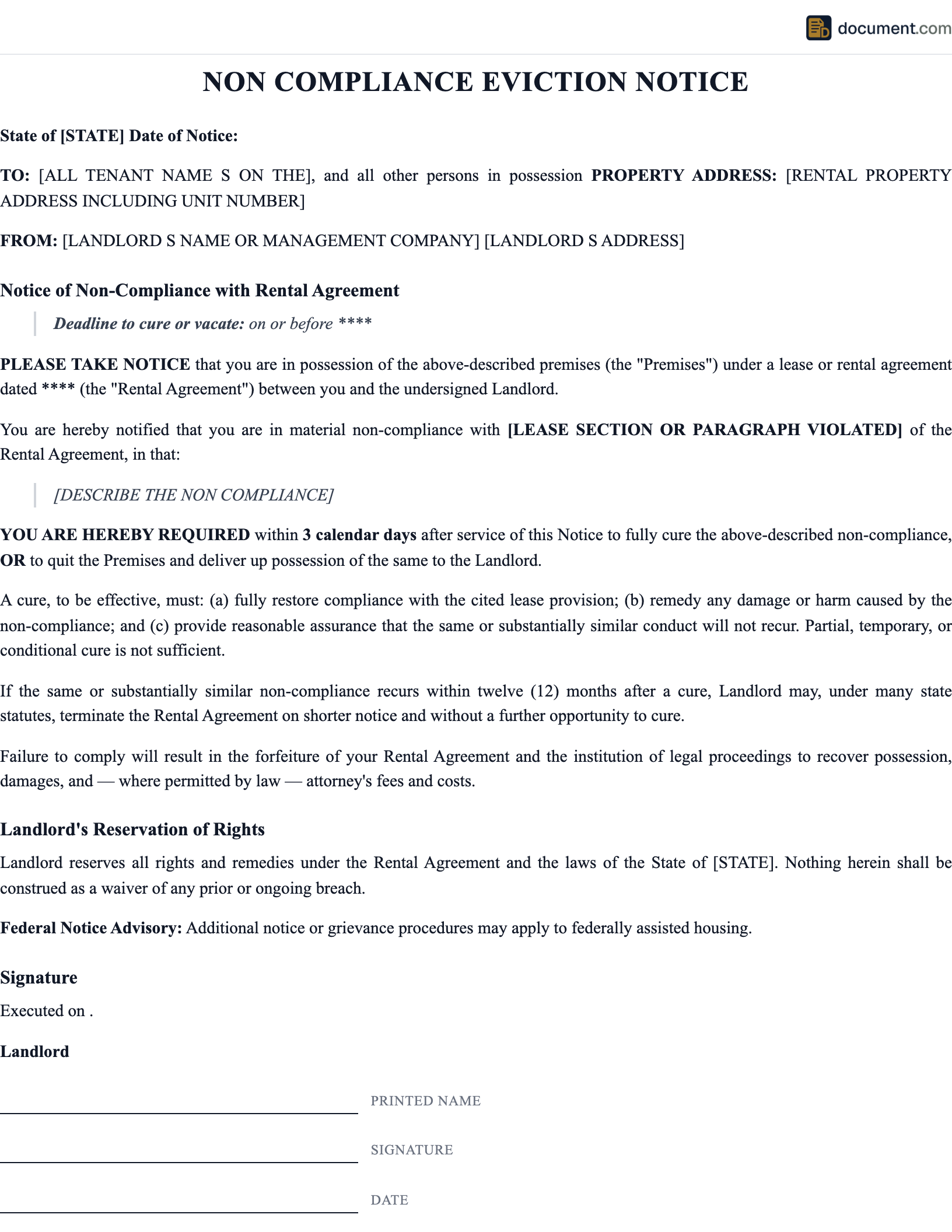
Sample Arizona Non-Compliance Notice
Below is a preview of a Arizona-specific notice for lease non-compliance. Your customized document will include all fields and statutory language required under A.R.S. 33-1368.
NOTICE OF NON-COMPLIANCE
5 OR 10 DAYS CURE-OR-QUIT NOTICE
Pursuant to A.R.S. 33-1368
TO TENANT(S):
Name: [Full Legal Name]
Address: [Arizona Property Address]
NATURE OF VIOLATION:
You are in violation of the following provision of your lease agreement:
[Specific lease clause and factual description of the violation]
CURE DEMAND
Pursuant to A.R.S. 33-1368, you have the applicable number of days from the date of service of this notice to remedy the above violation. If you fail to cure the breach within the notice period, your rental agreement will terminate and the landlord will pursue legal action to recover possession of the premises through Arizona Justice Court.