



Alabama Illegal Activity Eviction Overview
Alabama's Uniform Residential Landlord and Tenant Act (Ala. Code Title 35, Chapter 9A) provides landlords with the legal framework to evict tenants who engage in illegal activity on or near rental premises. Unlike standard lease violation evictions that may allow a cure period, illegal activity evictions in Alabama typically involve a 7-day unconditional quit notice, meaning the tenant has no opportunity to remedy the situation and must vacate within the specified timeframe.
The Alabama legislature specifically addressed illegal activity in rental housing through provisions that recognize the danger criminal conduct poses to neighboring tenants, the property itself, and the surrounding community. The state's Drug Abatement Act (Ala. Code 6-5-155 through 6-5-158) further reinforces the urgency by potentially holding landlords who fail to address known drug activity liable for maintaining a public nuisance. This creates a strong incentive for Alabama landlords to act swiftly when criminal activity is discovered.
Alabama district courts handle unlawful detainer actions, and judges take illegal activity cases seriously. When a landlord presents clear evidence of criminal conduct - particularly drug manufacturing, distribution, violent crimes, or weapons offenses - Alabama courts typically move these cases through the system faster than standard evictions. However, landlords must still follow proper notice and filing procedures to avoid having the case dismissed on procedural grounds.
7 Days
Unconditional quit
$236-$301
Filing fees
No Cure
Right for felonies
2-4 wks
Court process
Legal Grounds & Alabama Statutes
Alabama provides several statutory bases for evicting a tenant engaged in illegal activity. Understanding these laws is essential for landlords to build a strong and defensible case in court.
Alabama Drug Abatement Act Warning
Under the Alabama Drug Abatement Act (Ala. Code 6-5-155), a rental property where illegal drug activity occurs may be declared a public nuisance. Landlords who have knowledge of drug activity and fail to take action can face civil penalties, including fines and court orders to abate the nuisance. This law creates an affirmative duty for Alabama landlords to act when they become aware of drug-related criminal activity on their property.
Key Alabama Statutes
- Ala. Code 35-9A-421: Governs material noncompliance by the tenant, including commission of illegal acts. Allows landlords to deliver a notice specifying the breach and that the rental agreement will terminate in not less than 7 days
- Ala. Code 35-9A-401: Establishes tenant obligations including maintaining the premises in a safe and clean condition and not engaging in criminal activity. Violation of this section supports eviction action
- Ala. Code 6-5-155 to 6-5-158 (Drug Abatement Act): Declares properties used for drug activity as public nuisances and provides a framework for abatement, reinforcing the landlord's duty to act
- Ala. Code 13A-12-210 through 13A-12-215: Alabama's controlled substances statutes defining drug offenses from trafficking to simple possession, which qualify as grounds for eviction when committed on rental premises
- Ala. Code 35-9A-461: Governs the unlawful detainer proceeding in district court, which is the formal eviction lawsuit process once the notice period has expired
Alabama Notice Requirements for Illegal Activity
For illegal activity evictions in Alabama, the notice must meet specific content and delivery requirements to be enforceable. Unlike standard lease violations where a 14-day notice with opportunity to cure is typical, illegal activity warrants a 7-day unconditional quit notice under Ala. Code 35-9A-421.
Required Notice Elements
- Written Format: The notice must be in writing. Verbal notices are legally insufficient under Alabama law and will not support an unlawful detainer action
- Specific Description of Activity: The notice must describe the illegal activity with reasonable specificity, including dates, nature of the criminal conduct, and how it violates the lease and Alabama law
- Unconditional Quit Language: For serious criminal activity, the notice should state that the tenancy will terminate and the tenant must vacate within 7 days with no opportunity to cure
- Tenant and Property Identification: Include full legal names of all tenants on the lease and the complete rental property address, including unit number if applicable
- Landlord Contact Information: The landlord's name, mailing address, and phone number must be included as required by the URLTA
- Date of Notice: The notice must be dated, and the 7-day period begins on the day after the tenant receives the notice
How to Serve an Illegal Activity Eviction Notice in Alabama
Proper service of the eviction notice is critical in Alabama. If the notice is not served correctly under Ala. Code 35-9A-303, the entire eviction can be dismissed regardless of the strength of the underlying illegal activity claims. Alabama recognizes several methods of service for eviction notices.
Gather Evidence of Illegal Activity
Before serving the notice, collect all available evidence: police reports, incident reports, photographs, security camera footage, witness statements from other tenants, and any correspondence referencing the criminal activity. File a police report if one has not already been made.
Prepare the 7-Day Unconditional Quit Notice
Complete the notice using an Alabama-specific template that includes all URLTA-required elements. Reference the specific illegal activity, the dates it occurred, and cite the relevant Alabama statutes (Ala. Code 35-9A-421). State clearly that the tenant has 7 days to vacate with no option to cure.
Serve the Notice Using an Approved Method
Alabama law permits: personal delivery directly to the tenant, delivery to a person of suitable age and discretion at the premises, or posting the notice conspicuously on the premises and mailing a copy via first-class mail. Personal delivery is preferred. Use a process server or bring a witness for documentation.
Document Service and Wait 7 Days
Record the exact date, time, method of service, and name of any witness. Retain a signed copy of the notice. The 7-day period begins the day after service. Do not accept rent during this period, as it may waive the notice.
File Unlawful Detainer if Tenant Remains
If the tenant does not vacate after 7 days, file an unlawful detainer complaint in Alabama district court. Include a copy of the notice, proof of service, and all evidence of illegal activity. The court will schedule a hearing, typically within 6-14 days of filing.
Qualifying Criminal Activities in Alabama
Not every minor legal infraction justifies an illegal activity eviction in Alabama. The following categories of criminal conduct are most commonly recognized by Alabama courts as grounds for expedited eviction proceedings:
Drug Offenses
Manufacturing, distributing, trafficking, or possessing controlled substances on the premises. Alabama's criminal code (Ala. Code 13A-12-210 et seq.) covers offenses from methamphetamine manufacturing to marijuana distribution. The Drug Abatement Act adds civil penalties.
Violent Crimes
Assault (Ala. Code 13A-6-21), domestic violence, robbery, or any violent felony committed on or near the premises. Documented threats of violence against other tenants or the landlord also qualify.
Weapons Offenses
Illegal possession, manufacturing, or distribution of firearms or weapons on the premises, particularly in violation of federal or state law. Discharging a firearm on the property creates an immediate safety hazard.
Gang Activity & Prostitution
Using the rental premises for gang-related criminal enterprise, prostitution, human trafficking, or organized criminal activity. These activities pose severe risks to other residents and the community.
Alabama Court Process & Timeline
When the tenant does not vacate after the 7-day notice period expires, the landlord must file an unlawful detainer action in Alabama district court. The process follows a specific legal sequence, and understanding the timeline helps landlords plan effectively.
| Stage | Typical Timeline | Details |
|---|---|---|
| Serve 7-Day Notice | Day 1-7 | Deliver unconditional quit notice to tenant |
| File Unlawful Detainer | Day 8 | File complaint in district court ($236-$301) |
| Court Hearing | Day 14-22 | Hearing scheduled 6-14 days after filing |
| Judgment Issued | Day 14-22 | Judge rules; 7-day appeal window begins |
| Writ of Possession | Day 22-30 | Sheriff enforces eviction if tenant remains |
Sample Alabama Illegal Activity Eviction Notice
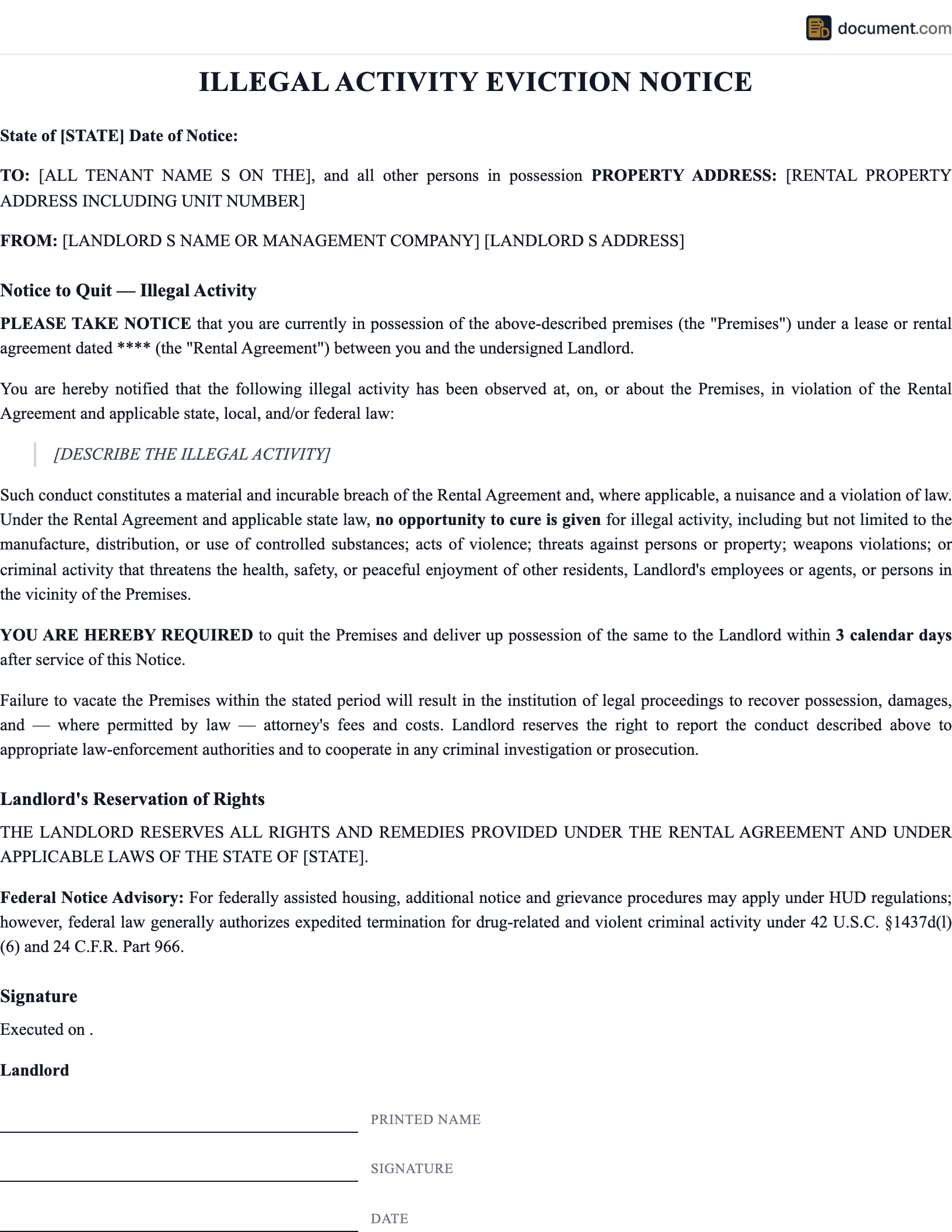
Below is a preview of an Alabama-specific eviction notice for illegal activity. This template includes all elements required under Alabama's URLTA, with specific references to the illegal activity statutes and the unconditional quit provision.
NOTICE TO QUIT FOR ILLEGAL ACTIVITY
STATE OF ALABAMA
Pursuant to Ala. Code 35-9A-421
TO TENANT(S):
Name: [Full Legal Name]
Rental Address: [Alabama Address]
NOTICE OF ILLEGAL ACTIVITY & DEMAND TO VACATE:
You are hereby notified that you have engaged in illegal activity on the above-described premises in violation of your lease agreement and Alabama law. Specifically: [Description of Illegal Activity] on [Date(s)].
7-DAY UNCONDITIONAL QUIT
Pursuant to Ala. Code 35-9A-421, you are required to vacate and surrender possession of the premises within SEVEN (7) DAYS of receiving this notice. This is an unconditional notice to quit. There is no opportunity to cure this violation. Failure to vacate will result in the filing of an unlawful detainer action in Alabama District Court.