



Illinois 5-Day Eviction Notice Overview
Illinois's eviction process is governed by the Code of Civil Procedure, specifically the Forcible Entry and Detainer Act at 735 ILCS 5/9-101 through 9-321. Illinois is one of the most prominent 5-day notice states for non-payment of rent, and the 5-day notice is one of the most commonly used eviction documents in the state. The notice requirement applies to both residential and commercial tenancies.
Illinois has 102 counties, each with its own Circuit Court. Cook County (which includes Chicago) processes the overwhelming majority of the state's eviction filings and has a dedicated Eviction Court section. Outside Cook County, eviction cases are filed in the general civil division of the local circuit court. Chicago properties are subject to the additional requirements of the Chicago Residential Landlord and Tenant Ordinance (RLTO), which creates a separate layer of tenant protections that landlords must navigate carefully.
5 Days
Non-payment notice
$100-$269
Court filing fee
Circuit
Court type
4-10 Wks
Total process
735 ILCS 5/9-209 Explained
Illinois Is a True 5-Day Notice State
Illinois explicitly requires a 5-day notice for non-payment of rent under 735 ILCS 5/9-209. This is the correct and most commonly used eviction notice type in the state. Tens of thousands of 5-day notices are served annually in Illinois.
Under 735 ILCS 5/9-209, a landlord or landlord's agent may serve a tenant a demand requiring payment of rent within 5 days. If the tenant fails to comply within the 5-day period, the landlord may consider the lease terminated and may file a forcible entry and detainer action. The statute applies to both residential and commercial properties.
Illinois also provides a 10-day notice for lease violations other than non-payment (735 ILCS 5/9-210) and a 30-day notice for terminating month-to-month tenancies. For leases in municipalities with populations under 500,000, a 10-day notice suffices. In Chicago and other large cities, 30 days is required for month-to-month terminations.
Illinois Notice Periods at a Glance
| Eviction Reason | Notice Period | Statute |
|---|---|---|
| Non-Payment of Rent | 5 days | 735 ILCS 5/9-209 |
| Lease Violation | 10 days | 735 ILCS 5/9-210 |
| Month-to-Month (under 500K pop.) | 30 days | 735 ILCS 5/9-207 |
| Month-to-Month (Chicago/500K+) | 30 days | 735 ILCS 5/9-207 + RLTO |
Chicago RLTO: Additional Requirements
Chicago Properties Have Extra Rules
If the rental property is within the City of Chicago limits, the Chicago Residential Landlord and Tenant Ordinance (RLTO) imposes additional requirements beyond state law. Failure to comply with the RLTO can invalidate the notice and provide tenants with affirmative defenses and counterclaims, including potential statutory damages.
Key Chicago RLTO requirements that affect 5-day notices include: the landlord must provide the RLTO summary to the tenant at lease signing; the landlord must hold the security deposit in a federally insured interest-bearing account; the landlord must provide specific written disclosures about the property's lead paint status, bed bug history, and other conditions. Violations of these RLTO requirements give tenants powerful defenses against eviction.
In practice, many Cook County eviction judges will allow RLTO violations as affirmative defenses even in non-payment cases. A landlord who failed to provide the RLTO summary or properly handle the security deposit may find that the eviction case is dismissed or that the tenant is awarded a counterclaim exceeding the back rent owed.
Illinois Legal Requirements for 5-Day Notices
To be enforceable in Illinois Circuit Court, a 5-day notice must contain specific elements. Illinois courts have dismissed eviction cases for technical deficiencies in notices, so precision is essential.
Required Notice Contents
- Tenant Names: Full names of all tenants on the lease agreement
- Property Address: Complete street address including unit number, city, and county
- Amount of Rent Due: The exact dollar amount owed, broken down by month if multiple months are past due
- 5-Day Demand: Clear statement that rent must be paid within 5 days or the lease will be terminated
- Landlord/Agent Signature: Signature of the landlord or authorized agent with date
- Payment Instructions: Where and how the tenant can deliver payment
How to Serve a 5-Day Notice in Illinois
Illinois law at 735 ILCS 5/9-211 specifies that the notice must be served by delivering a written or printed copy to the tenant, or by leaving such copy with a person above the age of 13 years residing on or in possession of the premises, or by sending the notice by certified or registered mail with return receipt requested.
Personal Delivery (Preferred)
Hand the notice directly to the tenant. Illinois courts consider this the most reliable method. Use a witness or a licensed Illinois process server for documentation.
Leave with Resident Age 13+
Under Illinois law, you may leave the notice with any person age 13 or older who resides at the property. This is more permissive than many states that require the person to be 18+.
Certified or Registered Mail
Send the notice via certified or registered mail with return receipt requested. The 5-day period begins when the tenant signs for the letter, not when it is mailed.
Document Service
Prepare an affidavit of service recording the date, time, method, and witnesses. Illinois Circuit Courts require proof of proper service when filing the forcible entry and detainer complaint.
File After 5 Days Expire
If the tenant does not pay within 5 days, file a forcible entry and detainer complaint in the Circuit Court of the county where the property is located.
Illinois Eviction Timeline
The Illinois eviction timeline varies considerably depending on whether the case is filed in Cook County or elsewhere. Cook County's high-volume Eviction Court processes thousands of cases monthly, which can create delays. Downstate courts typically move faster.
After the 5-day notice expires and the landlord files the complaint, the court issues a summons. In Cook County, the first court date is typically set 14 to 21 days after filing. Downstate courts may schedule hearings within 7 to 14 days. If the landlord prevails, the court enters an order of possession, usually giving the tenant 7 to 14 additional days to vacate.
If the tenant does not leave voluntarily, the landlord obtains a writ of possession, and the Cook County Sheriff's office (or county sheriff elsewhere) schedules the physical eviction. In Cook County, the sheriff's backlog can add 2 to 4 weeks. Self-help evictions are illegal in Illinois under 735 ILCS 5/9-101.5 and expose the landlord to liability.
Illinois Eviction Filing Fees & Costs
Filing fees in Illinois vary by county. Cook County has some of the highest eviction filing fees in the state. Below are typical costs for a forcible entry and detainer action.
| Fee / Cost | Typical Amount |
|---|---|
| Cook County Filing Fee | ~$269 |
| Downstate County Filing Fee | $100 - $230 |
| Sheriff Service of Process | $30 - $75 |
| Attorney Fees (Uncontested) | $750 - $2,500 |
| Writ of Possession / Eviction Order | $50 - $125 |
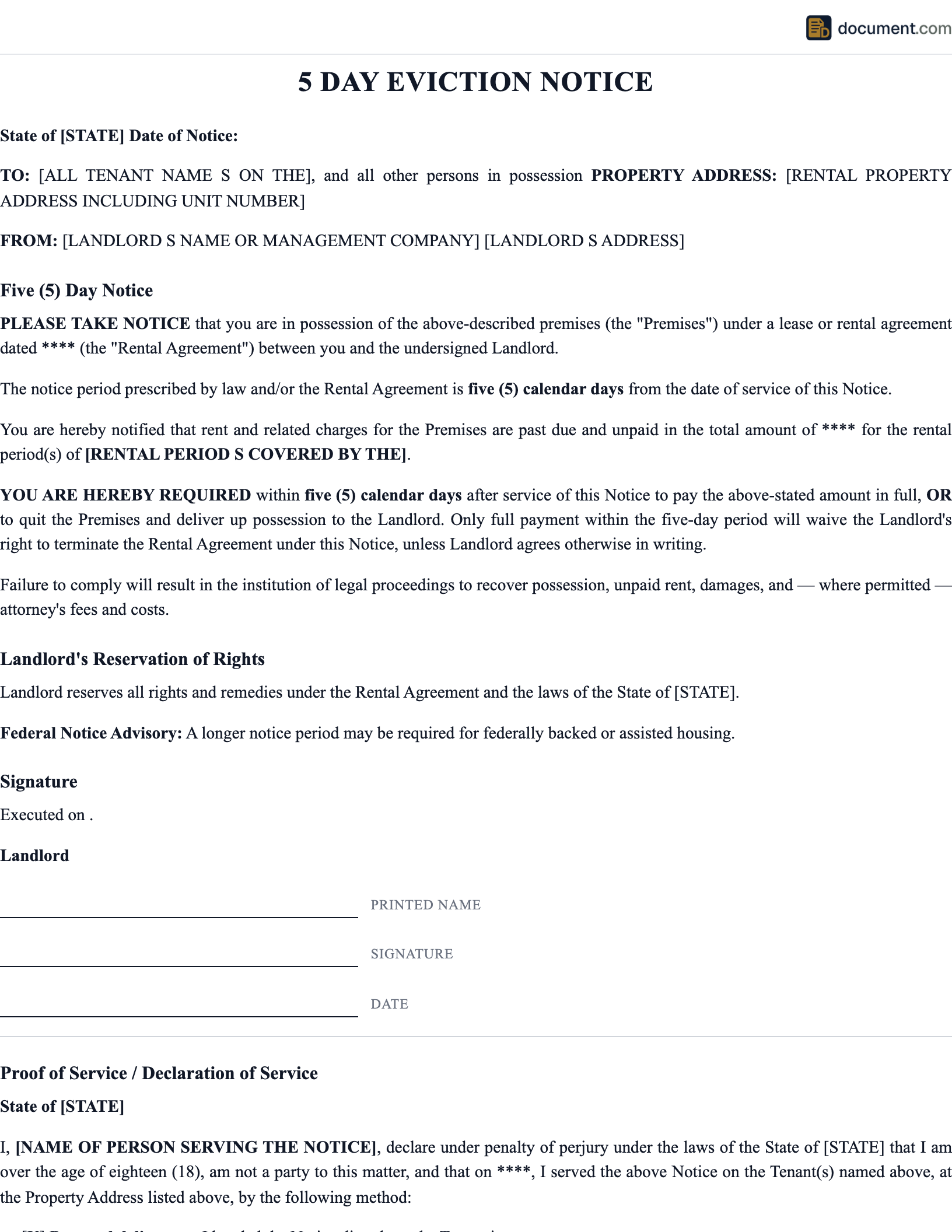
Sample Illinois 5-Day Pay or Quit Notice
Below is a preview of the Illinois-specific 5-day notice for non-payment of rent. The document references 735 ILCS 5/9-209 and includes all elements required by Illinois Circuit Courts.
FIVE-DAY NOTICE OF DEMAND FOR RENT
STATE OF ILLINOIS
Pursuant to 735 ILCS 5/9-209
TO TENANT(S):
Name(s): [All Tenant Names]
Premises: [Full Illinois Address]
County: [Cook / DuPage / Lake / etc.]
DEMAND:
You are hereby notified that there is now due the undersigned landlord the sum of $[Amount] being rent for the premises. You are further notified that payment of said amount is demanded within FIVE (5) DAYS of service of this notice, or your lease will be terminated.
ILLINOIS COMPLIANCE
This notice complies with 735 ILCS 5/9-209. For Chicago properties, additional RLTO requirements may apply. The 5-day period is the statutory minimum for non-payment of rent.