



New Jersey Eviction Overview: No 3-Day Notice
New Jersey Does Not Use 3-Day Notices
New Jersey's Anti-Eviction Act (N.J.S.A. 2A:18-61.1) creates one of the most complex and tenant-protective eviction frameworks in the United States. There is no 3-day notice period. Landlords must follow a multi-step process that includes specific statutory grounds, proper notices, and a court proceeding in the Special Civil Part.
New Jersey stands apart from most states when it comes to eviction law. The Anti-Eviction Act, enacted in 1974, prohibits landlords from evicting tenants except for specific enumerated causes. This means a landlord cannot simply refuse to renew a lease or give a no-cause notice to quit. Even non-payment of rent triggers a structured court process rather than a simple notice-and-file procedure.
The state's eviction cases are handled through the Special Civil Part of the Superior Court (formerly the landlord-tenant division). New Jersey's most active eviction courts are in Essex County (Newark), Hudson County (Jersey City), Camden County, and Passaic County. Each court may have slightly different scheduling practices, but the substantive law applies uniformly. Landlords accustomed to states with quick 3-day notice processes will find New Jersey's system substantially more time-consuming and procedurally demanding.
No Fixed
Notice period varies
$50-$250
Filing fees
Cause
Required for eviction
6-12 wks
Typical process
The NJ Anti-Eviction Act Framework
Instead of a simple notice period, New Jersey requires landlords to navigate a multi-step process. The specific steps depend on the ground for eviction. For non-payment, the process is somewhat streamlined, but still more involved than a 3-day notice state.
Non-Payment of Rent Process
- Written Notice: Serve a written notice demanding the past-due rent. No specific statutory cure period is required
- File Verified Complaint: File a verified complaint for possession in the Special Civil Part of Superior Court
- Court Hearing: Attend a court hearing where both parties present their case. Tenant can pay to stop eviction
- Judgment for Possession: If granted, a warrant for removal is issued with a 3-day grace period
- Execution: Court officer executes the warrant if the tenant does not vacate voluntarily
Lease Violation Process (Notice to Cease + Notice to Quit)
- Notice to Cease: First, serve a written notice telling the tenant to stop the lease violation
- Notice to Quit: If the violation continues, serve a notice to quit giving the tenant one month to vacate
- File Complaint: After the notice to quit expires, file the complaint in court
The New Jersey Eviction Process
New Jersey's eviction process is significantly more involved than states using 3-day notices. The process is handled through the court system from start to finish.
Identify the Statutory Ground
Determine which enumerated cause under N.J.S.A. 2A:18-61.1 applies. Non-payment of rent, lease violations, and disorderly conduct each have different procedural requirements.
Serve the Required Notice(s)
For non-payment: serve a written demand for rent. For violations: serve a Notice to Cease, then a Notice to Quit if the violation continues. Service must comply with NJ court rules.
File in Special Civil Part
File a verified complaint for possession of premises in the Special Civil Part of the Superior Court in the county where the property is located.
Attend Court Hearing
Both parties appear before the court. The tenant can pay all rent owed plus costs to stop the eviction for non-payment cases. Adjournments are common.
Obtain Warrant for Removal
After judgment, the court issues a warrant for removal. The tenant has 3 business days after the warrant is served before the court officer can execute the lockout.
New Jersey Eviction Timeline & Common Delays
New Jersey's eviction process is among the longest in the nation. For non-payment of rent, the typical timeline from initial notice to lockout is 6-12 weeks. However, many cases take significantly longer due to court adjournments, settlement negotiations, and hardship stays.
Common delays include: the tenant requesting adjournments (courts typically grant at least one), court backlogs in high-volume counties like Essex and Hudson, tenants filing for government rental assistance programs during the case, and hardship stays of up to 6 months after judgment.
Contested evictions involving lease violations can take 4-8 months due to the additional Notice to Cease and Notice to Quit requirements. Landlords should budget for lost rent during this period and consider whether negotiated move-out agreements might resolve the situation faster than the full court process.
New Jersey Court Fees & Costs
New Jersey eviction court fees are set by the Judiciary and apply statewide.
| Fee / Cost | Typical Amount |
|---|---|
| Summary Dispossess Filing | $50 - $100 |
| Service of Complaint | $15 - $50 |
| Warrant for Removal | $35 - $75 |
| Court Officer Execution | $50 - $200 |
| Attorney Fees (highly recommended) | $750 - $3,000+ |
Sample NJ Notice to Quit (Non-Payment)
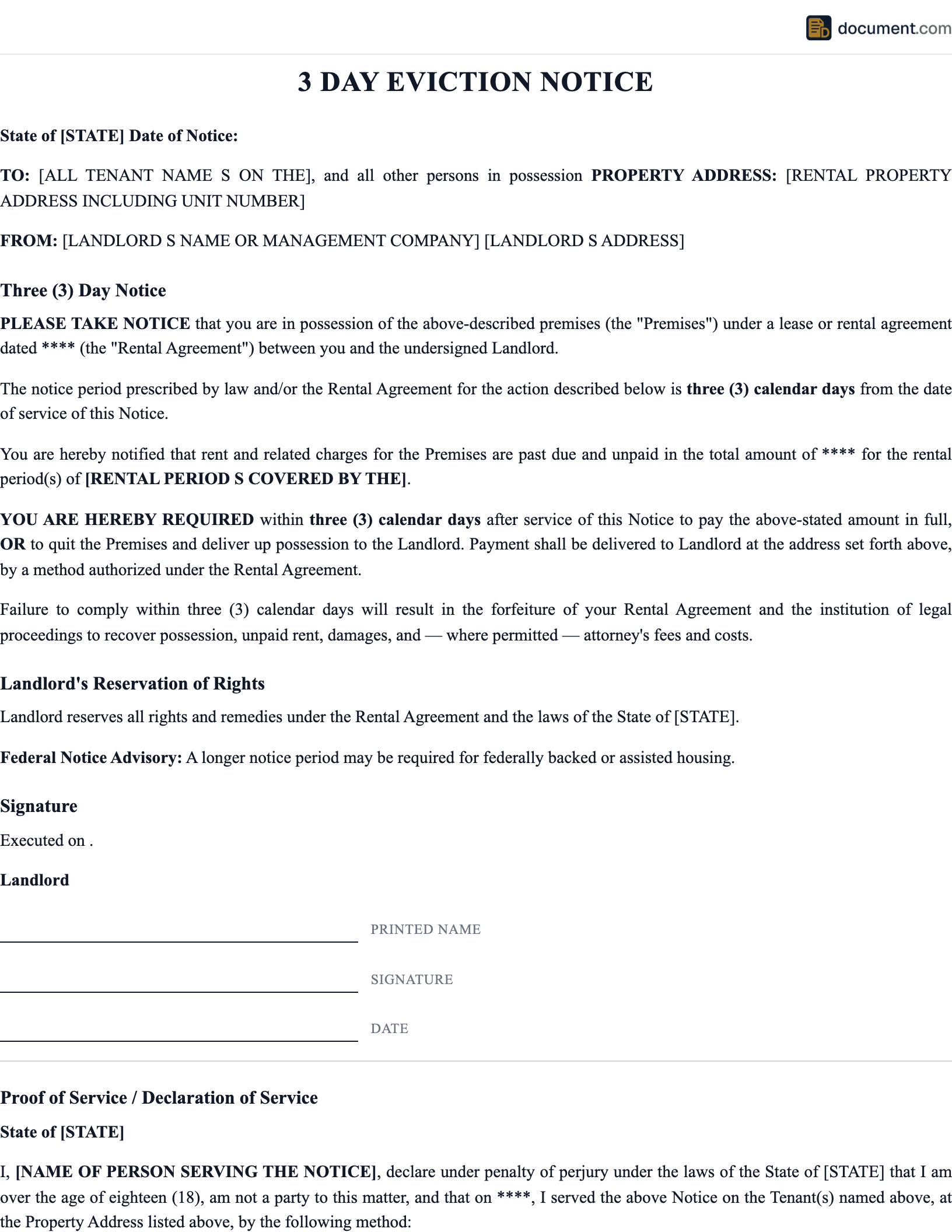
Below is a preview of a New Jersey notice demanding rent. This is not a "3-day notice" but the proper NJ format for initiating the non-payment eviction process.
NOTICE TO QUIT AND DEMAND FOR RENT
STATE OF NEW JERSEY
Pursuant to N.J.S.A. 2A:18-61.1(a)
TO TENANT(S):
Name: [Full Legal Name]
Address: [NJ Property Address]
NOTICE AND DEMAND
You are hereby notified that rent in the amount of $[Amount] is past due for the period of [Month/Year]. You are demanded to pay the full amount owed. Failure to do so will result in the filing of a complaint for possession in the Special Civil Part of the Superior Court of New Jersey, [County] County.