



Florida 3-Day Eviction Notice Overview
Florida is one of the most important 3-day notice states in the country, given its large renter population. Under Florida Statute 83.56(3), part of the Florida Residential Landlord and Tenant Act (F.S. Chapter 83, Part II), landlords must serve a 3-day notice before filing an eviction lawsuit for non-payment of rent. Florida's notice is unique because the 3 days exclude weekends, legal holidays, and the day of service, making it effectively a 3-business-day notice.
The Florida 3-day notice is exclusively for non-payment of rent. For lease violations, Florida uses a separate 7-day notice under F.S. 83.56(2). The notice must be carefully drafted to include only rent owed and not late fees or other charges, as overstating the amount is the most common basis for dismissal. Florida's eviction cases are handled in County Court, and the process is relatively fast compared to many states.
3 Days
Excl. weekends/holidays
$185-$300
Filing fee
Rent Only
No late fees
3-5 Wks
Court process
F.S. 83.56 Notice Types
3-Day Notice for Non-Payment (F.S. 83.56(3))
The landlord delivers written notice demanding the tenant pay rent within 3 business days (excluding weekends, holidays, and the day of delivery). The notice must specify the amount of rent due. If the tenant pays within the 3 business days, the notice is voided. The landlord should demand only rent, not late fees or utilities.
7-Day Notice for Curable Violations (F.S. 83.56(2)(a))
For lease violations that can be corrected (unauthorized pets, noise, unauthorized occupants), the landlord gives 7 days' written notice identifying the violation. The tenant has 7 days to cure it. If the same violation recurs within 12 months, the landlord may give a 7-day unconditional notice to vacate.
7-Day Unconditional Quit (F.S. 83.56(2)(b))
For non-curable violations (intentional destruction of property, repeated violations within 12 months), the landlord serves a 7-day notice with no opportunity to cure. The tenant must vacate within 7 days or face an eviction lawsuit.
Florida 3-Day Notice Content Rules
Florida Courts Strictly Enforce Notice Rules
Florida County Courts will dismiss eviction cases if the 3-day notice overstates the amount owed, includes charges beyond rent, or fails to meet service requirements. Even a small error can require starting over with a new notice.
- Rent Only: Demand only past-due rent. Do not include late fees, utilities, NSF fees, or other charges
- Exact Amount: State the precise dollar amount of rent owed. Do not round up or overstate
- Property Address: Include the complete address with unit number, city, state, and ZIP code
- 3-Day Demand: State the tenant has 3 days (excluding weekends and holidays) to pay rent or surrender possession
- Tenant Names: Include the names of all tenants on the lease agreement
- Landlord Signature: Sign and date the notice
How to Serve a 3-Day Notice in Florida
Florida Statute 83.56(4) specifies how a 3-day notice must be served. Proper service is essential because it establishes when the 3-business-day clock starts running.
Hand Delivery (preferred)
Deliver the notice personally to the tenant. Bring a witness or use a process server. The 3-day period begins the next business day
Leave at Residence
If the tenant is absent, leave the notice at the residence with any person residing there who is 15 years or older, and mail a copy
Post on Door
If no one is available, post the notice in a conspicuous place on the door and send a copy by mail. This is the last resort method under Florida law
Document and File Certificate of Service
Complete a certificate of service recording the date, time, and method. This document is required when filing the eviction complaint in County Court
Florida Eviction Timeline
After the 3 business days expire, the landlord files an eviction complaint in County Court. The clerk issues a summons, and the tenant has 5 days (excluding weekends and holidays) to file a response. If the tenant does not respond, the landlord can move for default judgment. If the tenant responds, the court schedules a trial or hearing.
Florida law requires the tenant to deposit disputed rent into the court registry if they want to contest the eviction. Failure to pay into the registry can result in a default judgment for the landlord. After judgment, the clerk issues a writ of possession, and the sheriff posts a 24-hour notice before executing the lockout.
Total timeline: 3 to 5 weeks for uncontested cases. In busy counties like Miami-Dade, Broward, or Orange, the process may take 4 to 8 weeks due to court scheduling. Contested cases can take 6 to 12 weeks. If the tenant pays all rent owed into the court registry, the case may be resolved through mediation.
Florida Court Fees & Costs
| Fee / Cost | Typical Amount |
|---|---|
| County Court Filing Fee | $185 - $300 |
| Service of Process | $10 - $50 |
| Writ of Possession | $90 - $115 |
| Sheriff Lockout | $90 - $115 |
| Attorney Fees (if hired) | $800 - $3,000 |
Sample Florida 3-Day Notice
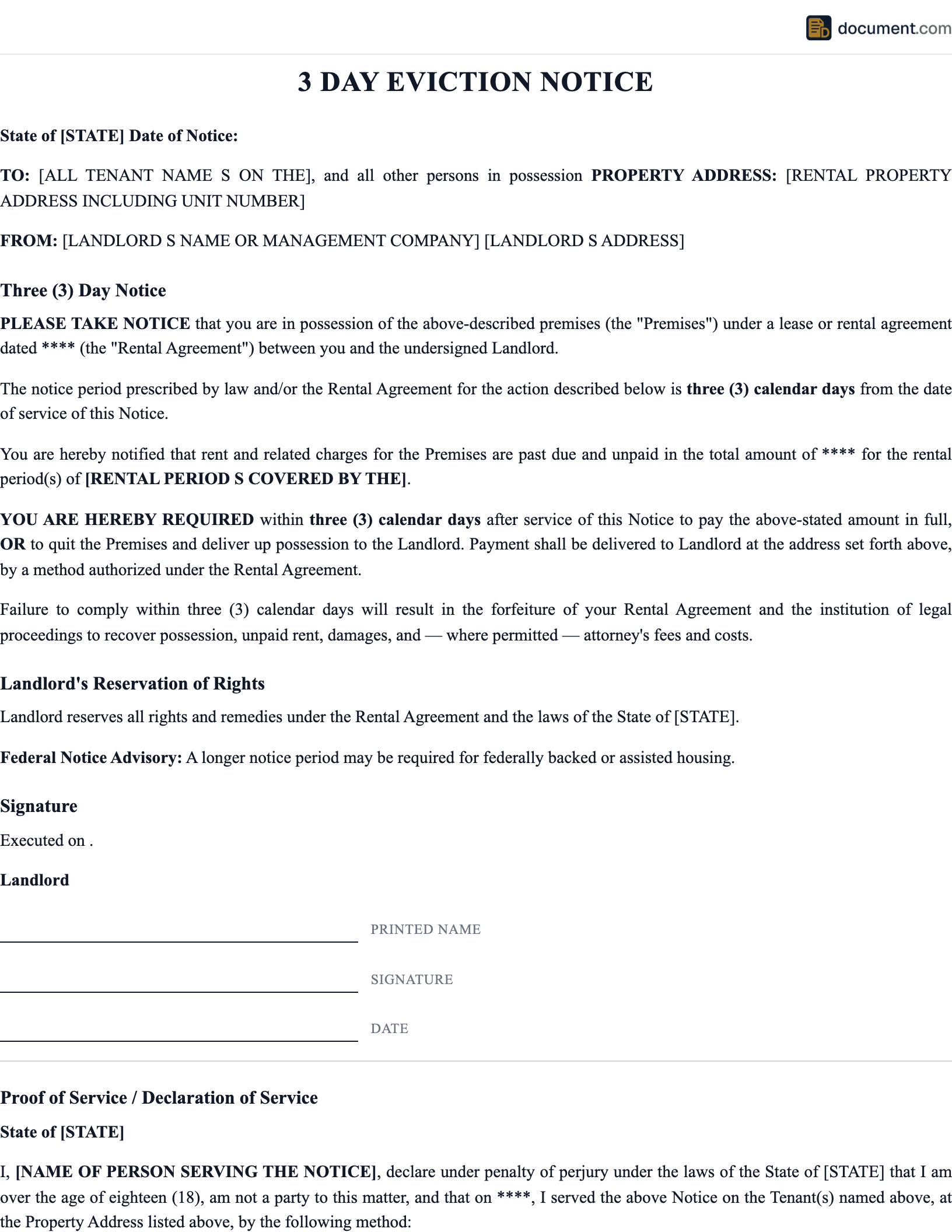
Below is a preview of a Florida-compliant 3-day notice for non-payment under F.S. 83.56(3).
THREE-DAY NOTICE
STATE OF FLORIDA
Pursuant to F.S. Section 83.56(3)
TO TENANT(S):
Name: [Tenant Full Name]
PREMISES:
Address: [Address, City, FL ZIP]
County: [Florida County]
RENT DUE (rent only, no late fees):
Amount: $[Amount] for: [Period]
FLORIDA COMPLIANCE
This notice complies with F.S. 83.56(3). The 3-day period excludes weekends, legal holidays, and the day of delivery. Only past-due rent is demanded.