
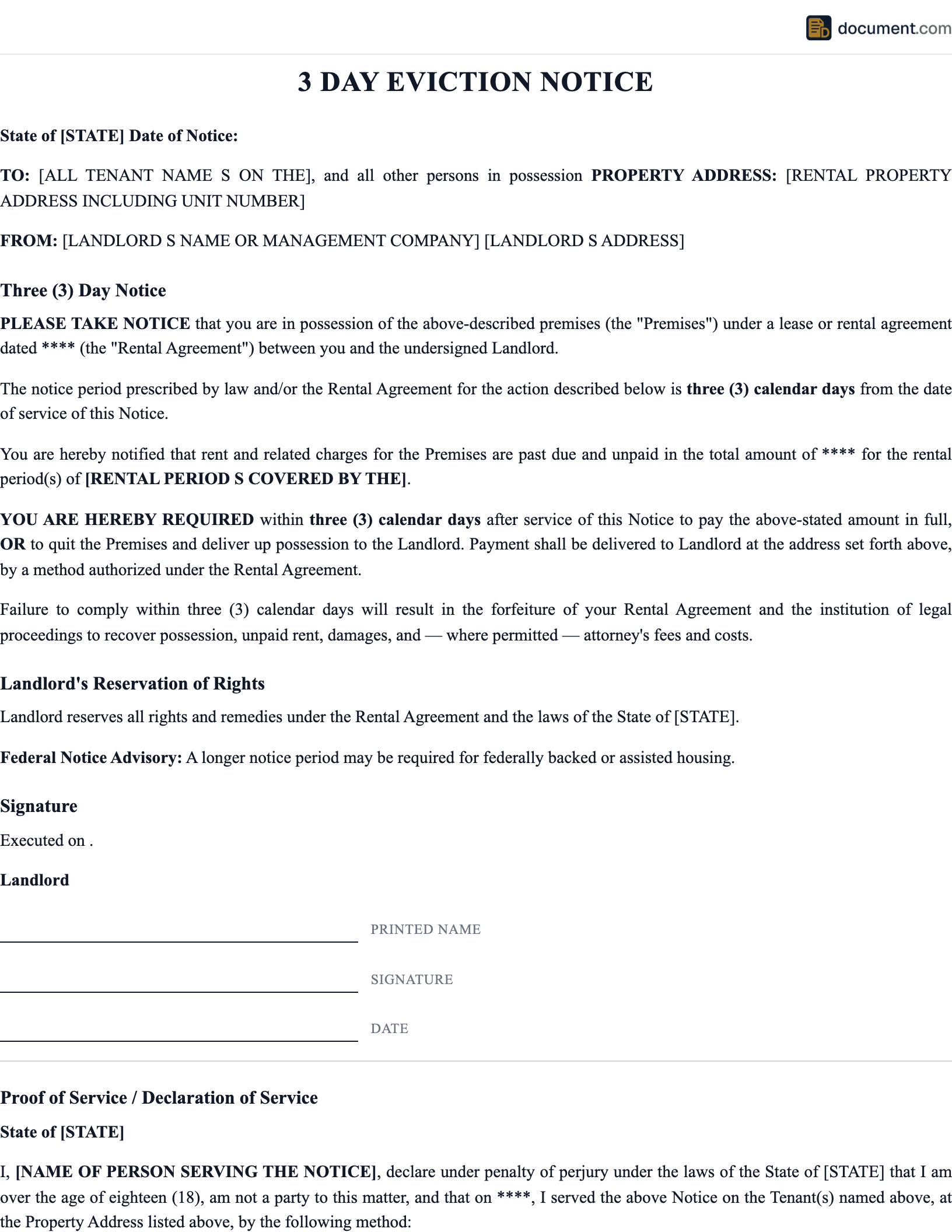



Connecticut 3-Day Notice to Quit Overview
Connecticut is one of the states that uses a 3-day notice period for non-payment of rent. Under CGS 47a-23, a landlord must serve a written notice to quit at least 3 days before the date specified for the tenant to move out. Connecticut's term for an eviction notice is "notice to quit," and the entire eviction lawsuit is called a "summary process" action.
Connecticut's eviction system is notable for its Housing Sessions, specialized divisions of the Superior Court that handle landlord-tenant cases in Hartford, New Haven, Bridgeport, and Waterbury. These courts have trained mediators who help resolve disputes before trial. Connecticut also provides a right to counsel for low-income tenants in certain eviction proceedings, making it one of the more tenant-friendly states despite the short 3-day notice period.
3 Days
Notice to quit
$175-$250
Filing fee
Right to Cure
Savings clause
3-6 Wks
Court process
Connecticut Notice to Quit Process
3-Day Notice to Quit for Non-Payment (CGS 47a-23(a))
When rent is unpaid, the landlord serves a notice to quit giving the tenant at least 3 days to vacate. The notice must specify the reason (non-payment) and the date by which the tenant must leave. This is a notice to vacate, not a "pay or quit" notice. However, payment before judgment can still cure the default under the savings clause.
Pretermination Notice for Lease Violations (CGS 47a-15)
For lease violations other than non-payment, the landlord must first serve a pretermination notice under CGS 47a-15 giving the tenant 15 days to cure the violation. Only if the tenant fails to cure can the landlord then serve a notice to quit. This two-step process provides more protection for lease violation cases than for non-payment.
Savings Clause (CGS 47a-26h)
Connecticut's savings clause allows tenants to stop eviction by paying all rent owed plus court costs, even after the summary process case has been filed. This right can be exercised before the court enters judgment. However, if the tenant has used the savings clause within the past year, the court may deny it. This provision makes Connecticut's 3-day notice less harsh than it initially appears.
CGS 47a-23 Notice Requirements
- Written Form: The notice to quit must be in writing as required by CGS 47a-23
- Quit Date: Specify a date at least 3 days from service by which the tenant must vacate
- Reason for Eviction: State the specific ground for eviction (non-payment, lease violation, lease expiration, nuisance)
- Service by Authorized Person: Must be served by a state marshal, constable, or indifferent person, not by the landlord personally
- Certified Mail Copy: A copy must also be sent by certified or registered mail to the tenant
- Return of Service: The server must complete a return of service documenting how and when the notice was delivered
How to Serve a Notice to Quit in Connecticut
Connecticut has strict service requirements. The landlord cannot serve the notice personally, it must be served by an authorized third party.
Hire a State Marshal or Constable
Connecticut requires a state marshal, constable, or "indifferent person" (someone not party to the action) to serve the notice. Landlords cannot serve the notice themselves
In-Hand or Abode Service
The server delivers the notice to the tenant in person or leaves it at the tenant's usual place of abode with a family member of suitable age and discretion
Mail a Certified Copy
Send a copy by certified or registered mail to the tenant at the rental property address. This is required in addition to personal or abode service
File the Return of Service
The server files a return of service with the court, documenting the date, time, and manner of service. This is required before the summary process action can proceed
Connecticut Eviction Timeline
After the 3-day notice to quit expires, the landlord files a summary process complaint and summons with the court. The summons specifies a return date, which must be at least 6 days after service on the tenant. The tenant has 2 days after the return date to file an appearance and then 2 more days to file an answer.
If the tenant does not appear, the landlord can request a default judgment. If the case is contested, the court schedules a trial or mediation. The Housing Sessions in Hartford, New Haven, Bridgeport, and Waterbury offer mediation services that can resolve cases faster than trial.
After judgment, there is an automatic 5-day stay of execution. The state marshal then posts a 24-hour notice before physically removing the tenant. Total timeline: 3 to 6 weeks for uncontested cases, 6 to 12 weeks for contested cases. Appeals can extend the process significantly.
Connecticut Court Fees & Costs
| Fee / Cost | Typical Amount |
|---|---|
| Summary Process Filing Fee | $175 - $250 |
| State Marshal Service | $40 - $80 |
| Execution (Writ) | $100 - $200 |
| Attorney Fees (if hired) | $1,000 - $3,500 |
| Certified Mail | $10 - $15 |
Sample Connecticut 3-Day Notice to Quit
Below is a preview of a Connecticut-compliant notice to quit for non-payment under CGS 47a-23.
NOTICE TO QUIT POSSESSION
STATE OF CONNECTICUT
Pursuant to CGS Section 47a-23
TO TENANT(S):
Name: [Tenant Full Name]
PREMISES:
Address: [Street, City, CT ZIP]
QUIT DATE:
You must vacate on or before: [Date - at least 3 days from service]
CONNECTICUT COMPLIANCE
This notice complies with CGS 47a-23. Must be served by a state marshal, constable, or indifferent person. A copy must also be sent by certified mail.