
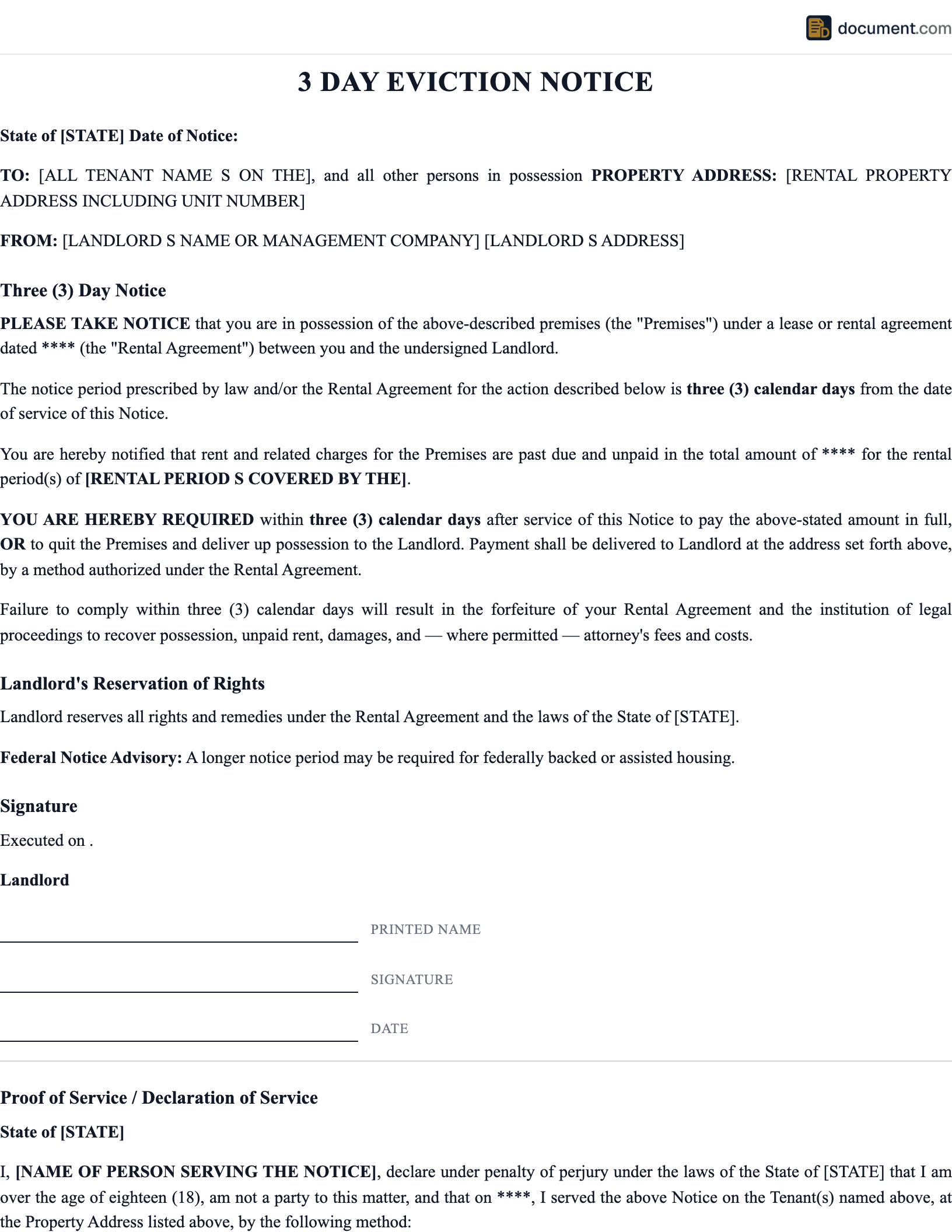



Colorado 3-Day Eviction Notice Overview
Colorado Changed to 10-Day Notice in 2021
Colorado House Bill 21-1121, signed into law on June 23, 2021, increased the non-payment notice period from 3 days to 10 days. Any 3-day notice for non-payment of rent served after this date is legally invalid and will result in dismissal of the Forcible Entry and Detainer action in County Court. The 3-day period may still apply to certain lease violations.
Before 2021, Colorado was a 3-day notice state for non-payment of rent, similar to California and Florida. HB21-1121 represented a significant shift in Colorado landlord-tenant law, more than tripling the notice period and adding numerous tenant protections. The bill was part of a nationwide trend following the COVID-19 pandemic to extend eviction notice periods and provide more time for tenants to seek rental assistance or find alternative housing.
Colorado's eviction process is governed by C.R.S. Title 13, Article 40 (Forcible Entry and Detainer). The state's eviction courts are the County Courts, which handle FED actions as summary proceedings with expedited timelines. Despite the longer notice period, Colorado's court process itself remains relatively fast once a case is filed.
10 Days
Non-payment (was 3)
$85-$115
FED filing fee
5% Cap
Late fee maximum
4-6 Wks
Court process
HB21-1121: From 3-Day to 10-Day Notice
HB21-1121 made sweeping changes to Colorado landlord-tenant law. Understanding these changes is critical for landlords who may have used the old 3-day notice process.
10-Day Notice for Non-Payment (C.R.S. 13-40-104(1)(d.5))
The notice period for non-payment increased from 3 days to 10 days. The notice must state the amount of rent owed and give the tenant 10 days to pay in full. If the tenant pays within 10 days, the notice is void. The notice must also inform the tenant of available rental assistance programs.
Late Fee Cap
HB21-1121 capped late fees at the greater of $50 or 5% of the monthly rent. Late fees cannot be charged until rent is at least 7 days overdue. This was a major change for landlords who previously had no statutory cap on late fees in Colorado.
Rental Assistance Protection
If a tenant has applied for rental assistance and the landlord has been notified, the landlord cannot proceed with eviction for non-payment until the assistance application is resolved. This provision was added to prevent evictions when help was on the way.
Current Colorado Legal Requirements
Under current Colorado law, the 10-day notice for non-payment must include specific elements to be valid in County Court.
- Written Notice: Must be in writing. Colorado does not recognize verbal eviction notices
- Exact Rent Amount: State the specific amount of past-due rent. Do not include late fees or other charges in the demand
- 10-Day Demand: Clearly state the tenant has 10 days to pay or the tenancy will terminate
- Rental Assistance Information: Include information about available rental assistance programs
- Property Address: Full address of the rental property including unit number
- Date and Signature: Date the notice and sign it to establish when the 10-day period begins
How to Serve an Eviction Notice in Colorado
Colorado law under C.R.S. 13-40-108 specifies acceptable service methods for eviction notices.
Personal Service
Hand deliver the notice directly to the tenant. This is the most reliable method. Use a process server or bring an adult witness
Posting and Mailing
If the tenant cannot be found, post the notice on the door and mail a copy by first-class mail. Colorado requires both steps for this method to be valid
Wait Full 10 Days
Allow all 10 calendar days to pass. The day of service does not count as day 1. If the 10th day falls on a weekend or holiday, the notice period extends to the next business day
File FED in County Court
If the tenant does not pay within 10 days, file a Forcible Entry and Detainer complaint in the County Court of the county where the property is located
Colorado Eviction Timeline
After the 10-day notice expires, the landlord files an FED action in County Court. Colorado requires the tenant to be served with the summons and complaint at least 7 days before the court date. Most County Courts schedule FED hearings within 7 to 14 days of filing.
At the hearing, both parties present evidence. If the landlord prevails, the court issues a judgment for possession. A writ of restitution is issued, and the sheriff typically executes it within 48 hours. The entire process from 10-day notice to possession takes approximately 4 to 6 weeks for uncontested cases.
Contested cases, especially those involving habitability defenses, rental assistance applications, or appeals, can take 6 to 12 weeks. Denver County Court, due to high volume, may experience longer wait times than rural counties.
Colorado Court Fees & Costs
Colorado FED filing fees are set by the Judicial Department and apply statewide.
| Fee / Cost | Typical Amount |
|---|---|
| FED Filing Fee | $85 - $115 |
| Service of Process | $30 - $75 |
| Writ of Restitution | $25 - $50 |
| Sheriff Execution | $50 - $100 |
| Attorney Fees (if hired) | $800 - $3,000 |
Sample Colorado 10-Day Eviction Notice
Below is a preview of a Colorado-compliant 10-day notice for non-payment. Because Colorado now requires 10 days (not 3), this template reflects current law under HB21-1121.
10-DAY DEMAND FOR PAYMENT OF RENT OR POSSESSION
STATE OF COLORADO
Pursuant to C.R.S. 13-40-104(1)(d.5)
TO TENANT(S):
Name: [Tenant Full Name]
PREMISES:
Address: [Street, City, CO ZIP]
County: [Colorado County]
RENT DUE:
Amount: $[Amount] for: [Dates]
COLORADO COMPLIANCE
This notice complies with C.R.S. 13-40-104(1)(d.5) as amended by HB21-1121, requiring a 10-day notice period. The previous 3-day notice is no longer valid for non-payment in Colorado.