



Alaska 3-Day Eviction Notice Overview
Alaska Does Not Use 3-Day Notices
Alaska's landlord-tenant law, based on the Uniform Residential Landlord and Tenant Act (URLTA), requires a minimum 7-day notice for non-payment of rent under AS 34.03.220(b). A 3-day notice served in Alaska would be legally insufficient and would result in dismissal of the Forcible Entry and Detainer action in District Court.
Alaska adopted a version of the URLTA in 1974, codified at AS 34.03.010 through 34.03.360. This framework provides comprehensive rules for residential landlord-tenant relationships, including specific notice requirements that must be followed before a landlord can file for eviction. The statute applies to most residential rental agreements in the state, with limited exceptions for certain transient occupancies and employer-provided housing.
Because Alaska is a large state with a relatively small number of judicial districts, eviction cases are concentrated in a few courthouses. Anchorage, Fairbanks, Juneau, and the Mat-Su Valley handle the majority of Alaska's eviction filings. Remote communities may have limited court access, making proper notice procedures even more important to avoid delays.
7 Days
Non-payment notice
~$75
Filing fee
10 Days
Lease violation notice
3-5 Wks
Court process
Alaska's Actual Notice Periods
Alaska law establishes different notice periods depending on the eviction grounds. Using the wrong notice period is a common basis for dismissal, so landlords must match the notice to the situation.
7-Day Notice for Non-Payment (AS 34.03.220(b))
When a tenant fails to pay rent when due, the landlord must deliver written notice giving the tenant 7 days to pay the full amount or vacate. If the tenant pays all rent owed within the 7-day period, the notice is voided and the tenancy continues. The notice must state the exact amount of rent owed and the date by which it must be paid.
10-Day Notice for Curable Lease Violations (AS 34.03.220(a))
For material lease violations other than non-payment (unauthorized pets, excessive noise, unauthorized occupants), the landlord must give 10 days' written notice describing the specific violation and allowing the tenant to remedy it within 10 days. If the same type of violation recurs within 6 months, the landlord may serve a non-curable 5-day notice.
24-Hour Notice for Illegal Activity (AS 34.03.220(e))
Alaska allows a shortened 24-hour notice when the tenant, a guest, or an invitee engages in illegal activity involving a controlled substance or prostitution on the premises. This is an unconditional quit notice with no right to cure. The landlord can file for eviction immediately after the 24-hour period expires.
Alaska Legal Requirements
A valid Alaska eviction notice must contain specific elements to be enforceable in District Court. Missing any required element gives the tenant grounds to have the case dismissed.
- Written Format: Alaska requires all eviction notices to be in writing under AS 34.03.220. Verbal notices are not enforceable
- Tenant Identification: Include the full names of all tenants on the lease and the complete rental property address
- Specific Amount Owed: For non-payment notices, state the exact dollar amount of past-due rent without including late fees or other charges
- Correct Notice Period: Specify 7 days for non-payment or 10 days for curable lease violations
- Clear Demand: State that the tenant must pay or cure within the specified period, or the rental agreement will be terminated and the landlord will seek eviction
- Landlord Contact: Provide the landlord's or agent's name and address for accepting payment or cure
How to Serve an Eviction Notice in Alaska
Alaska law under AS 34.03.130 specifies acceptable service methods. The method used affects when the notice period begins, so landlords should choose carefully.
Personal Delivery
Hand the notice directly to the tenant. The notice period begins the day after delivery. Bring a witness or use a process server to document the handoff
Mail Service
Send the notice via first-class and certified mail to the tenant's address. When served by mail, add 5 additional days to the notice period per Alaska civil rules to account for mailing time
Posting and Mailing
If the tenant cannot be reached personally, post the notice on the door and mail a copy. This two-step approach is acceptable under Alaska law when personal delivery is impractical
Keep Proof of Service
Maintain certified mail receipts, signed declarations from the server, photographs of posted notices, and a copy of the notice itself. Alaska courts require proof of service to proceed
Alaska Eviction Timeline
Once the notice period expires without the tenant paying or curing, the landlord files a Forcible Entry and Detainer (FED) action in Alaska District Court. The court must schedule a hearing within 10 to 15 days of filing. Alaska uses an expedited process for eviction cases compared to other civil matters.
At the hearing, both parties present evidence. If the landlord prevails, the court issues a judgment of possession. The tenant typically has 2 to 5 days to vacate after judgment. If the tenant does not leave voluntarily, the landlord requests a writ of assistance, which the Alaska State Troopers or local police enforce by physically removing the tenant and their belongings.
For uncontested cases, the timeline from initial notice to regaining possession is typically 3 to 5 weeks. Contested cases or those involving appeals can extend the process to 2 to 3 months. Alaska's harsh weather and limited court access in rural areas can also cause delays.
Alaska Court Fees & Costs
Eviction costs in Alaska reflect the state's generally higher cost of living. The prevailing party may recover court costs and reasonable attorney fees.
| Fee / Cost | Typical Amount |
|---|---|
| FED Filing Fee | $75 |
| Service of Process | $50 - $100 |
| Writ of Assistance | $50 - $75 |
| Attorney Fees (if hired) | $1,000 - $3,500 |
| Appeal Bond (if appealed) | Varies (rent amount) |
Sample Alaska 7-Day Eviction Notice
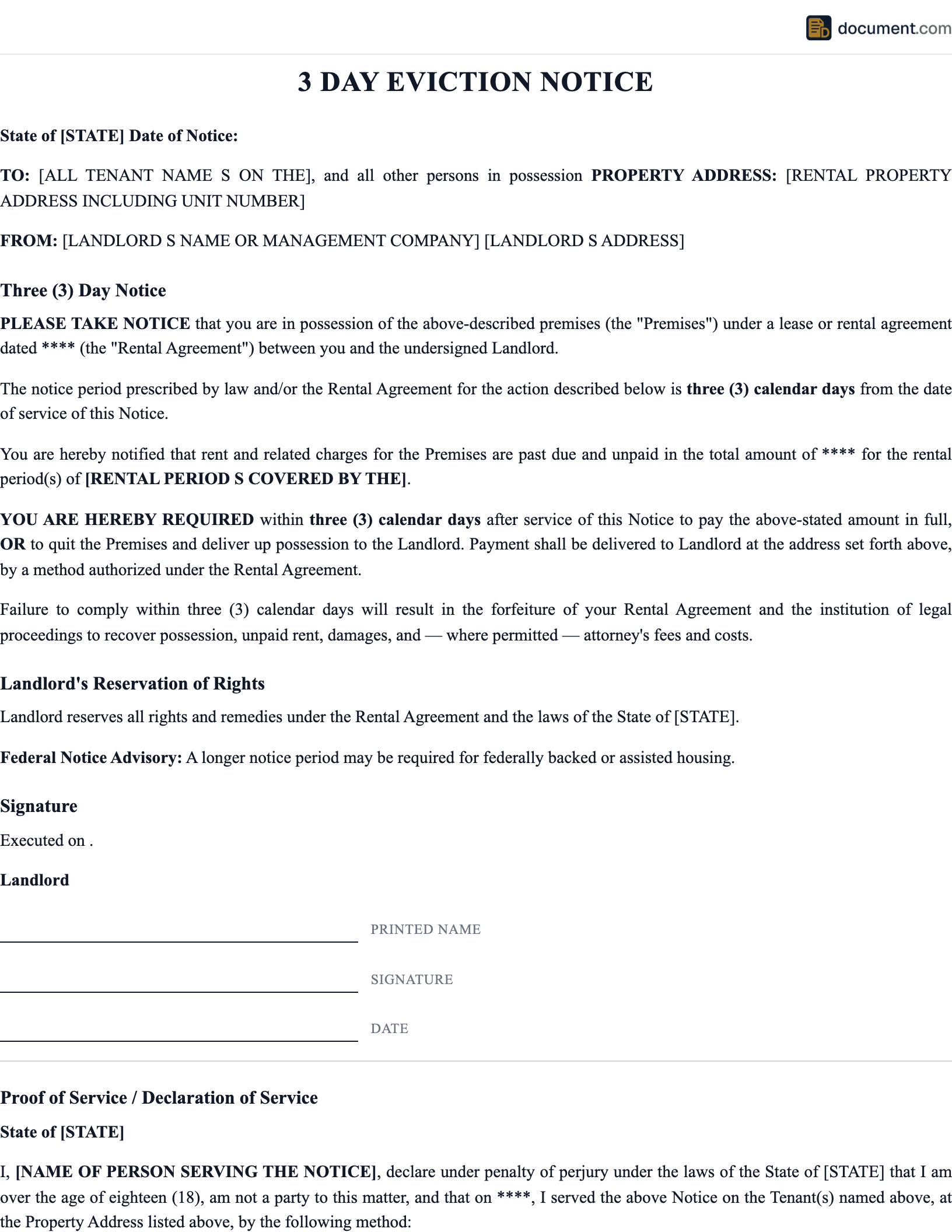
Below is a preview of an Alaska-compliant 7-day notice for non-payment. Because Alaska requires a 7-day minimum (not 3 days), this template reflects actual Alaska law under AS 34.03.220(b).
7-DAY NOTICE TO PAY RENT OR QUIT
STATE OF ALASKA
Pursuant to AS 34.03.220(b)
TO TENANT(S):
Name: [Tenant Full Name]
RENTAL PROPERTY:
Address: [Street Address, City, AK ZIP]
Judicial District: [1st/2nd/3rd/4th]
RENT DUE:
Amount: $[Amount] for period: [Dates]
ALASKA COMPLIANCE
This notice complies with Alaska Statute 34.03.220(b) requiring a minimum 7-day notice period for non-payment of rent. A 3-day notice is not valid in Alaska.