
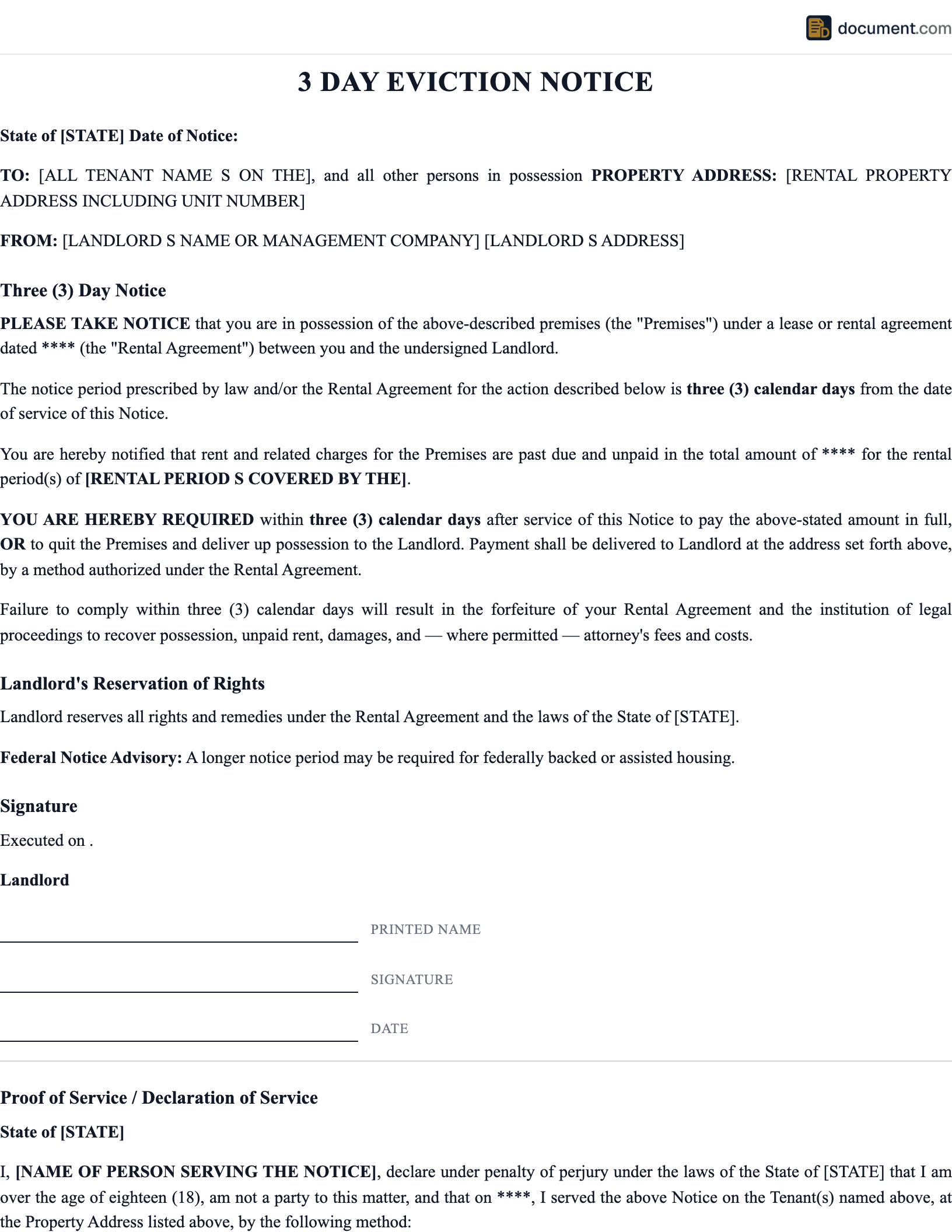



Alabama 3-Day Eviction Notice Overview
Alabama Does Not Use 3-Day Notices
Alabama's eviction notice periods are longer than 3 days. For non-payment of rent, the minimum period is 7 days under the Alabama Uniform Residential Landlord and Tenant Act (AURLTA), codified at Ala. Code Sections 35-9A-101 through 35-9A-603. A 3-day notice served in Alabama would be legally insufficient and could result in dismissal of the eviction case.
If you are searching for a 3-day eviction notice for Alabama, it is important to understand that the state's landlord-tenant law does not provide for a 3-day notice period. The AURLTA, which took effect in 2007, replaced much of Alabama's older common-law approach to landlord-tenant relationships with a modern statutory framework modeled on the Uniform Residential Landlord and Tenant Act.
Under the AURLTA, Alabama landlords must provide at least 7 days' written notice for non-payment of rent and 14 days' written notice for other lease violations that can be cured. For material lease violations that are not curable, landlords may give a 14-day unconditional quit notice. Certain severe violations, such as illegal drug activity, may allow shorter notice under Ala. Code Section 35-9A-421(a).
7 Days
Non-payment notice
$206-$291
Filing fees
14 Days
Lease violation notice
2-6 Wks
Court process
Alabama's Actual Notice Periods
The AURLTA establishes different notice periods depending on the reason for eviction. Understanding which notice applies to your situation is critical, because using the wrong notice period is one of the most common grounds for dismissal in Alabama District Courts.
7-Day Notice for Non-Payment of Rent
Under Ala. Code Section 35-9A-421(a), if the tenant fails to pay rent when due, the landlord may deliver a written notice demanding that the tenant pay within 7 days or vacate. If the tenant pays all rent owed within the 7-day period, the notice is void. The landlord cannot refuse partial payment to keep the notice alive; however, acceptance of partial payment may waive the right to evict depending on the circumstances.
14-Day Notice for Curable Lease Violations
Under Ala. Code Section 35-9A-421(b), for violations other than non-payment (e.g., unauthorized pets, noise violations, unauthorized occupants), the landlord must give 14 days' written notice describing the violation and allowing the tenant 14 days to cure it. If the same type of violation recurs within 6 months, the landlord may serve a 14-day unconditional quit notice without a cure period.
7-Day Unconditional Quit for Severe Violations
For serious breaches, including illegal drug activity on the premises, the landlord may deliver a 7-day unconditional quit notice under Ala. Code Section 35-9A-421(a). This notice does not provide the tenant with an opportunity to cure the violation. The tenant must vacate within 7 days.
Alabama Legal Requirements Under AURLTA
To be enforceable in Alabama District Court, an eviction notice must meet specific requirements established by the AURLTA. Failure to include any required element can result in the court dismissing the unlawful detainer action.
Required Notice Elements
- Written Form: All eviction notices in Alabama must be in writing. Verbal demands to vacate are not enforceable under the AURLTA
- Tenant and Property Identification: Include the full legal names of all tenants on the lease and the complete property address including county
- Specific Amount Owed: For non-payment notices, state the exact amount of past-due rent. Do not include late fees, utilities, or damages in this amount
- Correct Notice Period: Specify 7 days for non-payment or 14 days for curable lease violations. Using any shorter period renders the notice void
- Clear Demand: State that the tenant must either pay the amount owed (or cure the violation) within the notice period or surrender possession of the premises
- Landlord Contact Information: Include the landlord's or property manager's name and address where rent or cure can be delivered
How to Serve an Eviction Notice in Alabama
Alabama law under Ala. Code Section 35-9A-161 specifies acceptable methods for delivering notices. Improper service is a common defense raised by tenants in Alabama District Court, so following proper procedures is essential.
Personal Delivery
Hand the notice directly to the tenant. This is the most reliable method and preferred by Alabama courts. Have a witness present or use a process server to document delivery
Mail Service
Send the notice via U.S. mail to the tenant's last known address. When served by mail, additional days should be added to the notice period to account for delivery time per Alabama Rules of Civil Procedure
Posting on Premises
If personal delivery and mailing are impractical, post the notice in a conspicuous place on the premises. This should be used only as a last resort when the tenant cannot be located
Document Service Carefully
Record the date, time, and method of service. Keep a copy of the notice, any certified mail receipts, and a signed affidavit of service from the person who delivered it
Wait the Full Notice Period
Allow 7 full days (non-payment) or 14 full days (lease violation) to pass before filing in District Court. The day of service does not count as the first day of the notice period
Alabama Eviction Timeline
After the notice period expires without the tenant paying rent or curing the violation, the landlord files an unlawful detainer action in the District Court of the county where the property is located. Alabama uses the District Court (not Circuit Court) for eviction proceedings, and the process is designed to move relatively quickly.
Once the complaint is filed, the clerk issues a summons directing the tenant to appear at a hearing. Under Alabama law, the tenant must be given at least 6 days' notice of the hearing. Most Alabama District Courts schedule eviction hearings within 7 to 14 days of filing. If the landlord prevails, the court enters a judgment for possession.
After judgment, the tenant has 7 days to appeal to Circuit Court. If no appeal is filed, the landlord can request a writ of restitution, which the county sheriff executes. Total timeline from notice to physical removal is typically 3 to 6 weeks for uncontested cases. Contested cases with appeals can extend the process to 2 to 4 months.
Alabama Court Fees & Costs
Eviction costs in Alabama vary by county. Below are typical fees for filing an unlawful detainer action in Alabama District Court. Landlords may recover court costs from the tenant if they prevail.
| Fee / Cost | Typical Amount |
|---|---|
| District Court Filing Fee | $206 - $291 |
| Sheriff Service of Process | $25 - $50 |
| Writ of Restitution | $50 - $75 |
| Attorney Fees (if hired) | $500 - $2,500 |
| Appeal to Circuit Court | $300 - $500 |
Sample Alabama 7-Day Eviction Notice
Below is a preview of an Alabama-compliant 7-day notice for non-payment of rent. Because Alabama requires a 7-day minimum (not 3 days), this notice reflects the actual legal requirements under the AURLTA.
7-DAY NOTICE TO PAY RENT OR VACATE
STATE OF ALABAMA
Pursuant to Ala. Code Section 35-9A-421(a)
TO TENANT(S):
Name: [Tenant Full Legal Name]
And all other occupants of the premises at:
RENTAL PROPERTY:
Address: [Street Address]
City: [City] County: [Alabama County]
AMOUNT OF RENT DUE:
Past-due rent: $[Amount]
For the period: [Dates]
ALABAMA COMPLIANCE NOTE
This notice complies with the Alabama Uniform Residential Landlord and Tenant Act (Ala. Code Section 35-9A-421). Alabama requires a minimum 7-day notice period for non-payment of rent. A 3-day notice is not sufficient under Alabama law.