



Wyoming Warranty Deed Overview
In Wyoming, warranty deeds are recorded with the County Clerk in the county where the property is located. Wyoming has 23 counties and the County Clerk handles real property recording in each. Wyoming is one of the few states with no real estate transfer tax, no state income tax, and no state capital gains tax, making it genuinely one of the lowest-tax environments for property transfers in the country. The state is also notable for its LLC laws, which provide strong asset protection and privacy, leading many investors to hold Wyoming real estate through Wyoming LLCs or trusts.
Wyoming's deed requirements are relatively simple compared to states with transfer tax affidavits and mandatory e-filing requirements. The grantor must sign and have the deed notarized, and the instrument must include a complete legal description and identify the parties. Recording fees are based on page count and start around $12 per document. No transfer tax forms need to accompany the deed. For buyers coming from high-tax states, Wyoming's recording process tends to be refreshingly uncomplicated.
$12
Recording fee
None
Transfer tax
Required
Notarization
0
Witnesses required
Wyoming Requirements
Wyoming's deed requirements are among the most straightforward in the country. There is no transfer tax form to prepare, no mandatory online filing system, and no separate grantor-grantee tax. The grantor executes the deed before a notary, and the notarized original is presented to the County Clerk for recording along with the recording fee. If the grantor is an LLC, trust, or corporation, the executing party should bring documentation establishing their authority to sign on behalf of the entity.
Wyoming Specific Note
Wyoming has no real estate transfer tax, which makes recording costs substantially lower than most states. Recording fees start around $12 and increase with page count. Because Wyoming LLCs and trusts are frequently used to hold property for privacy and asset protection purposes, the grantor in a Wyoming deed transfer is often an entity rather than an individual. When an LLC or trust conveys property, the deed must be signed by an authorized manager, member, or trustee, and the signing authority should be clearly identified in the signature block or an attached authorization document.
Document Requirements
- Notarization: Must be notarized by a Wyoming notary public or authorized notary
- Witnesses: Wyoming requires 0 additional witness(es)
- Legal Description: Complete legal description as it appears on the current deed of record
- Parcel Number: Assessor's parcel number or tax ID
- Return Address: Mailing address for returning the recorded document
- Formatting: Standard formatting with adequate margins, black ink, minimum 10-point font
How to File in Wyoming
Filing in Wyoming involves preparing the document, getting it notarized, and recording it. Follow these steps for a smooth process.
Prepare the Document
Fill in the full legal names of all grantors and grantees. If the grantor or grantee is an LLC, trust, or other entity, identify it precisely as it appears in its formation documents. Copy the legal description verbatim from the current recorded deed. Include the consideration amount or a standard recital. Wyoming has no mandatory transfer tax form to complete
Get the Document Notarized
The grantor (or the authorized representative of the grantor entity) must sign before a Wyoming notary public. Wyoming authorizes remote online notarization, so a notary with RON authorization can notarize the deed even if the grantor is located out of state. Bring or present valid government-issued ID. No additional witnesses beyond the notary are required
Present to the County Clerk
Bring the notarized original to the County Clerk's office in the county where the property is located. In many Wyoming counties, recording is processed at the counter while you wait. If the grantor is an LLC or trust, bring a copy of the operating agreement, trust agreement, or resolution documenting signing authority, as some clerks request this for entity-conveyed deeds
Pay the Recording Fee
Wyoming charges no transfer tax whatsoever. You pay only the per-page recording fee, which starts around $12 for most county clerks. Fees increase with page count. Confirm the exact amount with your specific county clerk before arriving, as fees are set at the county level and can vary
Update County Assessor Records and Insurance
After recording, the county assessor will update ownership records based on the recorded deed. In Teton County, which includes Jackson Hole, property tax assessments are high due to the area's exceptional real estate values, so make sure the assessor has your correct mailing address for tax notices. Update any property and liability insurance policies to reflect the new ownership name, particularly if the property has been transferred to an LLC
Wyoming Fees & Costs
Typical costs for filing in Wyoming. Actual fees may vary by county.
| Fee / Tax | Amount |
|---|---|
| Recording Fee | $12 |
| Transfer Tax | None |
| Notarization | $5 - $25 per signature |
| Certified Copy | $1 - $10 per page |
| Attorney Review (optional) | $150 - $500 |
Wyoming Tax Implications
Wyoming has no real estate transfer tax and no state income tax, which means there is no state-level tax on capital gains from real property sales. This combination makes Wyoming one of the most tax-favorable states in the country for real estate transactions. Sellers pay only the small county clerk recording fee. There is no documentary stamp tax, no grantor's tax, and no excise tax on privilege of transfer. For a $500,000 sale, a Wyoming seller pays a recording fee of roughly $12 to $15. A comparable sale in a high-tax state might generate thousands of dollars in state transfer taxes.
Federal capital gains tax still applies to Wyoming property sales. For investment properties held longer than one year, the long-term capital gains rates of 0%, 15%, or 20% apply depending on taxable income. For primary residences, the IRC Section 121 exclusion can shelter up to $500,000 of gain for married couples who satisfy the two-year ownership and use tests. A 1031 exchange can defer federal capital gains on the sale of investment real estate if the proceeds are reinvested in like-kind replacement property within the required time frames.
Wyoming has no state estate tax and no state gift tax, which significantly simplifies wealth transfer planning for Wyoming property owners. The federal estate tax applies to large estates, and federal gift tax rules govern transfers of Wyoming real estate as gifts. For property held in Wyoming LLCs, the transfer of LLC membership interests may have different tax treatment than a direct deed transfer of the underlying real estate, and this should be reviewed with a tax advisor familiar with both Wyoming LLC law and federal partnership taxation rules.
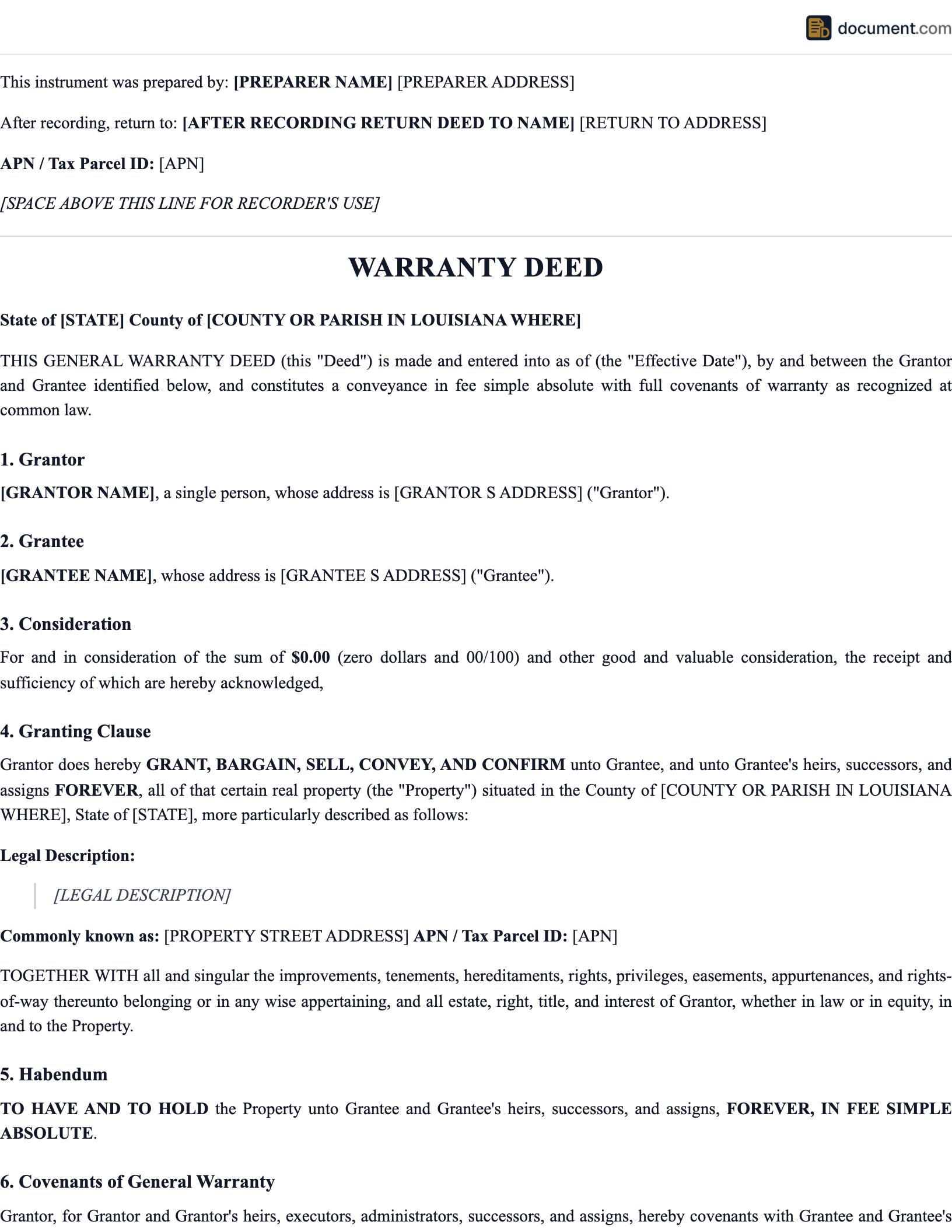
Sample Wyoming Warranty Deed
Preview of our Wyoming-specific template. Your document will include all fields required for recording in any Wyoming county.
WARRANTY DEED (GENERAL WARRANTY DEED)
STATE OF WYOMING
Legal Document
PARTY INFORMATION
Name: [Full Legal Name]
Address: [Wyoming Address]
County: [County]
PROPERTY DESCRIPTION
County: [County] State: Wyoming
Legal Description: [Per Recorded Plat]
Parcel No.: [APN]
Wyoming Warranty Deed FAQ
Common questions about filing in Wyoming, including requirements, fees, and tax implications.
Official Wyoming Resources
Official state resources for verifying requirements and finding your local recording office.
Important Considerations
Wyoming LLC and trust ownership structures deserve real consideration for anyone acquiring Wyoming real estate as an investment. A Wyoming LLC provides strong charging order protection, meaning a creditor of a member typically cannot force a sale of LLC assets to satisfy a personal judgment. Wyoming also allows anonymous LLC ownership, with no requirement to list member names in public filings. For real estate investors who hold multiple properties, putting each property in a separate Wyoming LLC is a common strategy to isolate liability between assets.
Teton County is in a category by itself. Jackson Hole is one of the most expensive real estate markets in the country, and Teton County property values are far above the Wyoming median. While the absence of a transfer tax remains a significant advantage, buyers in Teton County should be prepared for high property tax assessments given the market values, and they should verify property tax history carefully before closing. The county assessor reassesses property annually, and a purchase at market value can meaningfully increase the assessed value and future tax bills.
Mineral rights in Wyoming are significant, particularly in the Powder River Basin counties and areas with active oil and gas production. As in West Virginia, Wyoming deeds may convey surface rights only if mineral rights were previously severed. When purchasing Wyoming land in agricultural or energy-producing areas, ask whether the mineral estate has been severed and what rights, if any, are being conveyed. A title search that includes a mineral chain of title is the only way to know for certain what subsurface rights come with the surface.
Wyoming Attorney Consideration
Wyoming real estate attorneys can assist with deed preparation, LLC formation for ownership structures, mineral title review, and coordination with the County Clerk. For Teton County transactions, where property values frequently exceed several million dollars, professional involvement at both the title and legal review stage is standard practice. For out-of-state owners using Wyoming LLCs to hold property, an attorney familiar with Wyoming entity law and real estate practice can ensure the structure provides the intended privacy and liability protection.
Related Documents
Depending on your situation, you may need additional documents alongside this one. Below are commonly related documents that are frequently used together in real estate transactions.
Important Considerations
Before proceeding with your document, there are several important factors to consider. Each real estate transaction is unique, and understanding the specific requirements and implications of your situation will help ensure a smooth and legally compliant process.
Real estate laws and regulations are subject to change, and local requirements may differ from state-level rules. It is always advisable to verify current requirements with your local recording office before submitting any documents for recording.
If your transaction involves complex circumstances such as multiple parties, commercial properties, trusts, estates, or interstate elements, consulting with a licensed real estate attorney is strongly recommended. An attorney can provide guidance specific to your situation and help you avoid potential legal issues.
Keep copies of all documents related to your real estate transaction in a safe place. Recorded documents become part of the public record, but having your own copies ensures you can reference the terms and conditions at any time. Digital copies stored securely are also recommended as a backup.
Professional Recommendation
While our templates are designed to be comprehensive and legally compliant, we recommend having your completed document reviewed by a licensed attorney before recording, especially for high-value transactions or complex situations. Many attorneys offer flat-fee document review services that provide peace of mind at a reasonable cost.
Related Documents
Depending on your situation, you may need additional documents alongside this one. Below are commonly related documents that are frequently used together in real estate transactions.
Create your Wyoming Warranty Deed in under 5 minutes.
Answer a few questions and download a Wyoming-compliant document, ready for the state agency.