



Wisconsin Warranty Deed Overview
In Wisconsin, warranty deeds are recorded with the Register of Deeds in the county where the property sits. Wisconsin uses a Register of Deeds system rather than a County Clerk or County Auditor, and the register indexes all real property instruments in the county's grantor-grantee index. One of Wisconsin's most important procedural requirements is the Electronic Real Estate Transfer Return (eRETR), an online form that must be submitted to the Wisconsin Department of Revenue before the deed can be recorded. The register requires the eRETR confirmation number as a condition of recording.
Wisconsin imposes a Real Estate Transfer Fee of $3 per $1,000 of consideration at recording. The state also has a list of statutory exemptions, including transfers between spouses and transfers to revocable trusts, that can eliminate this fee for qualifying transactions. Deeds must be notarized, but Wisconsin does not require additional witnesses beyond the notary. Recording fees start around $30 for a standard two-page deed. Because Wisconsin is not a community property state, spousal joinder is generally not required unless the property is held in both names.
$30
Recording fee
$0.30 per $100
Transfer tax
Required
Notarization
0
Witnesses required
Wisconsin Requirements
Wisconsin's single biggest procedural hurdle for deed recording is the eRETR requirement. The Electronic Real Estate Transfer Return must be filed online through the Wisconsin Department of Revenue before you present the deed to the Register of Deeds. The register will not accept the deed for recording without the eRETR confirmation number. Budget time to complete this step before your recording appointment, and double-check the sale price entry because errors on the eRETR can affect the transfer fee calculation.
Wisconsin Specific Note
Wisconsin requires completion of the Electronic Real Estate Transfer Return (eRETR) online at the Wisconsin Department of Revenue website before the deed can be recorded. The Register of Deeds will ask for the eRETR confirmation number. The Real Estate Transfer Fee is $3 per $1,000 of consideration ($0.30 per $100). Certain transfers are exempt, including transfers between spouses and transfers to revocable trusts where the grantor is the principal beneficiary. The appropriate exemption code must be entered on the eRETR. Recording fees start around $30 for a standard deed.
Document Requirements
- Notarization: Must be notarized by a Wisconsin notary public or authorized notary
- Witnesses: Wisconsin requires 0 additional witness(es)
- Legal Description: Complete legal description as it appears on the current deed of record
- Parcel Number: Assessor's parcel number or tax ID
- Return Address: Mailing address for returning the recorded document
- Formatting: Standard formatting with adequate margins, black ink, minimum 10-point font
How to File in Wisconsin
Filing in Wisconsin involves preparing the document, getting it notarized, and recording it. Follow these steps for a smooth process.
Prepare the Document
Fill in the full legal names of all grantors and grantees, include the grantee mailing address for tax billing, copy the complete legal description from the current recorded deed, and include the parcel identification number. Determine how the grantee will hold title (for example, as joint tenants or tenants in common) and include the vesting language in the deed
Complete the eRETR Online
Before recording, go to the Wisconsin Department of Revenue website and complete the Electronic Real Estate Transfer Return (eRETR). Enter the sale price, parties, and property information. If the transfer is exempt from the Real Estate Transfer Fee, select the applicable exemption code. Submit the eRETR and save the confirmation number, which you will need at the Register of Deeds
Get the Document Notarized
The grantor must sign before a Wisconsin notary public with valid government-issued ID. The notary completes the acknowledgment block. Wisconsin does not require additional witnesses beyond the notary. If multiple grantors are signing, each must be individually acknowledged
Record with the Register of Deeds
Bring the notarized deed and your eRETR confirmation number to the Register of Deeds in the county where the property is located. The register will verify the eRETR, collect the Real Estate Transfer Fee ($3 per $1,000) if applicable, collect the recording fee (starting around $30), stamp the deed with a document number, and return the original
Update Property Tax Records
Wisconsin municipal and county assessors receive ownership transfer information from the eRETR system, so property tax records are generally updated automatically. However, it is good practice to confirm with the local assessor's office that the tax billing address has been updated to reflect the new owner. If the grantee is entitled to any property tax exemptions, such as the first-dollar credit or lottery and gaming credit, those must be applied for separately
Wisconsin Fees & Costs
Typical costs for filing in Wisconsin. Actual fees may vary by county.
| Fee / Tax | Amount |
|---|---|
| Recording Fee | $30 |
| Transfer Tax | $0.30 per $100 |
| Notarization | $5 - $25 per signature |
| Certified Copy | $1 - $10 per page |
| Attorney Review (optional) | $150 - $500 |
Wisconsin Tax Implications
Wisconsin's Real Estate Transfer Fee is $3 per $1,000 of consideration, which works out to 0.3% of the sale price. The seller is customarily responsible for this fee at closing, though parties can negotiate otherwise. On a $350,000 Wisconsin home sale, the fee is $1,050. The fee is collected by the Register of Deeds based on the consideration reported on the eRETR. Providing an inaccurate sale price on the eRETR to minimize the fee can trigger penalties from the Wisconsin Department of Revenue.
Wisconsin taxes capital gains as ordinary income under its individual income tax. The state income tax rate structure is graduated, and gains from real property sales are included in Wisconsin taxable income. There is no separate Wisconsin capital gains rate. Federal capital gains rates also apply, and the primary residence exclusion under IRC Section 121 can shelter up to $500,000 of gain for married couples filing jointly who meet the ownership and use requirements.
Wisconsin has its own estate tax with rates ranging from 0.8% to 16% for estates exceeding the Wisconsin exemption threshold, which tracks the federal threshold. For property transfers at death, the recipient of inherited Wisconsin real estate generally receives a federal stepped-up cost basis, reducing the capital gain on any subsequent sale. Wisconsin's estate tax applies only to estates of Wisconsin residents or nonresidents with Wisconsin real property, so estates that include Wisconsin real estate held in a trust or LLC may need to be reviewed for state estate tax exposure.
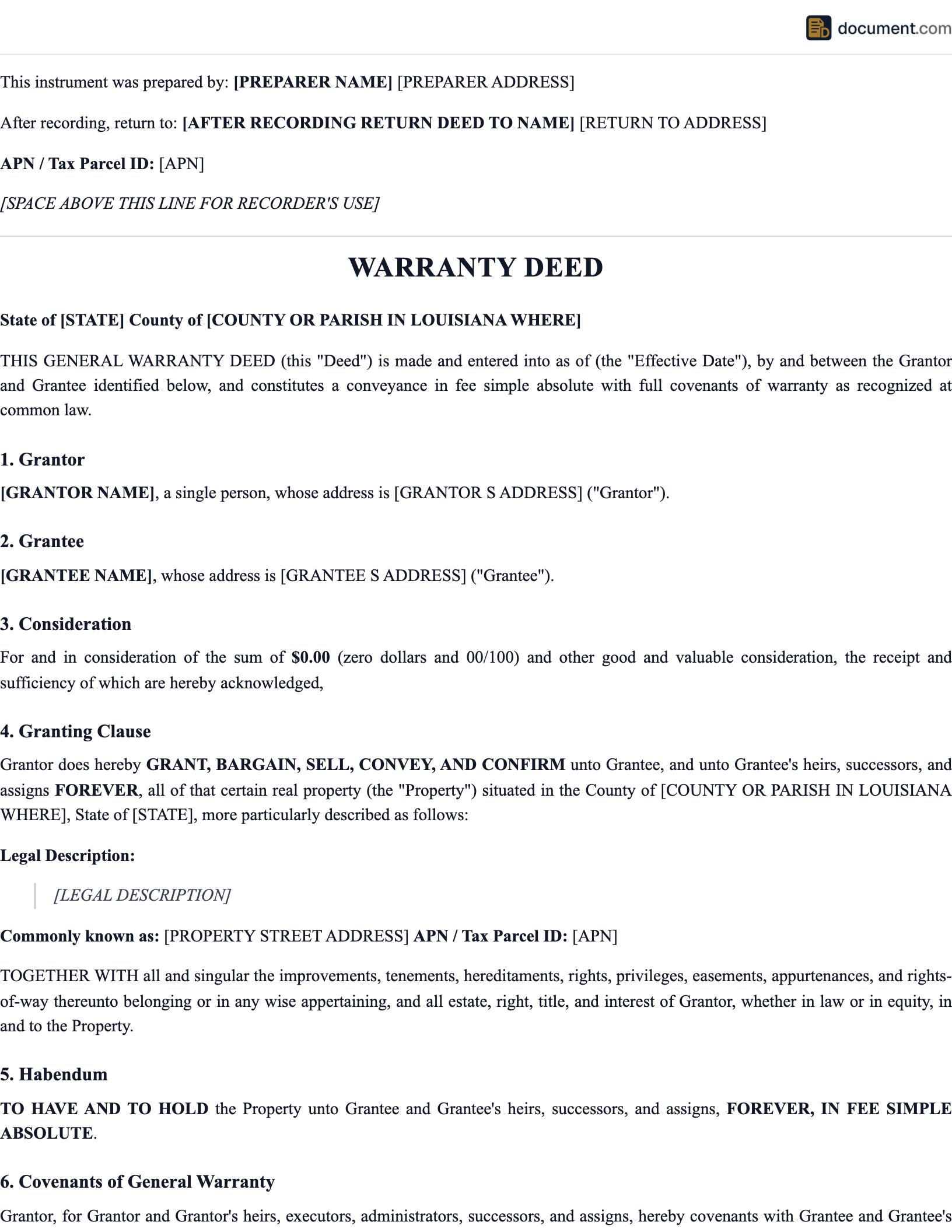
Sample Wisconsin Warranty Deed
Preview of our Wisconsin-specific template. Your document will include all fields required for recording in any Wisconsin county.
WARRANTY DEED (GENERAL WARRANTY DEED)
STATE OF WISCONSIN
Legal Document
PARTY INFORMATION
Name: [Full Legal Name]
Address: [Wisconsin Address]
County: [County]
PROPERTY DESCRIPTION
County: [County] State: Wisconsin
Legal Description: [Per Recorded Plat]
Parcel No.: [APN]
Wisconsin Warranty Deed FAQ
Common questions about filing in Wisconsin, including requirements, fees, and tax implications.
Official Wisconsin Resources
Official state resources for verifying requirements and finding your local recording office.
Important Considerations
The eRETR requirement catches first-time Wisconsin deed filers off guard because it must be completed before recording, not after. Set aside time to go to the Wisconsin Department of Revenue website, create an account if you do not already have one, and complete the form before your recording appointment. The confirmation number generated by the system is what the Register of Deeds will ask for. Arriving at the Register of Deeds without it means coming back another day.
Wisconsin distinguishes between joint tenancy and tenancy in common, and the vesting language in the deed controls which type of co-ownership applies. Joint tenancy includes the right of survivorship, meaning the surviving owner automatically inherits the deceased co-owner's share without going through probate. Tenancy in common does not include survivorship rights. If you are co-purchasing property with a family member and want the survivorship feature, the deed must explicitly say "as joint tenants" and include survivorship language. Simply listing two names without vesting language typically creates a tenancy in common under Wisconsin law.
Wisconsin has a Uniform Marital Property Act, which applies community property-like rules to property acquired by married couples during the marriage. This can affect deed transfers between spouses and the characterization of property for estate planning purposes. Unlike community property states, Wisconsin's marital property framework is opt-in for some purposes, but it applies by default to property acquired during the marriage. Married grantors and grantees should discuss vesting and survivorship options with a Wisconsin attorney when the property will serve as the marital home.
Wisconsin Attorney Consideration
Wisconsin real estate closings are commonly handled by title companies without mandatory attorney involvement, but attorneys are routinely involved in transactions above certain values or with complex circumstances. For transfers involving trusts, estate administration, business entities, agricultural land, or properties with easement or boundary disputes, a Wisconsin real estate attorney can identify issues that a standard title search may not catch. The eRETR exemption codes also require careful attention to ensure the correct one is claimed for family or reorganization transfers.
Related Documents
Depending on your situation, you may need additional documents alongside this one. Below are commonly related documents that are frequently used together in real estate transactions.
Important Considerations
Before proceeding with your document, there are several important factors to consider. Each real estate transaction is unique, and understanding the specific requirements and implications of your situation will help ensure a smooth and legally compliant process.
Real estate laws and regulations are subject to change, and local requirements may differ from state-level rules. It is always advisable to verify current requirements with your local recording office before submitting any documents for recording.
If your transaction involves complex circumstances such as multiple parties, commercial properties, trusts, estates, or interstate elements, consulting with a licensed real estate attorney is strongly recommended. An attorney can provide guidance specific to your situation and help you avoid potential legal issues.
Keep copies of all documents related to your real estate transaction in a safe place. Recorded documents become part of the public record, but having your own copies ensures you can reference the terms and conditions at any time. Digital copies stored securely are also recommended as a backup.
Professional Recommendation
While our templates are designed to be comprehensive and legally compliant, we recommend having your completed document reviewed by a licensed attorney before recording, especially for high-value transactions or complex situations. Many attorneys offer flat-fee document review services that provide peace of mind at a reasonable cost.
Related Documents
Depending on your situation, you may need additional documents alongside this one. Below are commonly related documents that are frequently used together in real estate transactions.
Create your Wisconsin Warranty Deed in under 5 minutes.
Answer a few questions and download a Wisconsin-compliant document, ready for the state agency.