



West Virginia Warranty Deed Overview
In West Virginia, warranty deeds are recorded with the County Clerk in the county where the property is located. West Virginia has 55 counties, and the County Clerk serves both as the real property recorder and as the collector of the state's excise tax on property transfers. One feature that distinguishes West Virginia real property practice is the prevalence of severed mineral estates. Across much of the state, subsurface coal, gas, and oil rights were separated from the surface estate generations ago. A warranty deed that conveys "all that certain lot or parcel of land" without specifically addressing mineral rights may convey only the surface, not the minerals below it.
West Virginia charges an excise tax on the privilege of transferring real property at $1.65 per $500 of consideration. Because the state has relatively modest property values compared to the national median, the total excise tax on a typical West Virginia residential transaction is low compared to most states. Recording fees start around $20. West Virginia law also requires that every deed include a certificate identifying the person who prepared it, a requirement that catches many first-time filers off guard if they are using a form from another state.
$20
Recording fee
$1.10 per $500
Transfer tax
Required
Notarization
0
Witnesses required
West Virginia Requirements
Two West Virginia-specific requirements trip up out-of-state preparers most often. First, every deed must include a certificate of preparer identifying the person who drafted the instrument by name and address. Second, if the property being conveyed is located in a county with severed mineral rights, the deed should explicitly address mineral conveyance. Silence on minerals in West Virginia can lead to disputes about what was actually transferred.
West Virginia Specific Note
West Virginia charges an excise tax of $1.65 per $500 of consideration (or fraction thereof), collected by the County Clerk at recording. Every deed must also include a certificate identifying the preparer by name and address per West Virginia Code Section 39-1-2. County Clerks will reject deeds missing this certificate. For properties in coal-producing or gas-producing counties, verify whether mineral rights have been previously severed before completing the legal description. Severed minerals are common in Mingo, Logan, Wyoming, McDowell, and surrounding counties.
Document Requirements
- Notarization: Must be notarized by a West Virginia notary public or authorized notary
- Witnesses: West Virginia requires 0 additional witness(es)
- Legal Description: Complete legal description as it appears on the current deed of record
- Parcel Number: Assessor's parcel number or tax ID
- Return Address: Mailing address for returning the recorded document
- Formatting: Standard formatting with adequate margins, black ink, minimum 10-point font
How to File in West Virginia
Filing in West Virginia involves preparing the document, getting it notarized, and recording it. Follow these steps for a smooth process.
Prepare the Document
Fill in the full legal names of all grantors and grantees, copy the legal description exactly from the current recorded deed, and verify whether the property has severed mineral rights. If mineral rights are being conveyed, that must be stated expressly. Include the preparer certificate with the drafter's name and address, which is required by West Virginia Code Section 39-1-2
Get the Document Notarized
The grantor must sign before a West Virginia notary public or an authorized officer. Bring valid government-issued ID. The notary completes the acknowledgment block, which should include the notary's commission expiration date and official seal. West Virginia does not require additional witnesses beyond the notary
Present to the County Clerk
Take the notarized original to the County Clerk's office in the county where the property is located. The County Clerk will review the document for completeness, collect the excise tax and recording fee, stamp the deed with a deed book and page reference, and return the original to you or the address listed
Pay the Excise Tax and Recording Fee
The excise tax is $1.65 per $500 of consideration or fraction thereof. On a $200,000 transfer, the tax is $660. Recording fees start around $20 but vary by county and page count. The County Clerk collects both at the time of recording
Update Tax Records and Address Existing Liens
Notify the county assessor's office so property tax records reflect the new owner. If the property is subject to a deed of trust, the lender must separately record a release to clear that lien from the chain of title. Because some West Virginia counties are slower to update assessment records, follow up to confirm the ownership change has been processed
West Virginia Fees & Costs
Typical costs for filing in West Virginia. Actual fees may vary by county.
| Fee / Tax | Amount |
|---|---|
| Recording Fee | $20 |
| Transfer Tax | $1.10 per $500 |
| Notarization | $5 - $25 per signature |
| Certified Copy | $1 - $10 per page |
| Attorney Review (optional) | $150 - $500 |
West Virginia Tax Implications
West Virginia's excise tax on real property transfers is $1.65 per $500 of consideration. Because West Virginia has one of the lower median home prices in the country, this tax is modest in absolute terms for most residential transactions. A $180,000 home sale, which is near the state's median, generates approximately $594 in excise tax. The excise tax is typically the seller's responsibility at closing, though this is negotiable between the parties.
West Virginia does not have a separate state capital gains tax. Capital gains on real property are taxed as ordinary income under the state's personal income tax, which has a flat rate structure. Federal capital gains tax also applies, and the primary residence exclusion under IRC Section 121 can shelter up to $500,000 of gain for married couples meeting the two-year ownership and use requirements. For inherited property, the recipient typically receives a stepped-up basis to the date-of-death fair market value, which reduces the capital gain on any subsequent sale.
Gift transfers of West Virginia real estate require federal gift tax reporting if the value exceeds the annual exclusion. The recipient of a gift takes the donor's carryover basis, which matters particularly in West Virginia where some families hold land that has been in the family for generations and may have an extremely low cost basis relative to current market value. West Virginia also has no state estate tax, which makes property transfers at death relatively uncomplicated from a state tax perspective, though the federal estate tax may still apply to large estates.
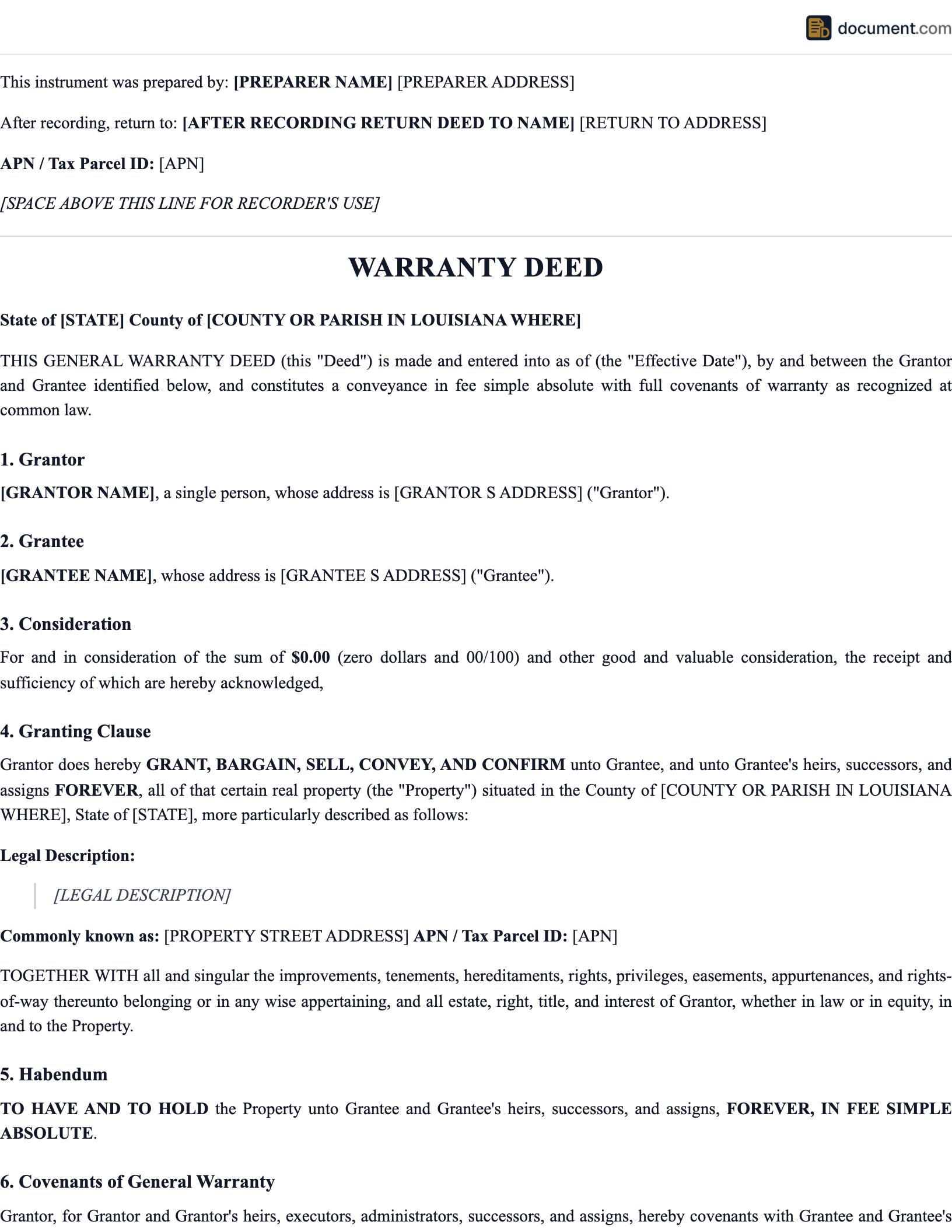
Sample West Virginia Warranty Deed
Preview of our West Virginia-specific template. Your document will include all fields required for recording in any West Virginia county.
WARRANTY DEED (GENERAL WARRANTY DEED)
STATE OF WEST VIRGINIA
Legal Document
PARTY INFORMATION
Name: [Full Legal Name]
Address: [West Virginia Address]
County: [County]
PROPERTY DESCRIPTION
County: [County] State: West Virginia
Legal Description: [Per Recorded Plat]
Parcel No.: [APN]
West Virginia Warranty Deed FAQ
Common questions about filing in West Virginia, including requirements, fees, and tax implications.
Official West Virginia Resources
Official state resources for verifying requirements and finding your local recording office.
Important Considerations
The mineral rights issue in West Virginia is not an edge case. It is the norm in much of the state. Buyers need to understand that purchasing surface rights does not automatically mean they own what is beneath the ground. Coal severance dates in southern West Virginia go back to the late 1800s and early 1900s when land companies systematically acquired mineral rights from farming families. Gas and oil rights in the eastern part of the state have a similarly complex severance history. When buying West Virginia real estate, always ask the seller and the title company to specifically search and address the mineral estate.
The preparer certificate requirement is easy to miss if you are using a deed form designed for another state. West Virginia Code Section 39-1-2 requires the name and address of the person who prepared the instrument. This is a separate requirement from the notary acknowledgment. If you are drafting your own deed, include a brief line identifying yourself as the preparer with your address. County Clerks do check for this and will return unrecorded deeds that are missing it.
West Virginia property tax assessments can lag behind market values in rural counties where the assessor is revaluing parcels on a longer cycle. After recording a deed, verify that the county assessor has updated the ownership record and that future tax bills will go to the correct address. If the new owner plans to use the property as a primary residence, certain homestead exemption benefits may be available depending on the county.
West Virginia Attorney Consideration
West Virginia real estate transactions benefit meaningfully from attorney involvement, particularly for properties in areas with historically severed mineral rights. A West Virginia real estate attorney can conduct or supervise a mineral title search, advise on what the deed should include regarding mineral conveyance, ensure the preparer certificate is correct, and identify any other chain of title issues before they become problems. Title companies in West Virginia also routinely provide closing and title search services that include mineral review.
Related Documents
Depending on your situation, you may need additional documents alongside this one. Below are commonly related documents that are frequently used together in real estate transactions.
Important Considerations
Before proceeding with your document, there are several important factors to consider. Each real estate transaction is unique, and understanding the specific requirements and implications of your situation will help ensure a smooth and legally compliant process.
Real estate laws and regulations are subject to change, and local requirements may differ from state-level rules. It is always advisable to verify current requirements with your local recording office before submitting any documents for recording.
If your transaction involves complex circumstances such as multiple parties, commercial properties, trusts, estates, or interstate elements, consulting with a licensed real estate attorney is strongly recommended. An attorney can provide guidance specific to your situation and help you avoid potential legal issues.
Keep copies of all documents related to your real estate transaction in a safe place. Recorded documents become part of the public record, but having your own copies ensures you can reference the terms and conditions at any time. Digital copies stored securely are also recommended as a backup.
Professional Recommendation
While our templates are designed to be comprehensive and legally compliant, we recommend having your completed document reviewed by a licensed attorney before recording, especially for high-value transactions or complex situations. Many attorneys offer flat-fee document review services that provide peace of mind at a reasonable cost.
Related Documents
Depending on your situation, you may need additional documents alongside this one. Below are commonly related documents that are frequently used together in real estate transactions.
Create your West Virginia Warranty Deed in under 5 minutes.
Answer a few questions and download a West Virginia-compliant document, ready for the state agency.